Vision Model Selection for Clinical UI Parsing
Most vision models fail below 9% accuracy on real clinical software systems.

Vision model selection for clinical software is not a minor technical decision buried inside a larger product roadmap. That decision is what lets a computer-use agent actually work inside an EHR or a payer portal, and the evidence from recent benchmarks says most models are nowhere close to ready.
How current vision models perceive a screen and the points where clinical UIs stress those approaches
Two approaches dominate how computer-use agents read a screen. The first is pixel-based: the model gets a raw screenshot and has to figure out, visually, what's a button, what's a table, what's a text field. The second relies on structured context, things like accessibility trees, HTML, or JSON schemas built for tools like MCP servers, which name and type each interactive element instead of asking the model to guess from appearance. Research on architectures like LiteCUA and AIOS 1.0 frames this second approach as a way to pull interface complexity apart from decision complexity. Many production systems split the difference: use structured data when it's there, fall back to vision when it isn't.
Pure pixel models run into trouble fast on clinical software. A lab results table with forty rows that all look nearly identical demands cell-level precision. Modals stack on top of alerts, which stack on top of tooltips, burying the field the agent actually needs. And clinical shorthand, dx, Rx, PRN, PA status, reads as noise to a model trained mostly on general web text, because that vocabulary appears little in its training data.
Structured-context approaches sidestep a lot of this, but only when the underlying app actually exposes a usable accessibility tree. Plenty of legacy EHRs don't. Most payer portals expose nothing at all. The MCP server model turns a computer into something the agent can reason about semantically rather than visually, and that's a real advance, but it depends on the EHR rendering environment cooperating, which it often doesn't. A model that handles a modern SaaS dashboard well can still misread a clinical layout badly. Scores on general benchmarks simply don't carry over.
What benchmark results on clinical software show about model readiness
MedCUA-Bench, published in 2026, is a benchmark built specifically for clinical computer-use agents rather than adapted from general web tasks. It covers 18 clinical scenarios spanning 10 medical domains, all rebuilt from real product manuals and open-source medical systems, and each task carries both an intent-level goal and a step-level goal, so a researcher can tell whether a failure came from bad clinical reasoning or from just clicking the wrong thing. Twenty-three agents were run through it, scored on five separate clinical safety dimensions on top of plain task completion.
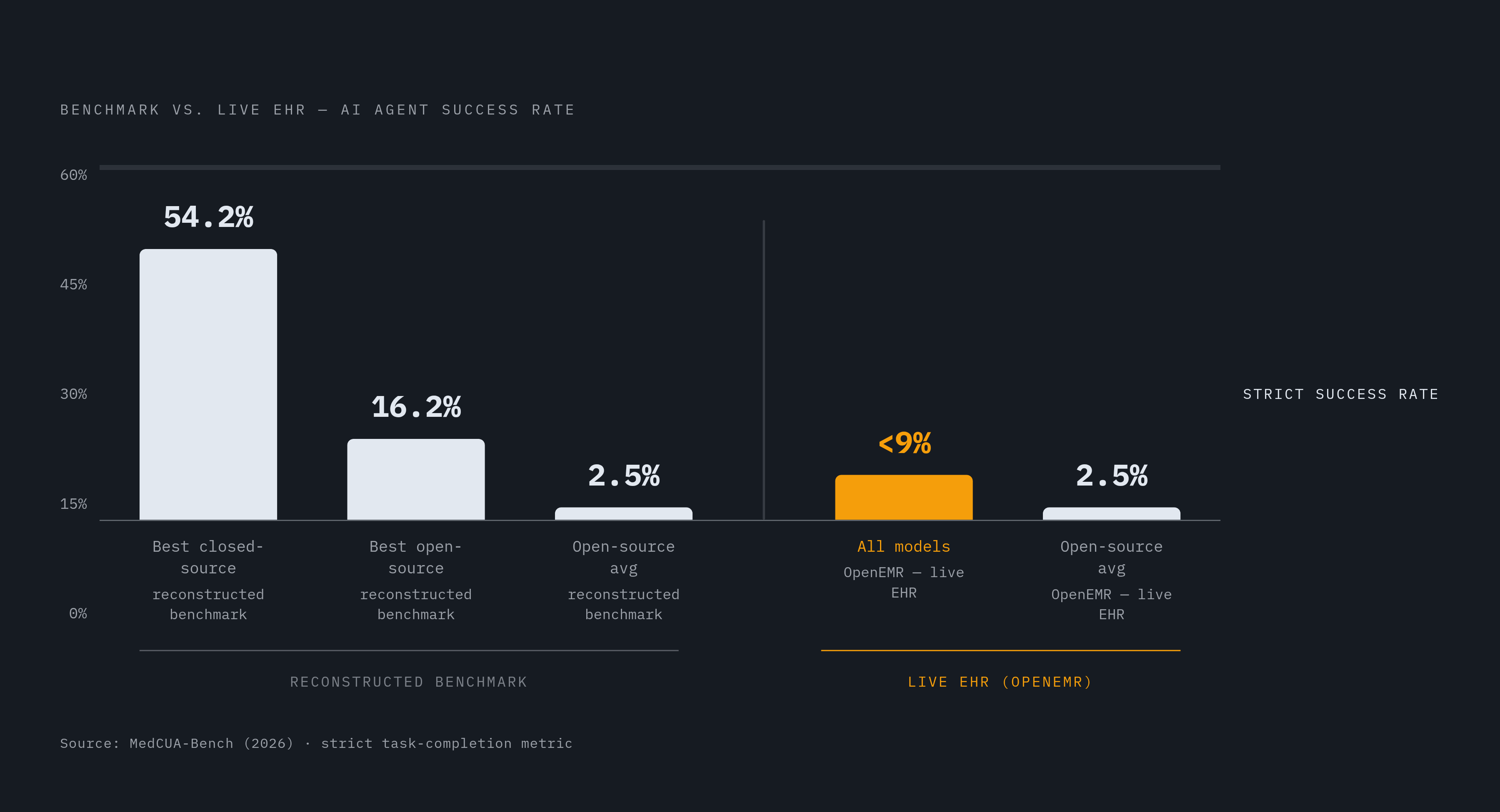
The results are not close to reassuring. The best closed-source model hit 54.2% strict success across the full benchmark. On the OpenEMR environment specifically, a live system rather than a reconstructed approximation, every model tested came in below 9%. Open-source agents averaged just 2.5% success, with the strongest open-source entry reaching 16.2%.
The OpenEMR number matters more than the headline 54.2%. MedCUA-Bench's broader tasks were built from manuals and reconstructed systems, while the OpenEMR portion reflects a live clinical environment with its own quirks and inconsistencies. So 54.2% is a ceiling, not a floor, and the floor on a real system is somewhere under 9%. Other efforts, HealthAdminBench, HealthAgentBench, and UI-CUBE, reflect a broader recognition in the field that single-task success rate does not capture the full picture of clinical agent performance. For anyone reading a vendor's accuracy claim built on OSWorld or a similar general benchmark, the honest read is that it says almost nothing about how that model will do on a payer portal.
The four properties of a clinical UI that a vision model must handle to be deployment-ready
Dense tabular grounding comes first. A model has to pick the right cell in a multi-row, multi-column grid, lab results, medication lists, claim line items, eligibility tables, without confusing one row for the next. Clicking the action button on the wrong row is a routine failure mode in payer portal prior auth queues, and it's the kind of mistake that looks like success right up until someone checks which patient it actually touched.
Small target precision is next. Checkboxes, radio buttons, and icon-only controls in a dense clinical layout are small, tightly packed, and easy to miss by a few pixels. Models built on pixel-level grounding lineages, the UGround family is one example cited in current research, are designed to address precise localization challenges of this kind.
Domain-aware text reading is the third property, and it's where a lot of general-purpose models quietly fail without anyone noticing right away. ICD and CPT codes, PA status labels, payer-specific shorthand, these are decision-relevant values, not clutter, and a model without healthcare-specific training is prone to treating them as irrelevant text rather than the exact field it needs to act on.
Fourth is state tracking across a multi-step workflow. Clinical tasks routinely bounce between systems, an EHR screen, a payer portal login, a clearinghouse form, and the model has to hold onto the original goal the whole way through without drifting. Research under the IntentCUA name, presented at AAMAS 2026, identifies intent drift and cascading perception errors as recurring failure patterns in long desktop workflows, and points to multi-agent architectures with shared plan memory as an approach designed to address these failure patterns. MedCUA-Bench's decision to score intent-level and step-level goals separately exists for exactly this reason: to tell a reasoning failure apart from a plain execution mistake.
How the choice between screenshot-only and structured-context perception shapes what a clinical agent can do
A screenshot-only model works on anything that renders on a screen, no exceptions, which is its main selling point for clinical software. Legacy EHRs and most payer portals never expose a usable accessibility tree, so a model that depends entirely on visual interpretation is the only one that even gets a shot at those systems. The tradeoff is that its accuracy rides entirely on how well it reads pixels, and that reading degrades once rendering gets inconsistent or a screen gets crowded. MedCUA-Bench runs its evaluation as screenshot-only by design, so its numbers show what a pure-vision model can do with zero structural scaffolding.
Structured-context models, the MCP or accessibility-tree route, cut down on visual guesswork by handing the model named, typed objects to reason over instead of raw pixels. The LiteCUA and AIOS 1.0 architecture treats the computer itself as an MCP server, which separates how complex the interface looks from how hard the decision actually is. That only works, though, if the target application bothers to expose a real accessibility tree or API surface, and a large share of EHRs, along with nearly every payer portal, simply don't.
Hybrid systems try to get the best of both, leaning on structure where it exists and falling back to vision where it doesn't. Most production-grade agents lean this way already. The catch is that the fallback vision performance is exactly the part that gets tested hardest on clinical UIs, so a hybrid system is only as good as its weakest mode. A system that only performs well when structured data is available will fail quietly on precisely the systems that matter most in healthcare operations: the ones with no API, the ones that charge for access, the ones running on a decade-old codebase nobody's touched.
What long-horizon, multi-system clinical workflows demand beyond single-screen accuracy
Prior authorization rarely lives on one screen. A single PA request might require pulling up a medication panel in the EHR, logging into a payer portal, filling out a criteria submission form, uploading supporting documents through a modal, and confirming the whole thing went through. Five, six, seven steps, across two or three separate systems, all of which have to stay linked to the same original intent.
The IntentCUA research from AAMAS 2026 names two failure patterns that occur repeatedly in long desktop workflows: intent drift, where the agent slowly loses track of the original goal across sub-steps, and local perception errors that accumulate and compound across subsequent steps. The biggest single fix researchers found was a cooperative multi-agent loop, with multi-view intent abstraction and a shared plan memory working together to keep things stable. Separately, the OS-Marathon benchmark focuses on vast-horizon, repetitive tasks, which maps directly onto high-volume clinical work like batch prior auth runs or overnight eligibility checks.
The risk profile here is uneven in a way that general desktop automation doesn't share. A perception error on step three of a seven-step PA workflow might not become visible until the payer sends back a denial days later. By then, the mistake is baked into a claim, not caught on a screen. That asymmetry is why single-task accuracy on a short benchmark overstates how ready a model actually is for clinical deployment, and why long-horizon completion rates and error-recovery behavior need to be scored as their own thing, not folded into one accuracy number. MedCUA-Bench's five separate clinical safety dimensions exist for the same reason: finishing the task and finishing it safely are not the same measurement, and treating them as one hides exactly the failures that matter most.
How deployment architecture affects which vision model properties matter most
A single practice running one EHR on one stable layout can get away with a model tuned specifically to that interface, prompt engineering or light fine-tuning included, because the surface area of UI variation is small and known in advance. A multi-location group or an MSO portfolio spanning several EHRs and several payer relationships is a different animal entirely: the model has to generalize across many UI conventions at once, without the luxury of custom-tuning a separate model per site.
Latency requirements split along similar lines. Real-time eligibility checks or live scheduling need fast responses, which might mean trading some accuracy for a lighter, quicker model. Overnight batch jobs, claim status runs or bulk prior auth, can afford a heavier model that takes longer but reads the clinical UI more carefully.
Infrastructure adds another layer of constraint. Microsoft's Copilot Studio computer-use capability, announced in 2025 as an early access research preview, runs on Microsoft-hosted infrastructure, which suits organizations without their own compute but brings its own data-residency questions along with it. In healthcare specifically, where a screenshot might capture PHI the instant it's taken, the question of where inference actually runs, on-premise, through a cloud API, or on vendor-managed infrastructure, carries real HIPAA exposure differences. That constraint alone can knock an otherwise strong-performing model out of consideration before accuracy even enters the conversation. An agent meant to work like a trained staff member, reading screens, clicking fields, typing values, navigating a payer portal without needing API access or a system overhaul, needs a vision model that holds up across the entire stack a practice already runs, not just the newer systems with clean interfaces.
What to evaluate when selecting a vision model for clinical UI work
Start with clinical benchmark performance specifically, not general web scores. Ask directly whether a model has been run on medical software. MedCUA-Bench is currently the most purpose-built published benchmark for clinical computer-use agents, and a strong OSWorld score says close to nothing about how that same model handles OpenEMR or a payer eligibility grid.
Check fallback behavior on low-structure interfaces next, since that's the condition most EHRs and nearly all payer portals actually run under in production. Then look at long-horizon stability: ask for performance data on tasks running five or more sequential steps, not single-screen demos, because that's where drift and cascading errors actually appear.
Clinical safety failure modes deserve their own line item, separate from task completion rate. MedCUA-Bench's framework treats these as distinct measures for good reason: a model finishing 70% of tasks while still getting patient-identity fields wrong on the safety dimension is not ready for a live clinic, no matter how the completion number looks on a slide.
PHI handling during inference is not optional homework; it's a prerequisite. Where does the screenshot data actually go, on-device, on-premise, or out to a third-party cloud? That answer sets the HIPAA exposure independent of how well the model parses a screen, and it needs to be settled before parsing quality is even discussed.
Last, weigh adaptability to UI change without retraining. Clinical software vendors push updates on their own schedule, not the practice's, and a model that needs re-scripting every time a menu moves is fragile in the same way old-school RPA scripts were fragile. A model built to read layout semantically, not memorize coordinates, is the one that survives a vendor's next update cycle. Given where the field actually stands, the strongest closed-source model at 54.2% on a reconstructed benchmark, every tested model under 9% on a live EHR, the honest conclusion is that architectural robustness and safety-aware evaluation deserve more weight in a selection decision right now than any headline accuracy number pulled from a non-clinical benchmark.
Sources
- MedCUA-Bench: A Screenshot-Only Benchmark for Clinical Computer-Use Agents — AI Agents
- LiteCUA: Computer as MCP Server for Computer-Use Agent on AIOS
- IntentCUA: Learning Intent-level Representations for Skill Abstraction and Multi-Agent Planning in Computer-Use Agents
- OS-Marathon: Benchmarking Computer-Use Agents on Vast-Horizon, Repetitive Tasks
- arxiv.org
- Announcing new computer use in Microsoft Copilot Studio for UI automation | Microsoft Copilot Blog
- Moving Beyond Sparse Grounding with Complete Screen Parsing Supervision