Payer Portal UI Fragmentation Across Payers
Most practices navigate seven or more fragmented payer portals each week, multiplying staff effort.
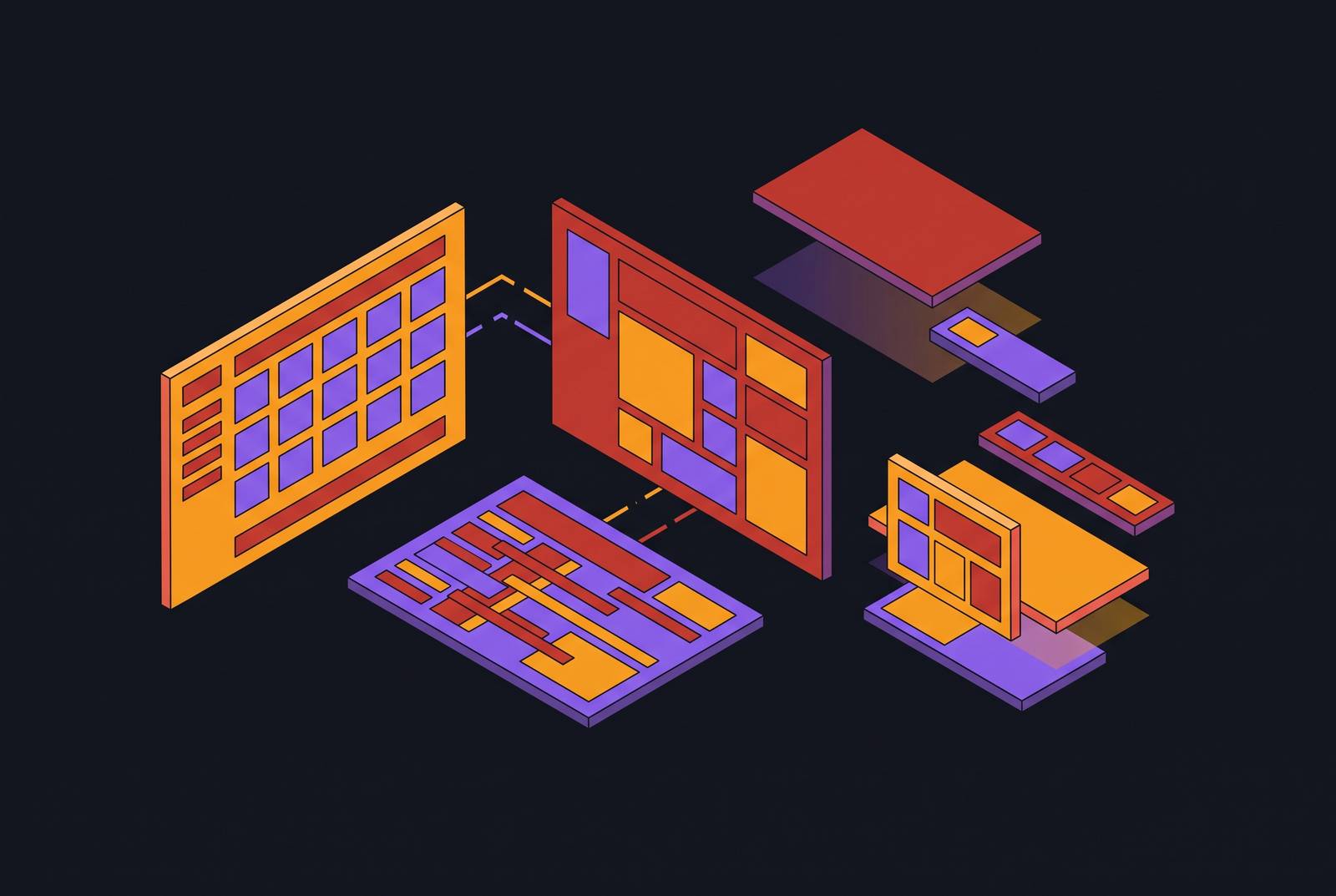
Payer portal UI fragmentation is not simply a nuisance, it is a structural operational burden that multiplies staff effort, degrades accuracy, and creates a hidden throughput ceiling for medical practices navigating a growing number of disconnected systems each week.
Payer portal fragmentation and why it keeps getting worse
Payer portal fragmentation is the condition where every major commercial payer, every Medicare Advantage plan, and every Medicaid managed care organization runs its own separate web portal, each with its own login credentials, its own navigation logic, its own field labeling conventions, its own workflow sequencing, and its own session timeout rules. That is not a defect in any one system. It is the structural byproduct of a market where each payer built its digital infrastructure independently, with no shared UX standard governing any of it.
Interoperability failures are about whether data can travel between systems. Portal fragmentation is a layer above that: it is about the screens a human being has to look at, click through, and interpret, regardless of whether the data underneath is technically exchangeable. A payer can have pristine backend data architecture and still force a billing coordinator to hunt through four menu layers to find a claim status field.
The scale of this is no longer a fringe complaint. An MGMA Stat poll, with 252 applicable responses, found that 61% of medical practices access seven or more payer portals a week, split between 35% at seven to ten and 26% at eleven or more. That figure changes the conversation. This isn't an occasional inconvenience that a practice manager mentions once a quarter. For most practices, it's a daily, multi-system navigation exercise that touches nearly every member of the administrative staff MGMA Stat Poll. And the portals in question aren't peripheral. They cover eligibility verification, prior authorization submission and status tracking, claim status, remittance, and appeals, and the fragmented layer underlies every core revenue cycle function a practice runs.
The sprawl keeps growing for reasons that have nothing to do with any single payer's competence. Each portal evolves on its own release schedule, so staff face a moving target rather than a fixed one. Payer consolidation, which should in theory reduce the number of systems in play, instead tends to add legacy portals on top of existing ones rather than retiring them. And new plan types, ACA marketplace products, Medicare Advantage expansions, arrive with their own portals bolted onto an already crowded stack, without displacing anything that came before.
How portal-to-portal variation creates concrete, repeatable staff friction
The variation between portals isn't random. It clusters into a small number of categories, and each category produces its own specific kind of friction. Login and authentication is the first: differing credential requirements, different multi-factor authentication methods, different session lengths, different lockout policies, all of which force staff to maintain separate credential sets and re-authenticate constantly throughout the day. Navigation architecture is the second: the eligibility check button lives in a different menu path on every portal, so staff can never build the kind of muscle memory that makes repetitive work fast.
Field labeling and data entry format make up a third category, and this one is easy to underestimate. NPI placement, date formatting, how a diagnosis code field behaves, what an attachment upload actually requires: the same underlying piece of data gets entered differently every single time, depending on which portal happens to be open. Status terminology compounds it further. One portal's "pending review" is another portal's "received" is a third portal's "in adjudication," so staff have to learn a proprietary vocabulary for every payer before they can even interpret what a status field is telling them.
None of this compounds gently. A staff member moving between eleven portals in a single shift is not performing one task eleven times MGMA Stat Poll. They are performing eleven structurally different tasks, once each. That distinction means the cognitive load doesn't scale the way a manager might assume it does. It's multiplicative, not additive. And when errors occur, field mismatches, misread status codes, a missed attachment requirement, those errors are a direct consequence of non-standardized interface design, not evidence of staff incompetence.
Black Book Research's Clinical Loop Closure Index, drawn from 2,040 clinicians across three countries, puts a number on how far this check has drifted from the clinical workflow itself. The check is a context switch, every time, not an embedded step in patient care. It's a context switch, every time.
The staff-hours cost that fragmentation hides inside normal operations
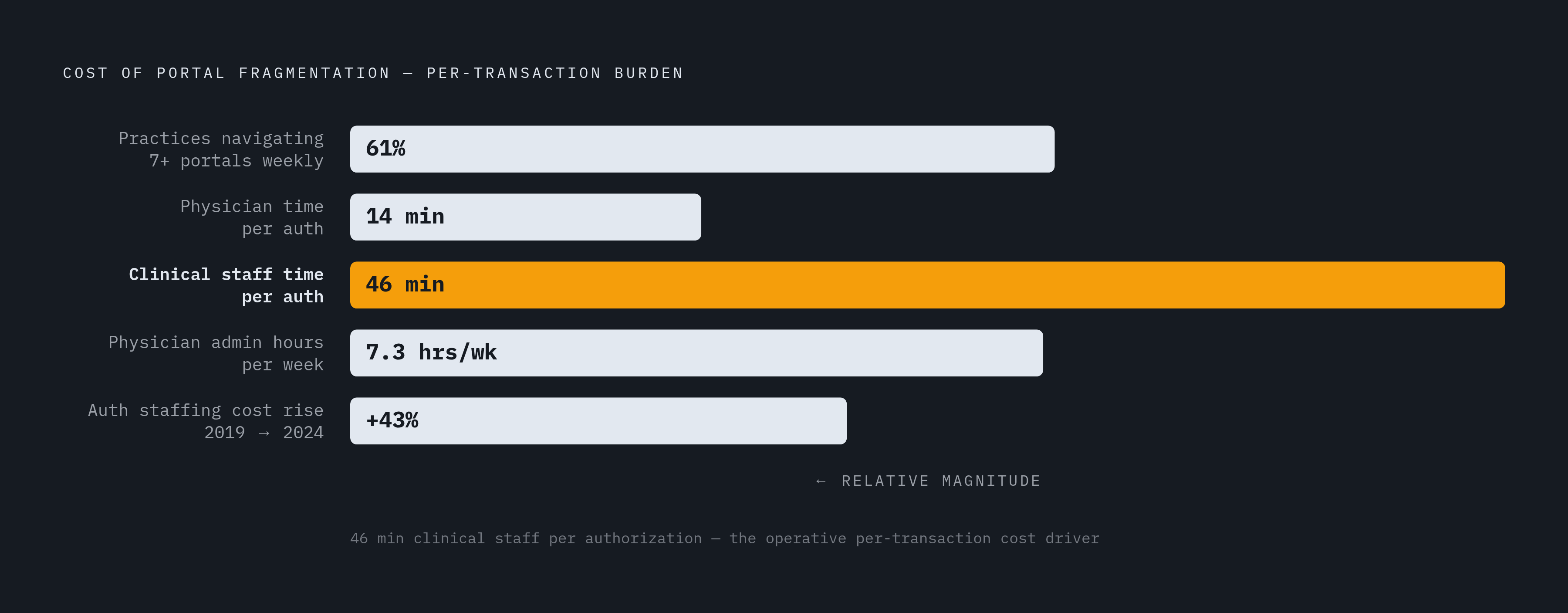
Start with the aggregate number, because it's stark on its own: physicians complete an average of 43 prior authorizations a week, and that work consumes more than 16 hours, over two full workdays, spent on forms, hold queues, and appeals Evolvance Market Research. Break that down to the transaction level and the portal's fingerprints are all over it. Each individual PA request eats an average of 14 minutes of physician time and 46 minutes of clinical staff time, and portal friction sits inside both of those numbers, since every login, every re-authentication, every status check is part of the clock running on that transaction Evolvance Market Research.
Physicians already report spending 7.3 hours a week on administrative tasks like prior authorization and insurance paperwork, according to AMA's national physician comparison data Solutionreach. Portal fragmentation isn't the sole cause of that number, but it appears in nearly every transaction that makes it up Solutionreach.
Staffing hasn't kept pace with any of this. Black Book's index found that 66% of U.S. clinicians said portal and inbox demand has grown faster than the staffing or triage support meant to absorb it. The workload is scaling up while headcount stays flat, which means the gap between demand and capacity widens every quarter rather than closing.
An opportunity cost creates itself here that's easy to miss if you only look at hours. Every minute a trained clinical staff member spends re-entering a diagnosis code into a payer's oddly formatted field is a minute not spent on work that actually requires clinical judgment. The cost isn't just time, it's the erosion of what a skilled employee is even doing all day. And it connects directly to burnout: Medscape's 2025 report found 62% of physicians reporting burnout, with bureaucratic work ranking among the top contributors. Portal fragmentation isn't background noise in that statistic. It's a structural component of the bureaucratic load itself. Non-PA portal work such as eligibility verification, claim status, and remittance review adds a further layer of portal navigation time that does not appear in PA-specific measurements, and the 16-hour figure understates total portal burden, according to Evolvance Market Research.
The dollar costs of fragmentation at the transaction level and the practice level
The 2025 CAQH Index puts a clean number on the transaction-level gap: a manual transaction averages $8.03, versus $2.65 for one handled electronically. Portal fragmentation is the reason so many transactions that get counted as "electronic" are functionally manual anyway, because staff are still navigating a portal screen by screen instead of receiving structured data inside their own workflow.
At the practice level, MGMA data shows spending on prior authorization staffing rose 43% between 2019 and 2024, even as reimbursement failed to keep pace with that increase Medical Group Management Association Solutionreach. That gap is a direct, measurable readout of what fragmentation has cost practices over five years Medical Group Management Association Solutionreach. Zoom out to the industry level and the AMA's Prior Authorization and Utilization Management Reform Progress Report puts the estimated national cost of manual prior authorization administration at $35 billion a year AMA 2025 Prior Authorization and Utilization Management Reform Progress Report.
Hospitals lose an estimated 3% to 5% of net revenue annually to what gets called integration debt: billing workflows that could run automated but instead get done by hand Solutionreach. Portal fragmentation is a primary source of that debt at the payer interface specifically Solutionreach. Layer in the current denial rate, 11.8% according to Experian Health's figures, and the picture compounds further: every month a practice runs understaffed on portal management, denials that could have been prevented at the authorization step, or caught and appealed fast, accumulate instead of getting resolved.
These aren't separate line items competing for attention on a budget spreadsheet. They share a single root cause. When the payer interface requires a human to manually click through it, every downstream function, authorization, claim status, appeal, inherits the cost and the error rate baked into that navigation layer. Fix the interface and the downstream numbers move together, not independently.
Patient consequences when administrative friction slows payer decisions
Portal fragmentation isn't only a back-office cost. It sits directly in the care delivery chain, because authorization decisions gate treatment, and treatment delayed is not a neutral outcome. The AMA's physician survey found that 93% of physicians say prior authorization delays patient care, and 29% have personally witnessed a serious adverse event, including hospitalization or permanent harm, tied to a treatment stalled while waiting on approval AMA 2024 Physician Survey.
Fragmentation's fingerprints are on that number too. When a prior authorization check requires navigating an unfamiliar portal, hunting for the right status field, decoding payer-specific terminology, and troubleshooting a failed upload, the delay compounds at every one of those friction points, not just once. Research cited by blueBriX, drawing on American Journal of Managed Care data along with a Medical Expenditure Panel Survey analysis of 21,876 adults, found that fragmented care touches 57.9% of U.S. adults and costs the most fragmentation-exposed patients $4,542 more a year in avoidable spending. Portal fragmentation feeds that number by slowing down the administrative decisions that are supposed to keep care coordinated in the first place.
This is the point where the conversation stops being purely operational. Practices have every financial reason to fix portal friction, but they also have a direct clinical reason, because the consequences here are not confined to a billing department's monthly close.
If the current state costs this much, in dollars, in hours, and in patient outcomes, the obvious next question is what regulation has actually done about it, and how much of the gap it closes.
What CMS-0057-F changes
The operational side lands first and it's substantial. Beginning in 2026, urgent PA requests must be answered within 72 hours and standard requests within seven days. Payers must give a specific reason for any denied PA decision, delivered through the portal, fax, email, mail, or phone, though this requirement doesn't extend to drug PA. And starting March 31, 2026, payers have to publicly report PA metrics for calendar year 2025, approval rates, denial rates, processing times, appeal outcomes, which creates the first real comparative accountability the market has had. By 2027, PA decisions themselves have to be exposed through a FHIR-based API. CMS estimates the rule will generate at least $16 billion in savings over ten years, most of it landing with providers CMS Interoperability and Prior Authorization Final Rule CMS-0057-F.
What the rule does not do matters just as much. It doesn't eliminate prior authorization as a requirement. It doesn't cap how many services fall under PA rules Evolvance Market Research. And critically, it doesn't require payer portals to adopt any common user interface standard. The Provider Access API and the new PA provisions can reduce reliance on manual portal navigation over time, but only as EHR-integrated, standardized data exchange actually matures across the industry, and until then, the portal layer remains the operative reality for most practices.
Gold carding exempts providers with high PA approval rates, typically 90% or above, from PA requirements for certain services, and at least six states had adopted gold carding legislation as of 2025. It doesn't touch prescription drug authorizations though, so the portal-dependent medication PA workload persists no matter how favorable a practice's approval history looks. Health Affairs research adds a sobering data point: electronic prior authorization on its own hasn't meaningfully reduced provider burden, which suggests that digitizing the submission step doesn't resolve the underlying portal navigation problem. Full-lifecycle automation is what the burden actually requires, not a digitized form.
CMS-0057-F is a meaningful structural improvement, and it's scheduled to mature over several years. It is not, however, a solution to the portal fragmentation practices are living with today.
Portal fragmentation as a throughput ceiling, not just a workflow annoyance
A throughput ceiling is a different kind of problem than a cost line on a budget. It's a structural limit on how much work a fixed staff can actually process in a day, a week, or a full authorization cycle, and portal fragmentation imposes that ceiling in several ways that compound rather than sit side by side.
Every portal demands orientation time on first use, and re-orientation whenever its UI changes, which means the ceiling resets downward every time a single payer pushes an update. Portal navigation also can't be parallelized by a human worker, who is stuck moving through one screen at a time, so any growth in a practice's payer mix multiplies labor requirements directly without any proportional gain in output. Status checks that can't be batched or automated pull staff off productive work at unpredictable moments throughout the day, fragmenting attention as much as time itself.
The Peterson Health Technology Institute's report captures the asymmetry this produces: health plans using AI now spend $40 to $50 per PA cycle, while physician practices absorb $20 to $30 per transaction on the manual side. Payers are automating their half of the transaction while providers remain stuck in the manual portal layer, and that gap is widening. The report names the U.S. friction pattern explicitly as payer authorization, EHR and RCM fragmentation, inbox growth, and payer portals, not a general lag in technology adoption but a problem specific to the payer interface itself.
The ceiling doesn't plateau, either. As a practice's payer mix grows more complex alongside patient volume, the portal burden grows faster than the volume that's driving it. The market has noticed: 76% of healthcare leaders say managing too many point solutions makes operations harder, and 53% are already prioritizing unified platforms as a response, even if that response is still early.
Computer-use agents operating across dissimilar payer portals without API access
FHIR mandates standardize the exchange of data between systems. They say nothing about the portal interface that staff sit in front of today, and that gap between what the regulation intends and what practices actually experience is exactly where computer-use agents operate.
A computer-use agent is software that reads and interacts with a live graphical interface, clicking, typing, navigating, without needing API access to whatever system sits underneath. It works the way a trained staff member works, which means it can operate any portal a human can operate, regardless of how that portal is built. Every category of friction described earlier, differing field labels, different navigation paths, inconsistent status terminology, gets absorbed by the agent learning that specific portal's layout and behavior. No API agreement with the payer has to exist first. No custom integration gets built per portal. The agent adapts to the interface as it stands, not as some future standardized version of it.
That has a direct payoff against the throughput ceiling described above. Portal UI updates that would ordinarily send staff back through a re-orientation cycle get absorbed by the agent instead, without disrupting the practice's workflow. This is also where computer-use agents diverge sharply from older rule-based RPA tools, which break the moment a UI changes underneath them. Computer-use agents perceive the screen contextually and adjust, which matters enormously for payer portals that update often and rarely warn anyone beforehand.
The coverage extends past the login screen. AI-driven automation built this way can handle the full prior authorization lifecycle: clinical evidence extraction, automated form completion, submission across whatever channel a given payer requires, real-time status tracking, denial analysis, and appeal generation. That's a meaningfully larger scope than what electronic PA digitizes, which is really just the submission step Evolvance Market Research. Agents can also move across the EHR, the payer portal, and any other system already sitting in the workflow, all within a single transaction, which means the real value isn't automating one portal in isolation. It's automating the entire workflow that happens to span several systems at once.
The deployment model is what makes this practical rather than theoretical for a practice trying to solve the problem this year rather than in 2027. Agents that go live in a matter of weeks, using existing staff credentials, sidestep the integration project altogether. No EHR replacement. No payer-side API negotiation to wait on. No full workflow overhaul required before a practice sees any benefit at all. That combination, direct interface access with fast, low-friction deployment, is precisely what a market stuck below a regulatory horizon that runs to 2027 actually needs in the meantime.
Sources
- Healthcare fragmentation: what causes it, what it costs, and how to fix it - blueBriX
- Modern Healthcare Payment Systems in 2026 | Solutionreach
- How many payer portals is too many? Most practices already know their answer
- CMS Interoperability and Prior Authorization Final Rule CMS-0057-F | CMS
- Prior authorization delays care—and increases health care costs | American Medical Association