Session Timeout Detection and Recovery in Clinical Software
AI agents need built-in timeout detection to prevent silent session failures in clinical software.
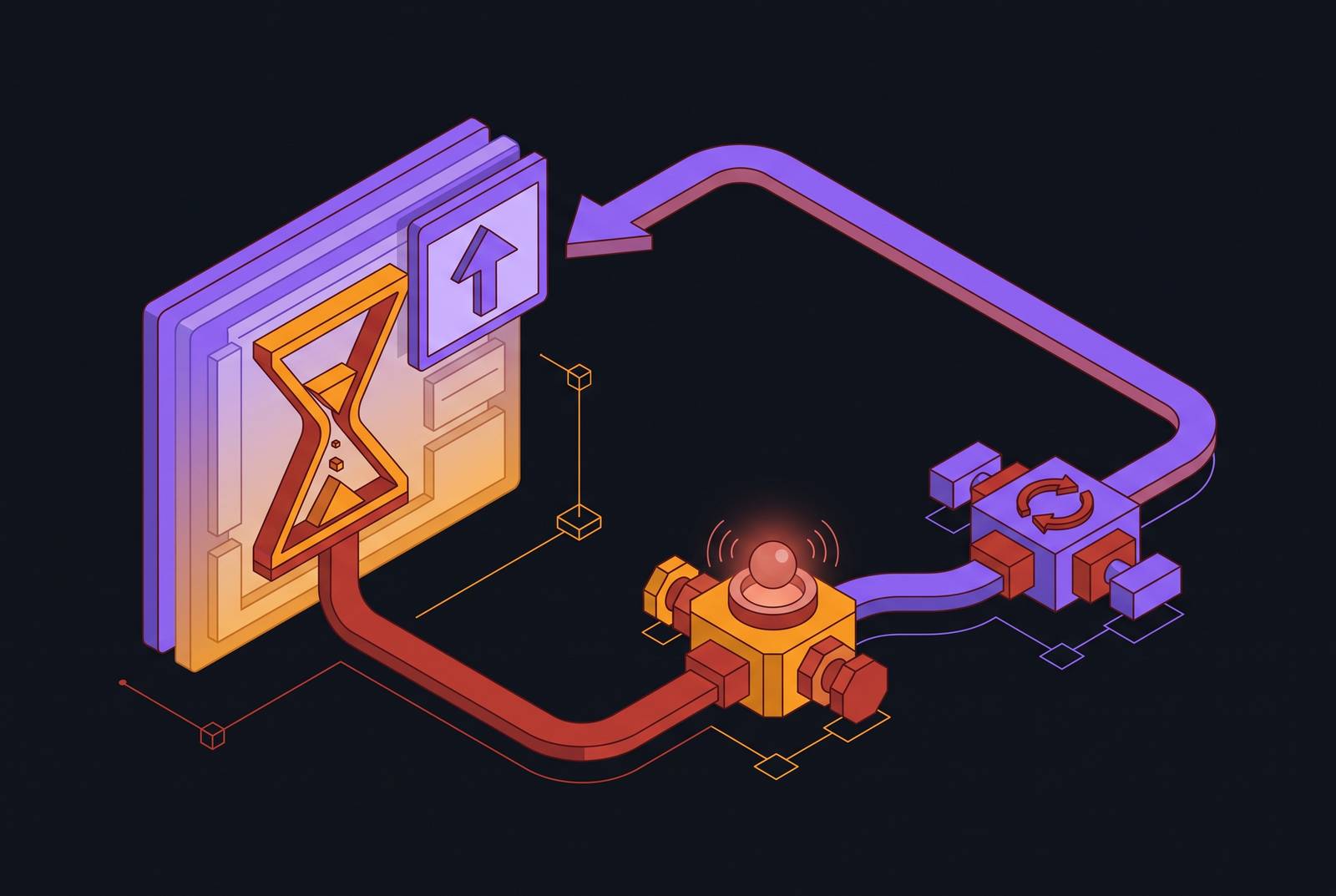
Session timeout looks like a compliance checkbox on paper. In practice, for any AI agent operating clinical software, it is a live failure mode that has to be caught and fixed in real time, with no person watching the screen to notice something went wrong.
Session timeout as a harder problem for AI agents than for human users
A human staff member who hits a timeout screen barely registers it. The modal pops up, they type their password again, maybe punch in an MFA code, and they're back where they left off ten seconds later. That instinct, noticing the screen changed and reacting appropriately, is not something software has by default. An agent has to detect the timeout, decide what it means, and recover, entirely through code, with no fallback to human judgment in the moment.
The cost asymmetry matters here. A person loses a few seconds and maybe mutters something under their breath. An agent that doesn't catch the timeout can crash outright, get stuck retrying an action against a login screen it doesn't recognize as a login screen, or worse, keep executing against what it thinks is a live session when the session died three steps ago. That last failure mode is the dangerous one: silent progression on stale state can corrupt a workflow mid-task, and nobody finds out until the output doesn't match what should have happened.
Clinical software stacks two separate timeout layers on top of each other, and both have to be respected independently. Device-level screen lock is one control. Application-level session timeout inside the EHR is a different control, enforced separately, often on a different clock. An agent that only handles one of these has only solved half the problem.
Payer portals add a third wrinkle. Timeout windows across payer portals run anywhere from 5 minutes to 30 minutes, and the reauthentication flow that follows a timeout is different on every single one. There is no universal pattern to lean on. An agent built to handle timeout on one portal will not automatically handle it on the next.
HIPAA and ONC requirements and organizational discretion
No federal rule specifies a timeout duration. That surprises people who assume HIPAA hands down a number, but it doesn't. The Security Rule requires an automatic logoff mechanism, and it classifies that requirement as "addressable," meaning the organization has to run its own risk assessment and either implement a reasonable control or document why some equivalent safeguard achieves the same protection. As of September 2026, that risk-based, technology-neutral structure is still the law of the land.
ONC certification works the same way. Certification confirms an EHR is capable of timing out. It does not tell a practice what duration to set, and it does not tell an agent developer what to expect walking into a given system. Every deployment inherits its own timeout parameters, set by whoever configured that particular install.
The two get conflated constantly, so the distinction between screen lock and application logoff matters. Screen lock protects against someone walking by and reading a monitor. It doesn't touch the underlying session. Application logoff is the real event: it terminates access tokens, kills background processes, and actually severs the connection to the system. An agent has to treat these as two separate things to watch for, because a screen lock recovery and a full reauthentication are not the same operation.
Computer-use agent perception and action on screen state, with timeouts breaking that loop
Computer-use agents don't talk to an EHR through an API most of the time. They look at the screen, either through pixel-level vision models or an accessibility tree, and they click and type the way a staff member would. That's the whole design premise: no integration required, because the agent operates the software visually, the same way a human logs in and clicks through a prior authorization form.
The mechanism underneath is a loop, and it runs continuously for the length of a task: read the current screen, decide on the next action, execute it, read the screen again, repeat. Simple in description, but it depends entirely on the "read the current screen" step producing an accurate picture of what's actually there.
A timeout breaks that loop in a few distinct ways. Occasionally a login screen just replaces the workflow screen the agent expected to see. Sometimes a session-expired modal appears floating over the form that was mid-fill. Sometimes the page goes blank, or silently redirects somewhere else entirely, no modal, no warning. Sometimes an HTTP 401, or a redirect to an authentication endpoint, appears before any visible change shows on screen.
Older automation built on rigid CSS selectors or XPaths falls over immediately here. Traditional RPA scripts are written against a specific layout, and the moment a payer updates its portal or a timeout modal renders somewhere the script wasn't coded to expect, the script breaks. That's a structural weakness, not a one-off bug: any script tied to a fixed selector is only as durable as the portal's willingness to never change its layout, and portals change layouts.
The three-stage recovery sequence a resilient agent must execute after a timeout
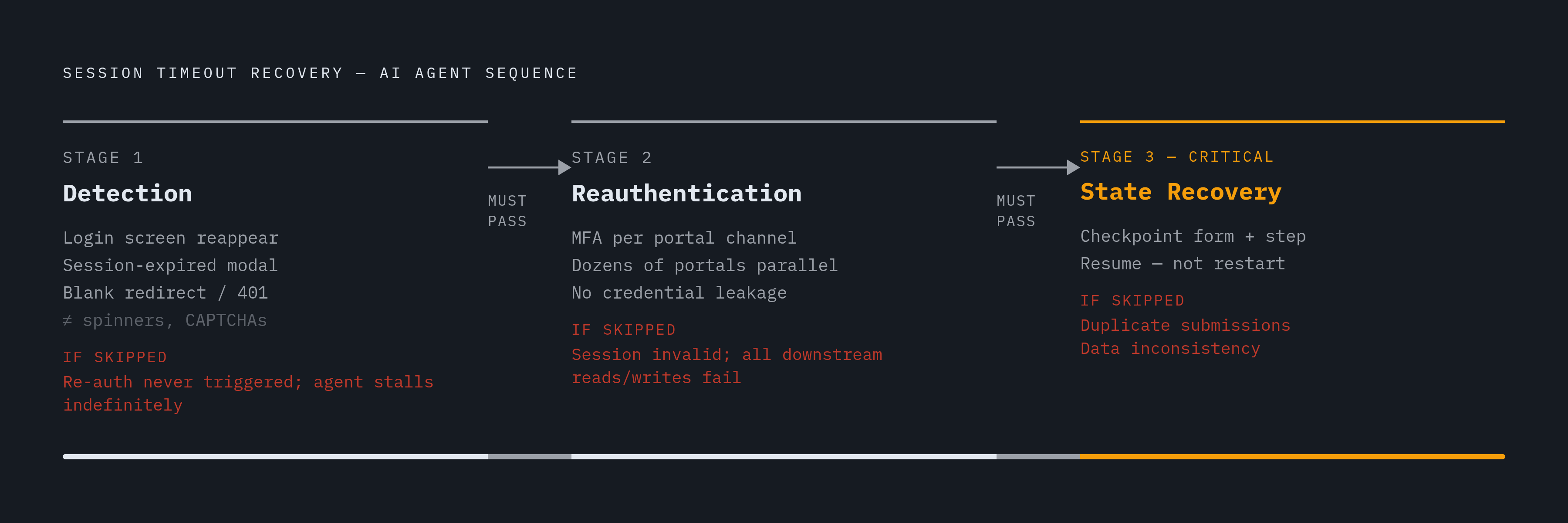
Detection, reauthentication, and state recovery have to happen as a sequence. Each stage depends on the one before it succeeding, and skipping ahead produces exactly the kind of corrupted workflow state that makes timeouts costly.
Detection comes first, and it's harder than it sounds because a timeout has to be distinguished from a handful of other screens that look similarly disruptive: error pages, loading spinners, expected navigation steps in the workflow, CAPTCHA challenges. Detection signals split into two categories. Visual signals include the login screen reappearing, a session-expired modal, or a blank redirect. Protocol-level signals include server responses that indicate an expired or invalid session before any visible screen change occurs. The real difficulty is that payer portals don't agree on how to announce a timeout. Each one builds its own expired-session UI, with no shared standard. Vision-based detection avoids the brittleness of fixed selectors, which break whenever a portal updates its layout.
Reauthentication comes second, and at scale it's a genuinely hard engineering problem, not a minor inconvenience. The agent has to work through whatever MFA channel that specific system enforces, whatever MFA method that specific system enforces, and it has to do this correctly across dozens of payer portals running in parallel, each with its own login flow. Credential handling through this stage carries real regulatory weight. The HHS OCR proposal from January 2025, if finalized, would require mandatory encryption of ePHI at rest and in transit, a technology-neutral standard that applies to any system touching ePHI, agents included, though it doesn't spell out specifics for AI data paths, temporary storage, or inference pipelines. Reauthentication also can't leak stored credentials onto a screen in a way that turns an unattended workstation into an exposure risk.
State recovery and resumption is the third stage, and it's where sloppy recovery does the most damage. Restarting a workflow from scratch after a timeout is not the same as resuming it, and treating them as interchangeable is how duplicate submissions and data inconsistencies happen, particularly when a prior form submission gets resent by accident. Semantic recoverability, the approach behind frameworks like DART, addresses this by enabling the agent to re-enter a workflow at the correct step rather than guessing from scratch. For payer portal prior auth work specifically, the agent has to check whether the partially completed form was actually saved server-side before the timeout hit or whether every field needs to be re-entered, and that check requires querying the current form state after reauthentication, before touching anything. When the agent can't resolve that ambiguity with confidence, the right move is to pause and flag it for a human, not guess and hope.
Payer portal automation and session timeout detection as the most operationally acute version of this problem
Payer portals exist in the first place because standardized APIs for prior authorization never did. Roughly 1,100 payers across the country. each built their own proprietary web interface for PA submission, and each built its own proprietary interface independently, with no shared standard for how agents should interact with them.
Timeout windows swing from 5 to 30 minutes depending on the portal, CAPTCHAs show up unpredictably, and interfaces change without any notice to the people relying on them. That means a single agent fleet has to track different timeout behavior, on different portals, simultaneously, with no single handling pattern that covers all of them.
The workflow itself mirrors what a human does at a desk: log in with credentials, clear whatever MFA prompt shows up, fill out a multi-page form by matching clinical data to the right fields, upload supporting documentation, check on approval status. Session management runs in parallel with all of it, without interrupting the actual task.
There's a regulatory shift coming that will eventually change this picture. By January 1, 2027, payers affected by the rule must support FHIR APIs for electronic prior authorization submission, covering the Prior Authorization API, Patient Access, Provider Access, and Payer-to-Payer exchange. Related Da Vinci Implementation Guides, covering Coverage Requirements Discovery, Documentation Templates and Rules, and Prior Authorization Support, are recommended but not formally mandated by CMS. Once that infrastructure is live, it opens a machine-to-machine path that reduces reliance on screen-based automation over time. Until then, though, screen-operating agents managing session state remain the only workable approach for commercial medical PA across most of the payer landscape.
The revenue cycle cost of agents that cannot handle timeouts reliably
Denial rates set the scale of what's at stake here. Claim denial rates climbed to nearly 12% industry-wide in 2026, and the average denied dollar amount rose 14% in hospital outpatient settings and 12% in inpatient settings compared to 2025. Forty-one percent of providers now report more than 10% of their claims denied, up from 30% in 2022, a jump that reflects a system under real strain.
One estimate put the figure for the country at hospitals spend roughly $19.7 billion annually just overturning denials that shouldn't have happened, at an average cost of about $57 per claim reworked.
The connection to timeout handling is direct. A prior authorization that times out mid-form and doesn't get recovered cleanly is an authorization that never completes. The claim tied to it gets denied, and someone on staff has to go back, figure out what happened, and redo the work by hand. Every one of those failures feeds straight into the denial numbers above.
Good session timeout handling in a production clinical agent deployment
Global settings don't work here. A production deployment has to store the specific timeout parameters for each EHR and each payer portal it touches, because a single blanket setting across systems that behave differently guarantees mismatches somewhere in the fleet.
Detection has to run on two channels at once, visual and protocol-level, rather than betting everything on one. A login screen reappearing is a visual signal; an HTTP 401 is a protocol signal. Relying on only one leaves blind spots the other would have caught.
Credential and token handling during reauthentication has to meet encryption standards consistent with current HIPAA rules, and with the proposed January 6, 2025 OCR rule, which would turn today's addressable specification into a mandatory one if finalized. That's not a minor technical footnote. It changes what "reasonable safeguard" means from a documented judgment call into a fixed requirement.
State has to be checkpointed before reauthentication is even attempted: the agent records what form it was on, which fields were filled, and what step came next, so that resumption afterward is targeted rather than a guess dressed up as a restart.
The place of computer-use agents in a practice's broader session security posture
Session timeout handling for an agent is one piece of a much larger security picture that a practice already has to manage: device-level screen lock, controls on shared workstations, VPN and VDI session limits, mobile app timeouts. All of it sits under the same HIPAA risk-based framework, and none of it exists in isolation from the others.
An agent operating clinical software answers to the same session security obligations as any human user logged into that same system. Being software doesn't earn it an exception to the practice's timeout policy.
That has a practical consequence. If a practice sets its EHR session timeout to somewhere between 10 and 15 minutes, the agent deployment running against that EHR has to be configured to actively handle a timeout on that schedule, not assume it will simply stay logged in because nobody's watching. Shared workstation and kiosk setups complicate this further, since multiple sessions, human and automated, may be cycling through the same physical access point, and each one needs its own accounting under the same policy.