Reasoning Loop Architectures in Agentic Systems
Agentic systems complete multi-step tasks autonomously through iterative reasoning and action loops.
The four-stage PRAO loop
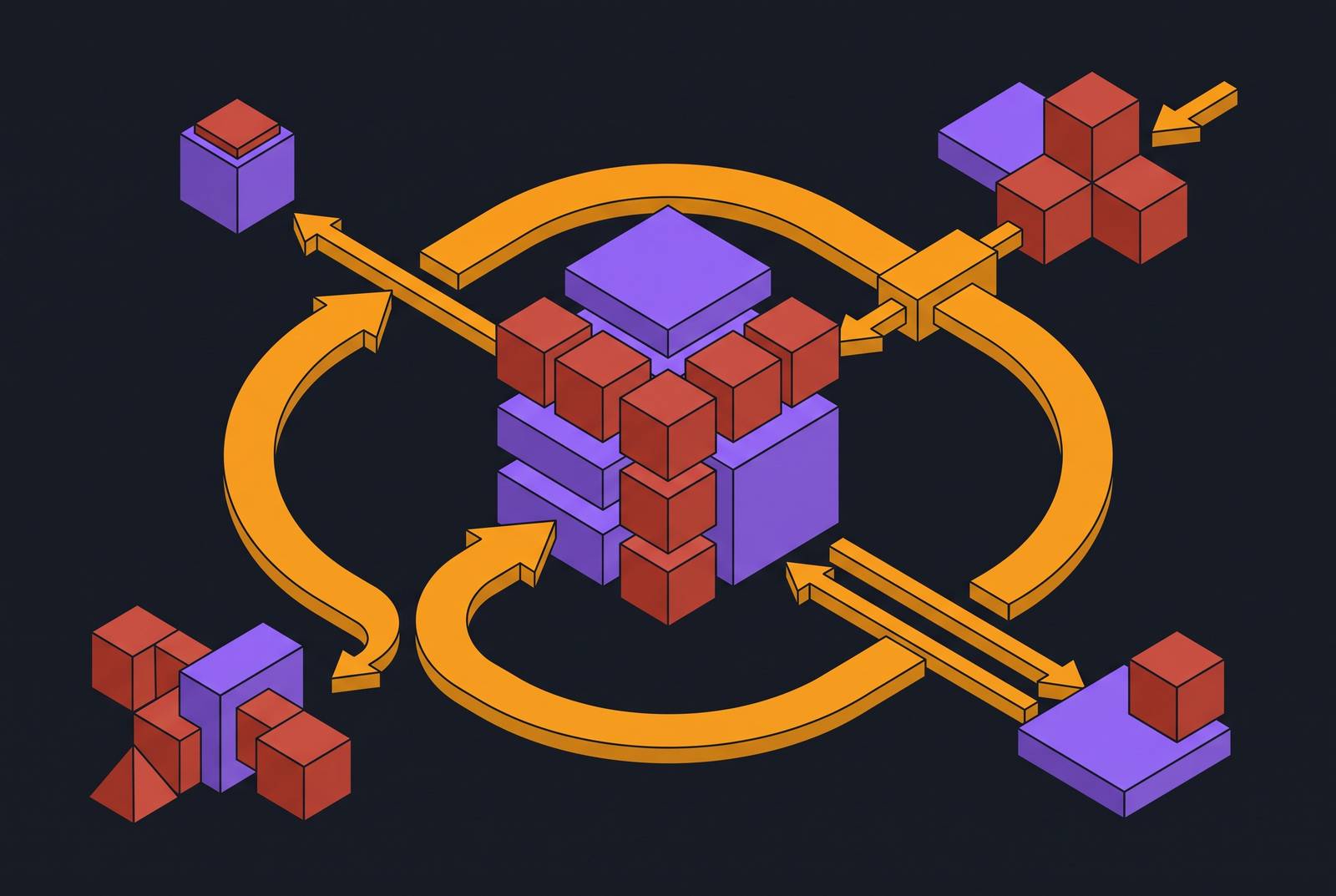
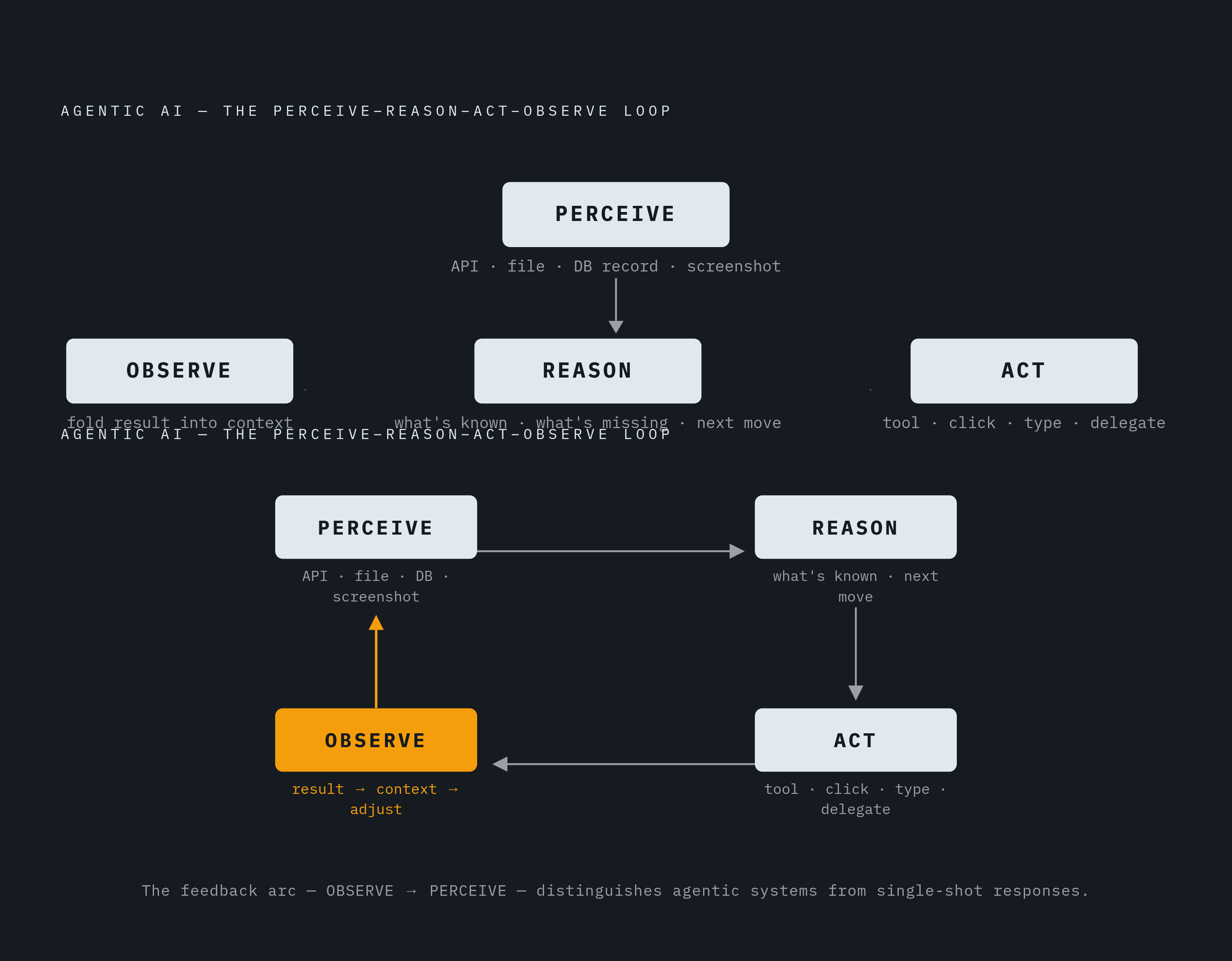
Reasoning loop architectures, not chatbot fluency, let an AI system finish a multi-step job on its own. The distinction runs through a four-stage cycle called Perceive-Reason-Act-Observe, or PRAO, and it explains why some AI tools can only answer questions while others complete an entire prior authorization from start to finish without anyone hovering over them. Most vendors selling "AI agents" into healthcare right now are selling chatbots with better marketing, and the PRAO loop is the test that separates the two.
A standard large language model interaction is a single exchange: someone prompts it, it responds, and the model stops there. Whatever happens next is on the human. An agentic system keeps operating instead: it perceives its environment, reasons about what to do, acts on that reasoning, and observes the result, cycling through that sequence for as long as the task demands. NJ Raman's technical guide from April 2026 offers a useful minimal definition: an agent is a PRAO loop running over an extended horizon, where the model retains or reconstructs enough context to behave coherently from one step to the next. Memory systems, multi-agent graphs, reflection loops, all of that is elaboration on top of this one core pattern, not a departure from it.
For anyone evaluating AI in healthcare operations, this distinction is the whole ballgame. Chatbots and voice assistants sit at the single-shot end of the spectrum, useful for answering a question or drafting a message but unable to carry a task across multiple systems. Computer-use agents, the kind that can navigate an EHR, click through a payer portal, and update a scheduling system, sit at the other end. The sections below break down each layer of that loop, so the difference between a workflow that finishes itself and one that stalls halfway becomes something you can check for, not something you have to take on faith.
Perceive is the intake stage. The agent pulls in whatever structured input the environment offers, an API response, a file, a database record. For a computer-use agent, that input is a screenshot paired with a log of prior actions. No API call happens in that case. The agent looks at pixels, the same as a person would.
Reason is where the backbone model does its actual work, and it's the step most people underestimate when they picture an agent as a glorified if-then script. The model isn't picking a tool from a menu. It generates natural-language reasoning about what it already knows, what's still missing, and what the next move should be, and that reasoning is where tool selection gets justified rather than just chosen.
Act is the consequential stage: the agent invokes a tool, clicks a button, types into a field, queries a database, or hands a sub-task off to another agent. These are real actions with real side effects on external systems, not simulated ones.
Observe closes the loop. The agent takes in whatever result came back from the action and folds it into its working context, adjusting the plan based on what actually happened rather than what it expected to happen. The cycle repeats until the goal is satisfied or some stopping condition kicks in, and the agent itself decides when that point has arrived.
This pattern has a name in the research literature: ReAct, from Yao and colleagues' 2022 paper, as described in lyzr.ai's guide to the pattern. The core insight is that reasoning and acting interleave rather than run as sequential phases. The model doesn't just select a tool; it reasons about why that tool fits the moment, executes it, processes what comes back, and reasons again before its next move.
A calibration problem gets missed constantly here. A system that reasons extensively over a trivial task burns tokens and time for no benefit, while a system that fires off one response to a complex, multi-step problem under-reasons and skips steps it needed to take. Matching reasoning depth to actual task complexity is an engineering judgment someone has to make on purpose. It doesn't happen automatically just because a model is capable of longer reasoning chains, and vendors who treat "more reasoning" as an unqualified good are getting this wrong.
Chain-of-thought prompting gets conflated with this constantly, but the two are separate. Chain-of-thought stays inside a single LLM call: no tool use, no external action, just a model thinking out loud before it answers. ReAct adds the iterative loop of acting in the world and observing what happened, and that loop is what makes a system agentic rather than just verbose.
The backbone model, tools, and memory combined into a production agent
A production-grade agent in 2026 is built from six components, as Raman's guide describes. The backbone LLM does the reasoning; frontier models now carry context windows ranging from 128,000 tokens up to several times that, with native tool-calling support baked in. The tool layer bridges that reasoning to the outside world, covering web search, code execution, database queries, API calls, or direct interaction with a graphical interface. Memory has its own architecture and its own failure modes, serious enough to deserve separate treatment below. The orchestration layer manages task decomposition, decides the order in which sub-agents get invoked, and aggregates results. The observation parser translates whatever a tool returns into a format the LLM can reason over. Stopping logic decides when the goal has been met, or when further reasoning has stopped being useful.
None of this is free, and cost is the part sales conversations tend to skip. Agents consume roughly four times the tokens of a standard chat interaction, and multi-agent systems can run up to fifteen times higher. Anyone budgeting for a deployment who isn't modeling that multiplier is going to be surprised by the invoice.
Observability matters just as much as raw capability. Every reasoning step, every tool call, every decision the agent makes across an iterative cycle needs to be traceable. Skipping observability turns debugging a production failure into guesswork, since there's no way to tell whether the model reasoned poorly, the tool returned bad data, or the orchestration layer misrouted a step.
The choice of backbone model isn't incidental either. Reasoning depth and instruction-following quality are what let the loop produce coherent, goal-directed behavior over dozens of steps, or what cause it to drift off course somewhere around step twelve.
In a healthcare operations context, the tool layer looks different from what most software engineers picture. The tools aren't API endpoints; they're EHR screens, payer portal pages, scheduling interfaces, the same graphical surfaces a human staff member would use. That's the detail that separates computer-use agents from integration-dependent automation, and it's the detail the next several sections build on.
Memory architecture's role in determining long-horizon task success or stalling
Treating memory as an optional add-on rather than core infrastructure, given the foundational problem of the bounded context window, is the single most common design mistake in this space. Once a task runs long enough that earlier observations fall outside what the model can hold at once, the agent starts losing track of what it already did. It repeats actions. It contradicts decisions it made three steps earlier. Memory that extends past the context window is the only thing standing between a working agent and a confused one at that point.
The arXiv paper "Memory in the Loop" by Khan and Lipizzi, published in 2026, quantifies how bad this gets. With a bounded context window and no memory system, recall dropped to 0 out of 5 across the models tested. Adding in-loop memory recovered recall to somewhere between 3.6 and 4.8 out of 5, and the paper traced the remaining misses to the agent's read policy, how it decided what to retrieve, rather than to any flaw in the underlying store. A write-side deduplication gate, designed once that diagnosis was clear, pushed recall up to a range of 4.8 to 5.0. Memory failure turns out to be an engineering problem with a traceable cause and a measurable fix.
Latency matters just as much as recall accuracy, and it's the variable most teams don't think to test. A networked vector store answers a query in 50 to 200 milliseconds. An in-process store answers in roughly 100 microseconds, three orders of magnitude faster. At that in-process speed, the per-step tax of checking memory basically disappears, and the store starts functioning as genuine extended working memory rather than a resource the agent has to budget around.
Holding the per-turn memory budget constant and varying only the store's answer speed, redundant actions rose from 0.0 out of 12 at in-process speed to 7.2 out of 12 at a 110-millisecond round trip, a result the authors report as statistically significant (p = 0.0079). Latency isn't a secondary performance concern. It changes what the agent actually does, step by step, in ways recall scores alone won't show.
The remaining bottleneck the paper identifies is network embedding, running around 200 to 400 milliseconds. Swapping in a small local embedder brings the whole operation down to roughly 40 microseconds, nearly closing the gap.
For administrative workflows, the stakes are concrete. A prior authorization or a claim appeal spanning dozens of steps across several portals demands an agent that can recall what it saw ten steps back, beyond what's sitting in its immediate context. Reasoning Agentic RAG, described in an arXiv survey, applies this same logic to knowledge retrieval, letting the agent decide when to retrieve, what to retrieve, and how, based on where its reasoning has gotten to, rather than querying a knowledge base once at the outset and working from that snapshot.
Multi-agent architectures that extend the loop across coordinated specialist agents
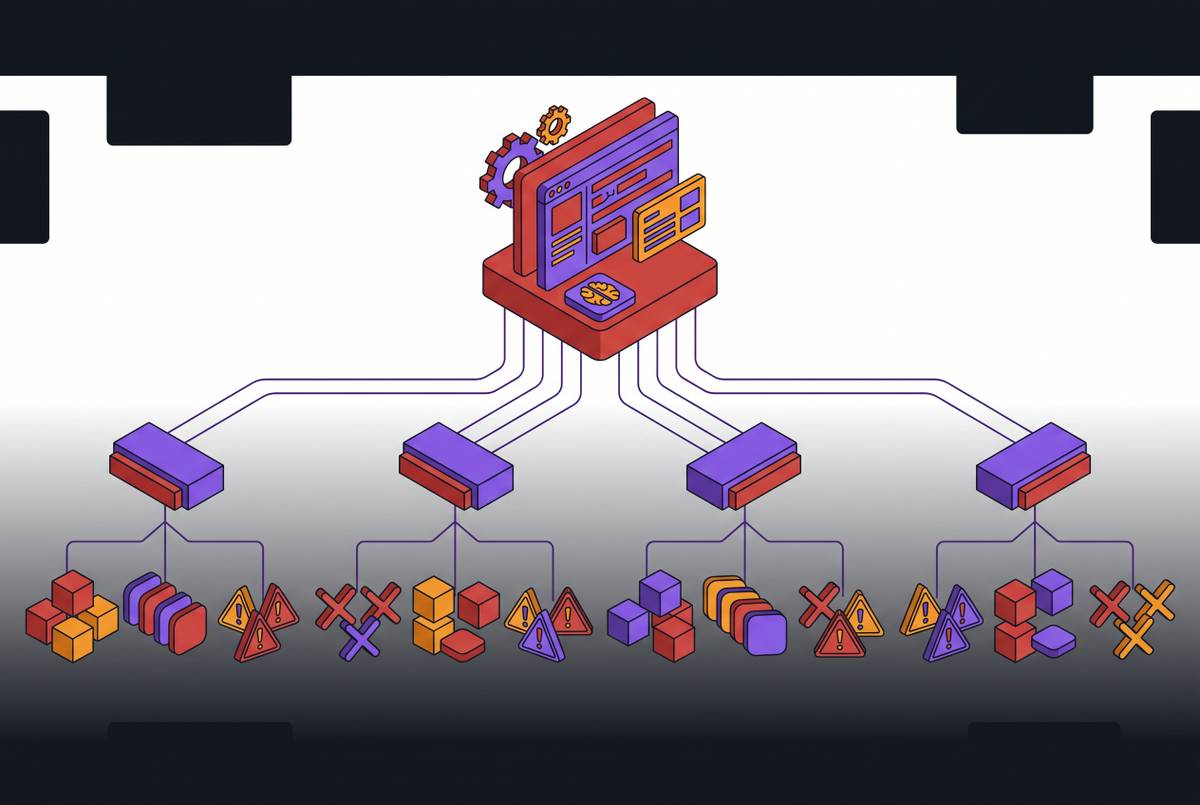
A single agent running one PRAO loop hits a ceiling once a workflow spans multiple applications, needs several things done in parallel, or simply runs longer than one context window can reliably manage. Multi-agent architectures answer that limit: an orchestrator agent breaks the problem into pieces, hands each piece to a specialist agent running its own independent loop, and folds the results back into an evolving plan.
By 2026, this had become a widely adopted production pattern rather than an advanced configuration reserved for edge cases. Leading enterprise systems increasingly run an agentic loop with explicit tool integration, structured memory, and multi-agent delegation built in from the start, and any vendor still pitching a single monolithic agent for complex healthcare workflows is behind the architecture curve.
The token cost scales accordingly. Multi-agent systems can burn up to fifteen times the tokens of a standard chat interface, which makes cost management and sensible task routing a real engineering concern rather than an afterthought.
Two standards matured over the 2025 to 2026 period to make this coordination workable at scale. The Model Context Protocol, or MCP, standardized how agents access tools. The Agent-to-Agent protocol, or A2A, standardized how agents talk to each other.
Consider how this plays out on a prior authorization request. An orchestrator agent receives the request and breaks it apart, assigning one specialist agent to log into the EHR and pull the relevant clinical documentation, a second to navigate the payer portal and submit the request, and a third to monitor the portal for a status update and trigger an escalation if the request comes back denied. Each specialist runs its own PRAO loop independently, and the orchestrator stitches the results into a coherent outcome.
This structure introduces its own failure modes, and they demand serious attention rather than a glance. An orchestrator can misroute a sub-task to the wrong specialist. A specialist agent can stall partway through. A result can come back in a format nothing downstream knows how to parse. Observability has to cover the entire agent graph, not just the internals of any one loop, or these failures become visible only after they've already done damage.
Reinforcement learning's role in teaching agents to discover better reasoning strategies themselves
Earlier agentic systems leaned on prompting techniques, chain-of-thought and ReAct among them, to coax step-by-step reasoning out of models that weren't designed to produce it natively. Someone had to engineer the reasoning strategy from the outside and impose it on the model, rather than the model discovering it on its own.
DeepSeek-R1 and OpenAI's o1 and o3 series changed that picture. Models trained with reinforcement learning began spontaneously discovering chain-of-thought reasoning, backtracking, and self-verification on their own, without any of those behaviors being explicitly programmed in. That's a meaningfully different mechanism from prompt engineering. Instead of a human writing a prompt that tells the model to think step by step, the training process rewards the model for reasoning in ways that happen to produce better outcomes, and the model converges on strategies no one specified in advance.
Mechanically, the model produces internal "reasoning tokens," visible chains of thought, before it commits to an action. Wired into an agentic loop, those tokens let the system decide, on the fly, when to call a tool, when to hand a sub-task off to another agent, and when it has enough information to commit to a final move.
Backtracking and self-verification carry particular weight in administrative work. An agent that notices a payer portal returned an error, reconsiders its approach, and retries on its own is doing something qualitatively different from an agent that marches forward linearly regardless of what came back. Tree-of-Thoughts, a related technique, pushes this further: rather than committing to one reasoning chain, it explores several paths in parallel and selects the strongest one. It costs more compute, which limits where it makes sense, but for high-stakes decisions where a wrong path carries downstream consequences, that cost earns its keep.
Reasoning-trained models raise the floor on how reliably the loop performs in situations it hasn't seen before. They generalize rather than pattern-match to a scripted path, which matters when a payer portal redesigns its interface overnight or a workflow runs into an edge case nobody wrote a rule for.
The safety layer separating intent validation from execution in production systems
Many current agentic systems share a structural weak point: model output gets treated as an executable command and passed straight to the execution layer with little checked in between. That design is a liability, because a stochastic model working with partial information about its environment can produce an action that's perfectly well-formed and still completely wrong for the situation.
An April 2026 arXiv paper on what it calls Sovereign Agentic Loops proposes a fix built around what it terms the Decoupling Principle: reasoning models should produce verifiable intent, not direct execution authority. Under this framing, a model's output is a proposal, and it has to clear validation before it touches anything real.
The architecture the paper describes, called SAL, adds a control-plane layer that intercepts every model-generated intent, checks it against the actual state of the system and whatever policy constraints apply, and only lets it through to execution once it passes. The design also includes what the paper calls an obfuscation membrane, which limits how much identity-sensitive state the model can see.
The paper's benchmark results, run on a prototype called OpenKedge, are specific: SAL blocked 93% of unsafe intents at the policy layer outright, caught the remaining 7% through consistency checks, prevented unsafe executions across the benchmark testing, and added a median latency of 12.4 milliseconds. Set against the time computer-use agents already spend per action navigating graphical interfaces, that 12.4-millisecond cost is close to negligible. Safety validation isn't buying reliability at the expense of speed here; the two move together.
The paper also describes an Evidence Chain, a cryptographically linked record of every state, intent, and executed action. That kind of record supports both auditability and deterministic replay, which matters directly for HIPAA's requirements around logging PHI access.
Agents that log into EHRs and payer portals on staff's behalf handle protected health information and submit claims that carry real financial weight. Trusting the model's judgment alone is not an adequate control in that context; the architecture itself has to do the enforcing. SOC 2 Type II and HIPAA compliance are the baseline expectations, and the SAL pattern describes how the underlying architecture actually earns that certification. Certification doesn't follow automatically from good intentions, and any vendor implying otherwise is skipping the hard part.
Computer-use agents as the implementation of the reasoning loop on real healthcare software
Computer-use agents are AI systems that interact with graphical interfaces the way a person does: reading what's on screen, clicking buttons, typing into fields, navigating menus, rather than calling an API behind the scenes. The input is a screenshot plus a history of prior actions; the output is the next action to take.
A 2025 arXiv survey splits these into three categories. GUI agents work with graphical interfaces. Terminal agents work at the command line. Cross-environment agents operate across multiple modalities and systems at once. Healthcare administrative work falls almost entirely into the first category: GUI agents navigating web-based payer portals and desktop EHR systems.
This architecture solves interoperability without requiring a single integration, because the agent sees whatever a human staff member would see on the screen. It doesn't need the EHR or the payer portal to expose an API for the workflow in question, and most of them don't expose APIs for the full range of administrative tasks staff handle daily. That's a sharp break from traditional RPA, which relies on brittle selectors tied to specific UI elements and breaks the moment an interface changes even slightly. Computer-use agents read the interface visually, so they adapt when a layout shifts instead of failing.
Several major AI providers had released computer-use platforms by 2026, including offerings from Anthropic, OpenAI, and Google. A more recent entrant, Claude Cowork, launched in January 2026, reached general availability in April 2026, and expanded to web and mobile in July 2026, running background tasks across mobile, web, and cloud environments.
None of this should be oversold, and pretending otherwise does the field no favors. Desktop agents handle structured, repetitive, multi-step tasks that span multiple applications reliably, but they aren't reliable enough to run entirely unsupervised on critical tasks without the policy and oversight layers described earlier in this piece. Anyone selling "fully autonomous, zero-oversight" claims for prior authorization work today is either wrong about the technology or wrong about the risk.
Where this architecture changes the deployment math is speed. Classic RPA takes months to stand up, largely because of selector scripting and integration work specific to each system it touches. Computer-use agents can go live in days, since no reverse-engineering of a system's internal structure is required, just configuration against a workflow the agent is meant to follow. A workflow configuration engine that turns an existing staff process directly into a deployable agent compresses that timeline further: what a staff member already does can become a live agent relatively quickly, needing nothing more than a login rather than a full integration project.
What end-to-end workflow automation means for healthcare administrative operations
The cost backdrop is stark. U.S. hospitals spent roughly $687 billion on administration in 2023, against $346 billion spent on direct patient care, a striking imbalance. Separately, the healthcare industry loses over $262 billion a year to inefficient revenue cycle processes.
Against numbers that size, automating a single isolated step, one form submission here, one status check there, delivers only marginal relief. Vendors selling point solutions as the answer to those figures are selling the wrong scope. The real value sits in automating the entire chain: pulling clinical documentation from the EHR, submitting it through the payer portal, tracking the response, and escalating or resubmitting when something comes back denied, all without a staff member manually bridging the gaps between those systems.
That's what "end-to-end" actually means here, and it's why the entire architecture covered above, the PRAO loop, the memory system, the multi-agent coordination, the safety layer, has to work together rather than in isolation. A workflow that spans an EHR, a payer portal, and a scheduling system doesn't fail because one component is missing. It fails at whichever seam nobody reinforced: a memory system that forgets step four by step fourteen, an orchestrator that misroutes a sub-task, or an execution layer with no validation standing between a model's proposal and a real submission to a payer. Closing every one of those seams is what separates an agent that finishes the job from one that quietly stalls out somewhere in the middle, leaving a human to pick up wherever it left off.
Sources
- Agentic Reasoning: How AI Agents Plan, Act, and Adapt in 2026
- The Architecture of Agency: A Deep Technical Guide to Agentic AI Systems in 2026 | by NJ Raman | Medium
- Reasoning RAG via System 1 or System 2: A Survey on Reasoning Agentic Retrieval-Augmented Generation for Industry Challenges
- Sovereign Agentic Loops: Decoupling AI Reasoning from Execution in Real-World Systems
- Memory in the Loop: In-Process Retrieval as Extended Working Memory for Language Agents
- arxiv.org