Memory and Context Management Across Long Agent Sessions
Why agents lose track of multi-day healthcare workflows and how to fix it.
Prior authorization tracking, denial appeals, referral scheduling, claim follow-up: none of these are single-step tasks. Each one spans multiple systems, multiple logins, and often multiple days before it resolves. That timeline is exactly where computer-use agents in healthcare either hold together or fall apart, and the difference almost always comes down to memory, not intelligence.
An agent that loses the thread mid-workflow doesn't fail loudly. It stalls, or it repeats a step it already completed, or worse, it acts on a stale or incomplete picture of where things actually stand. In a hospital billing office, that last failure mode is the expensive one. This piece breaks down what context management actually means for these systems, where it degrades, and what separates agents that finish the job from agents that quietly wander off it.
What computer-use agents are and how they perceive a workflow in progress
A computer-use agent operates the way a person would sit down at a keyboard: it takes a screenshot, identifies what's on screen, decides on the next action, executes it, checks the result, and loops back to start again. This perception-planning-action cycle is what makes the approach general-purpose. No API is required. If a human being can operate a piece of software by looking at a screen and clicking around, the agent can, in principle, do the same.
There are three levels of computer interaction available in practice today, and they carry very different reliability profiles. API integration is deterministic and highly reliable, but it only works when both systems on either end of the workflow expose an API, and somebody still has to build and maintain that connection. Browser automation navigates web interfaces much like a person clicking through tabs and forms, and it's reliable for workflows that live entirely on the web. OS-level desktop control is the most flexible of the three, capable of operating essentially any application, but it introduces real visual uncertainty and is a more moderate reliability tier as a result.
That screenshot-based model has a structural blind spot. Agents typically capture frames every three to five seconds, and between those frames, they're blind to motion and deaf to sound. A confirmation banner that flashes and disappears, a notification that auto-dismisses, an animation that resolves before the next snapshot lands: all of it can happen in the gap. The agent never sees it.
How memory degrades across a long session and why the context window is the wrong fix
Just feed the entire conversation history and action log back into the model on every single step, so nothing gets forgotten. It sounds sensible. It also breaks down fast once a session runs long.
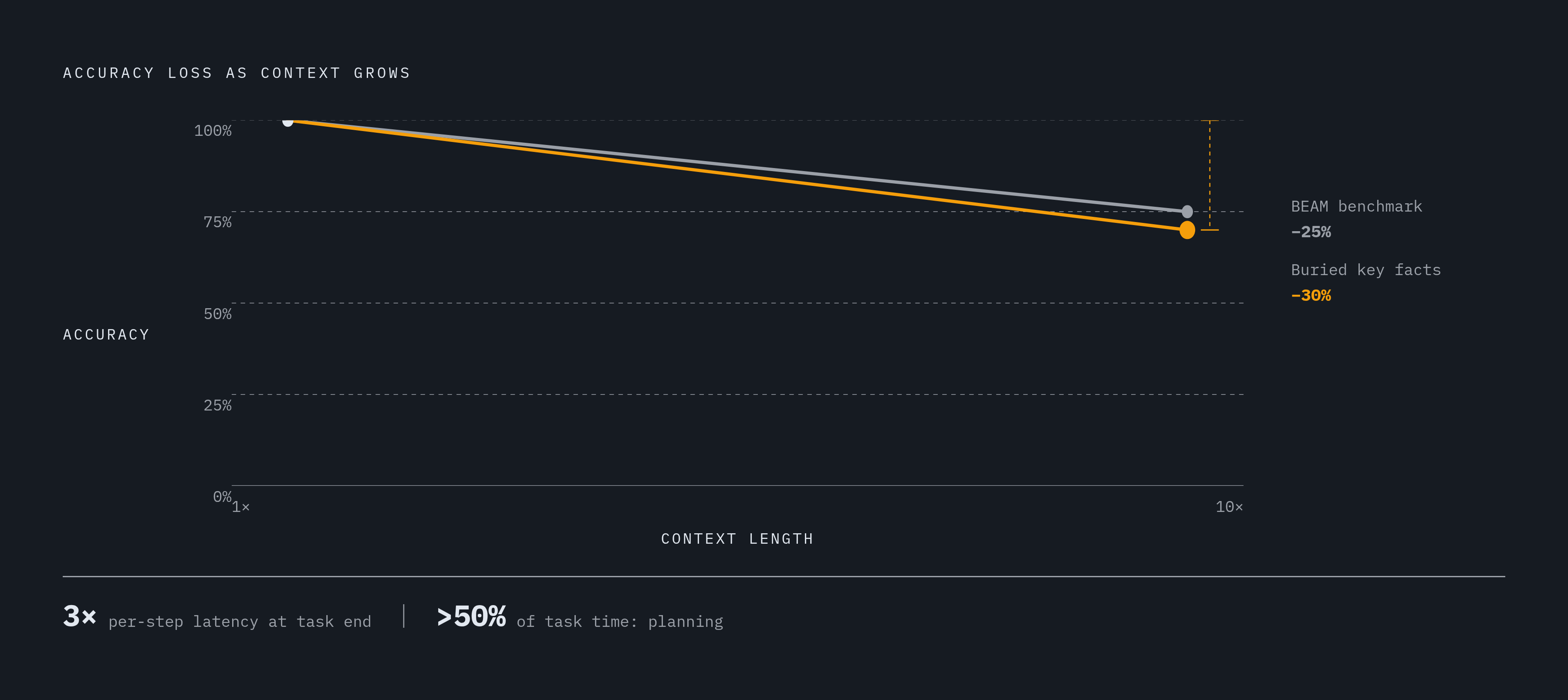
The first cost is latency, and it's not subtle. Passing a growing transcript into every prompt means the model re-processes redundant information at every step, so time-per-step climbs linearly as the session extends. The second cost is accuracy, and it's arguably worse. Burying key facts deep inside a long prompt has been shown to cause roughly a 30% drop in model accuracy, simply because the relevant detail gets lost in noise the model has to wade through. The BEAM benchmark tells a similar story from a different angle: performance drops by around 25% as context length scales up by a factor of ten.
There's a compounding latency problem layered on top of this, documented in recent agent-benchmarking work (arXiv:2506.16042): as an agent works through more steps in a task, each successive step can take up to three times longer than the steps at the start, largely because planning, reflection, and judging calls dominate the time budget. None of this is an academic curiosity for a hospital revenue cycle team. A prior authorization that involves dozens of portal steps, split across several sessions over multiple days, will run straight into these degradation curves in the ordinary course of business.
The four types of memory a well-designed agent uses across a healthcare workflow
Temporal management, meaning how an agent's grasp of context evolves over time, sits at the center of any serious memory design. That includes the split between short-term and long-term memory, the split between what persists within a session versus across sessions, and explicit policies for what gets forgotten and when.
Four distinctions matter most in a healthcare setting. In-session working memory covers what the agent is holding about the task directly in front of it: which fields on the current form are filled, what the last portal response said, what error just appeared. This is the live context the agent is reasoning over in real time, and it's the easiest layer to get right because it doesn't need to survive anything.
Cross-session persistent memory is harder. It is where most of the real risk lives. This is the set of facts that has to survive a session ending entirely: the claim number, the authorization reference, the last known portal status, which insurer is on file for the patient. Without this layer, every new session starts the agent from zero, as if the prior auth had never been touched before.
Evolving-fact memory is a subtler category still. Some facts don't get replaced, they accumulate a history. A claim that moves from submitted, to denied, to under appeal isn't three separate facts where the newest one overwrites the last; it's a sequence the agent needs to reason over to take the correct next action. Treating it as a simple overwrite causes the agent to lose the denial reason that is driving the appeal.
The fourth piece, decay and forgetting, is about restraint. Not every fact accumulated over a long workflow is equally relevant going forward, and keeping all of it indefinitely produces the context-window degradation described above. A well-designed agent needs a policy for what to drop and a policy for what to keep.
Take a prior auth appeal as the working example. The agent has to hold onto the original submission date, the specific denial reason, which documents have already been uploaded, and any payer-specific quirks it ran into along the way, potentially across many sessions spread over days. Dropping any one of those mid-workflow makes the resulting appeal either wrong or missing something a reviewer will bounce it for.
External memory stores and vector retrieval as the architectural solution
The fix is moving memory outside the model entirely, into an external database, so that only the facts relevant to the current step ever occupy the agent's active compute space. It's moving memory outside the model entirely, into an external database, so that only the facts relevant to the current step ever occupy the agent's active compute space.
A vector retrieval layer lets the agent query for what it needs, the denial reason, the current portal status, the auth reference, without dragging along the entire accumulated transcript of everything that's happened up to that point. This separation is the whole point: the system's performance doesn't collapse as sessions multiply and workflows stretch out over weeks, because the working set the model actually reasons over stays small and relevant regardless of how long the underlying history gets.
A handful of frameworks illustrate the different ways this problem gets solved as of 2026. Mem0 builds a dedicated memory layer meant to give agents memory that persists across sessions and evolves as new facts arrive, targeting general-purpose agent memory continuity. Zep leans hard into enterprise controls: SOC 2 Type II certification, HIPAA business associate agreements, and both bring-your-own-key and bring-your-own-cloud deployment options. Zep reports sub-200ms retrieval even at large graph sizes, along with benchmark scores of 94.7% on LoCoMo and 90.2% on LongMemEval, and its architecture treats a changed fact as a new entry in a history rather than a replacement, so a patient who switches insurers leaves both the old and new coverage on record rather than just the latest one. Letta, tied to the MemGPT research lineage, focuses on continual learning and context management, including a "sleep-time compute" concept aimed at agents that get better with use rather than staying static.
Observation gaps between screenshots and how they compound context problems in real workflows
Go back to that three-to-five-second screenshot cadence. Anything that appears and vanishes faster than that interval simply doesn't exist as far as the agent's perception is concerned.
Payer portals are full of exactly this kind of transient event: session-timeout warnings, CAPTCHA prompts, submission confirmations that flash on screen for a second or two and then auto-dismiss. None of this is a hypothetical edge case dreamed up for a benchmark paper; it's routine behavior on the kind of portals these agents spend their entire working life inside. If the agent misses a confirmation that a submission actually succeeded, it has no reliable record that the step worked, and if that missing confirmation never makes it into external memory, the agent is left guessing. It might resubmit a form that already went through, skip a step it assumes happened, or report back a status that's simply wrong.
Research on the Agent-Computer Observation Interface (arXiv:2606.29472) tested a fix for exactly this: giving agents a persistent text narration of captured frames, rather than relying on raw screenshots alone. The gain was substantial, +17 to +48 percentage points on dynamic browser tasks, with the largest improvements appearing specifically on tasks involving transient or audio content, the same category of event that payer portals produce constantly.
Efficiency degradation in long agent sessions and what it costs operationally
Even setting perception aside, the raw efficiency numbers for long agent sessions are sobering. OSWorld-Human research (arXiv:2506.16042) found that the best current agents take several times as many steps as a human expert would need to complete the identical task.
A meaningful chunk of that inefficiency traces back to visual grounding failures. In the same study, 23% of GTA1's errors were caused by poor visual grounding, and in some cases that single error type added up to 30 extra steps onto one task. Stack that on top of the latency compounding already discussed: planning, reflection, and judging calls dominate total task time, with planning alone eating more than half of it, sometimes approaching 75%, and that share only grows as the step count climbs.
For a single task run in isolation, a few extra steps and some added latency are annoying but tolerable. For a single task run in isolation, a few extra steps and some added latency are annoying but tolerable; for a healthcare operation running dozens of prior auths, appeals, and referral follow-ups across multiple payer portals at once, that inefficiency becomes a real, measurable operational cost.
What healthcare-specific memory evaluation looks like and why it matters for purchasing decisions
General-purpose agent benchmarks like OSWorld, LoCoMo, and LongMemEval measure computer-use accuracy well, but none of them were built to model patient continuity or the cross-session demands specific to healthcare workflows. Until recently, there simply wasn't a formal way to measure how well an agent's memory holds up on a healthcare task specifically.
MedMemoryBench closes that gap. It's a formalized evaluation framework built specifically around healthcare agent memory, covering 2,020 total sessions and 15,988 total dialogue turns spread across 98 distinct health-topic categories. What it captures that the general benchmarks don't: whether an agent correctly carries patient-specific context forward from one session into the next, whether it can handle information that contradicts or updates something it already knew (a coverage change, a revised denial reason), and whether its accuracy holds steady or degrades over long interaction histories.
For anyone evaluating a vendor in this space, the practical takeaway is to ask sharper questions than "what's your task completion rate?" Ask how accuracy changes as session length grows. Ask, specifically, how the system behaves when a fact changes between sessions, whether it overwrites the old value or preserves it as history. The answer says a lot about whether the underlying memory architecture was actually built for this domain or adapted from something else.
HIPAA and PHI compliance requirements that apply directly to the memory layer
The external memory store is where PHI actually lives in between sessions: claim numbers, patient identifiers, authorization references, denial reasons, coverage details, all of it sitting in a database specifically so the agent can retrieve it. It's where PHI actually lives in between sessions: claim numbers, patient identifiers, authorization references, denial reasons, coverage details, all of it sitting in a database specifically so the agent can pick up the thread days later.
That puts the memory layer squarely inside HIPAA's scope, on the same footing as any other system that touches protected health information. It needs a Business Associate Agreement in place, real access controls, audit logging, and clearly defined retention and deletion policies, beyond a general privacy statement bolted on afterward.
Analogous privacy frameworks make the underlying principle explicit. The underlying principle, common to multiple privacy frameworks, is that any system built to remember also has to be built with the mechanical ability to forget. Deletion has to be something the system can technically do at the database level. And critically, the specifics of how that plays out, who can inspect a stored memory, how long it sits before expiring, what deletion actually looks like at the database level, are not standardized across vendors today. Every deployment has to configure this explicitly rather than assume it comes built in.
What well-designed multi-system agents do differently to stay on task end to end
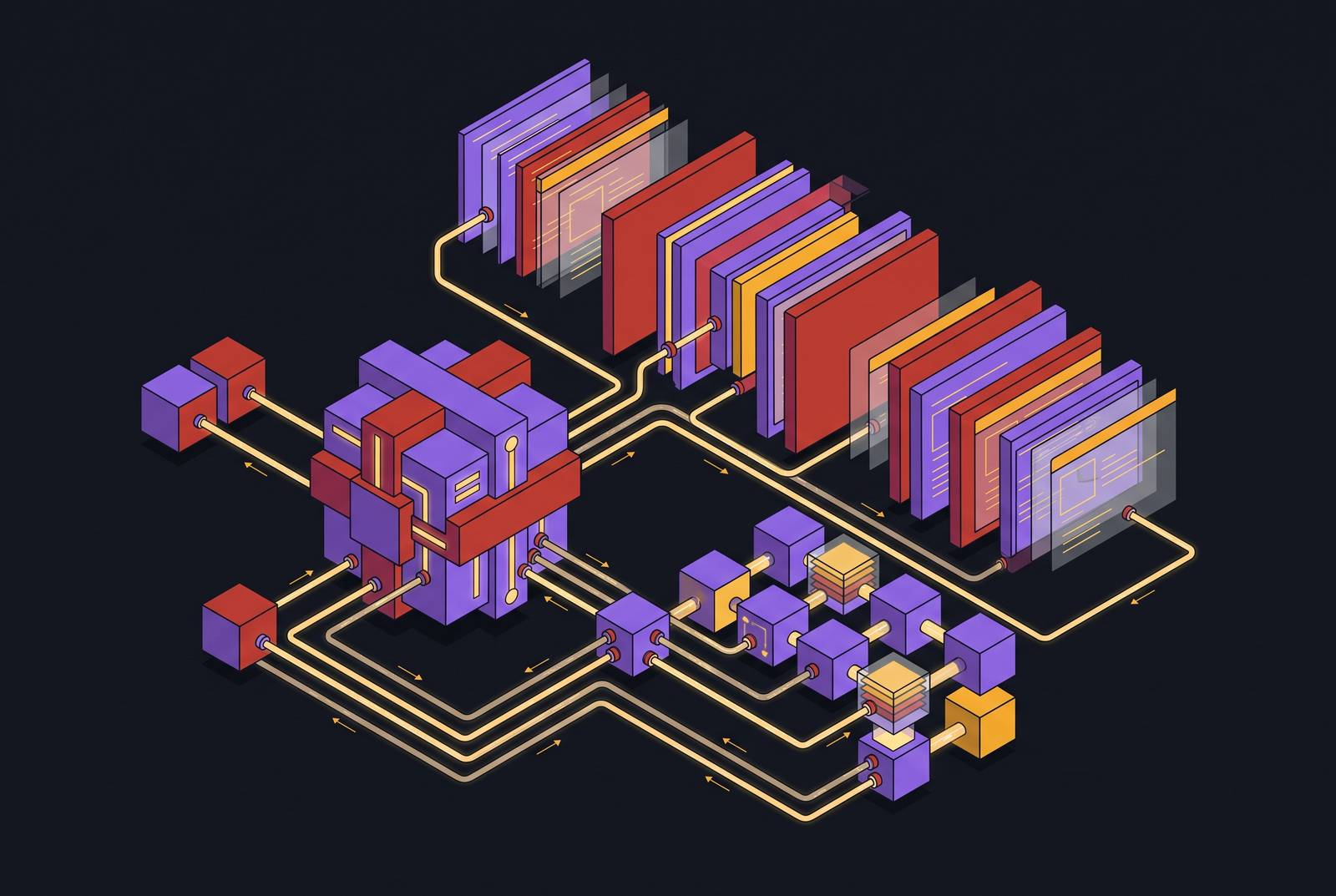
A healthcare agent session that actually works is a structured sequence with explicit state management at every handoff, EHR to payer portal, portal to internal scheduling system, and back again, where each transition is a deliberate checkpoint. It's a structured sequence with explicit state management at every handoff, EHR to payer portal, portal to internal scheduling system, and back again, where each transition is a deliberate checkpoint rather than an assumption that context just carries itself.
The defining property of agents that stay on task is external persistent state: workflow progress gets written to a durable store after every step, beyond being held in the model's working memory. That single design choice makes a portal timeout, a dropped network connection, or a browser crash either reset the entire workflow back to zero, or let the agent pick up exactly where it left off. Given everything degradation curves, observation gaps, and compounding latency do to a long session, that persistence layer is essential. An agent with that persistence layer finishes a prior auth; one without it quietly loses track of it somewhere around step forty.