Inconsistent Data Rendering Across EHR Instances
When the same patient data looks different across your EHR, claims and denials follow.

Nearly 96% of US hospitals and 78% of office-based physicians now use certified EHR systems, according to a University of Central Florida study published in Healthcare Incompleteness of Electronic Health Records: An Impending Process Problem Within Healthcare. That should have settled the question of whether electronic records behave consistently across a practice's various touchpoints. That question hasn't settled.
Inconsistent data rendering, in plain terms, means the same clinical information shows up looking different depending on who's viewing it and where. A diagnosis might carry one code in a referring physician's system and a slightly different mapping in the receiving practice's. None of this is a single bug waiting for a patch. It's the compounding result of multiple people entering data differently, multiple formats coexisting without translation, and no shared layer capable of reading every one of these systems the same way.
This piece works through that problem in three parts: the root causes that produce the inconsistency in the first place, what it actually costs a practice in claims, denials, and staff hours, and what a system-agnostic approach to reading EHR data looks like once you stop waiting for the industry to standardize on your behalf. None of this requires a background in data architecture. It requires understanding how the money and the time actually leak out, which a practice administrator is positioned to see first.
The four forces that produce inconsistent rendering (before anyone touches a payer portal)
Start with who's typing. EHR data gets handled by different people, in different locations, entering information for different purposes, and each of them carries their own shorthand into the record. A referring physician's note, a front-desk intake form, and a billing coder's field can all describe the identical clinical event in three incompatible ways, and nothing in most systems forces them to reconcile. Research on this exact pattern, going back to Shah and Khan's 2020 work, points to the same conclusion: inconsistent terminology makes it genuinely hard to compare one practitioner's assessment against another's, even when both are describing the same patient.
Format adds a second layer on top of that. Some systems store data in clean, structured fields. Others rely on free text, dictated notes, scanned documents, anything but a field a computer can parse on its own. Coding systems that were supposed to unify this, LOINC, SNOMED CT, RxNorm, aren't applied the same way everywhere, so even structured data doesn't guarantee two instances store the same fact identically. Integration analysis from Thinkitive makes the point bluntly: mapping and terminology differences mean no two EHR instances hold the same fact the same way, full stop. Estimates on how much healthcare data sits unstructured, or locked in systems that don't talk to each other, run high, roughly 80% by some counts, though that particular figure deserves to be read as directional rather than precise.
Then there's drift, which is the quieter and more dangerous force because it happens inside a single system over time. Schemas evolve. New variables get added, units change, coding gets adjusted for a new billing cycle. A lactate value recorded in mg/dL for years might shift to mmol/L going forward, with nothing retroactively correcting the older entries. The record is internally inconsistent with itself, not just inconsistent with some other system down the hall.
Historical data gets partially transferred, or dropped, during migrations, and nobody notices right away, with legacy data proving hardest to migrate at that point. Historical data gets partially transferred, or dropped, and nobody notices right away. One practice manager described finding, six months after a go-live, that certain lab values hadn't transferred correctly at all, which meant manually reviewing thousands of patient records just to confirm nothing dangerous had slipped through. These four forces don't operate in isolation. A schema change layered on top of years of multi-contributor entry, carried imperfectly through a migration, produces noise that gets worse with every new location or system a practice adds, not better.
Where interoperability standards fall short
HIMSS describes interoperability in four levels: foundational, where data simply moves from one place to another; structural, where it's parseable; semantic, where it's actually interpretable by the receiving system; and organizational, where governance and trust let real exchange happen. Most private clinics have reached the foundational level. Data moves. Getting to semantic and organizational interoperability, where a system doesn't just receive a value but understands what it means the same way the sending system did, is where progress stalls for the vast majority of practices.
HL7 and FHIR were supposed to close that gap, and in fairness, adoption is wide. But wide adoption isn't uniform adoption, and the lack of uniformity undermines the consistency of what actually gets captured. Plenty of vendors support FHIR only partially, which forces developers back onto HL7 v2, CCDs, or custom-built APIs just to move certain kinds of data at all. Proprietary platforms make this worse by design: they restrict data sharing and lock health systems into rigid ecosystems, a pattern the ONC has documented directly. Legacy systems, which still run the majority of practices, often provide limited API support or none.
None of this is cheap to fix through conventional means. A traditional EHR upgrade aimed at improving interoperability often runs $50,000 or more in consulting fees alone, on top of six to twelve months of implementation. For a smaller or independent practice, that math rarely closes. KLAS Research's 2025 EHR Interoperability Overview put the honest conclusion directly: interoperability is a team sport, and no single vendor, payer, or health system can solve it alone. Progress depends on shared terminology and shared accountability across an industry that has never fully agreed on either. Standards help. They reduce the size of the problem. They do not eliminate it, and a practice cannot afford to wait for the industry to converge before dealing with what's already appearing in its claims queue.
Operational costs of inconsistent rendering in claims, denials, and staff time
Poor interoperability costs the US healthcare system an estimated $30 billion a year, driven by redundant tests, administrative waste, and delayed treatment, according to a Health Affairs study. That's the macro number. The claims-level number is worse in its own way. Kodiak Solutions, which tracks revenue cycle data across more than 2,300 hospitals, found net revenue leakage hit $48.4 billion in 2025, a 25% jump from the year before, with outpatient commercial leakage alone climbing from 8.9% to 10.3% of net revenue in a single year sully.ai.
Denials are rising in step. Experian Health's State of Claims 2025 survey found 41% of providers now report more than 10% of their claims getting denied, up from 30% in 2022 sully.ai. Reworking those denials isn't free: US hospitals spend roughly $19.7 billion a year overturning them, at about $57 per reworked claim, according to a Premier estimate Experian Health's State of Claims 2025 sully.ai. And the problem doesn't sit still. 288 new CPT codes went live on January 1, 2026, alongside 614 new ICD-10-CM codes that took effect October 1, 2025 qualigenix.com sully.ai. Practices that haven't updated their EHR templates to match are submitting claims carrying outdated codes, and payers reject those claims on sight qualigenix.com sully.ai. Inconsistent data rendering isn't a historical artifact sitting in old records. It gets refreshed every time a coding cycle updates and propagates unevenly across whatever systems a practice runs.
Staff absorb the difference. A Freed survey found 57% of clinicians lose more than 44 hours a month to documentation alone. AMA data shows 20.9% of physicians spend more than eight hours a week on the EHR outside their normal working hours, a figure that hasn't budged since 2022 despite years of industry attention aimed squarely at this issue. Put together, inconsistent rendering isn't an abstract data-quality complaint for a systems team to file away. It appears as a denied claim, a rework fee, and a biller staying late to reconcile a field that two systems couldn't agree on in the first place.
The added difficulty of payer portals
Commercial payers haven't been standing still while providers absorb these costs. Over the past two years, they've deployed AI aggressively to review and deny claims faster, a shift Healthcare Finance News has tracked as something close to an arms race. Providers, meanwhile, are largely still on manual, portal-by-portal workflows, negotiating against a counterparty that's gotten considerably faster than they have.
Payer portals compound the underlying problem instead of solving it. They render forms, fields, and displays inconsistently, sometimes even between one login session and the next. Any system trying to read EHR data and then act on a payer portal has to reconcile two separate layers of inconsistency at once, not one. Prior authorization sits right at the center of that friction: physicians and staff spend an average of 13 hours a week completing prior auths, handling roughly 39 requests per physician weekly, and 89% say the process meaningfully worsens burnout, according to AMA survey data.
Regulation is starting to add a new layer of structured data into this picture, though it comes with its own reconciliation burden. Under the CMS Interoperability and Prior Authorization Final Rule, Medicare Advantage, Medicaid, and ACA marketplace plans must now publicly report turnaround times, approval rates, and appeal outcomes starting January 1, 2026, with first public reports due by March 31, 2026, and must expose decisions through a FHIR-based API by January 1, 2027. That's genuinely useful information, giving providers visibility into payer behavior they've never had before. It's also one more data stream that has to be read, parsed, and reconciled against everything else already in play.
The adoption gap tells the real story here. The 2026 Healthcare AI Trends survey found 59% of respondents haven't implemented AI or automation in their revenue cycle at all, and only 2% say they've fully or mostly integrated these tools across RCM operations. Payers are automating aggressively. Providers, for the most part, are not. Inconsistent rendering was never contained inside the EHR to begin with; it propagates outward into every portal and system a practice has to touch, and the payer side is widening the gap by moving faster.
What AI agents trying to read these systems encounter
Computer-use agents, in this context, are autonomous systems built to interact with existing software the same way a staff member does: reading a screen, clicking a button, typing into a field, navigating from page to page, with no API integration required underneath. That distinction matters, because it means these agents inherit the exact same rendering problem a human biller inherits, field by field, screen by screen.
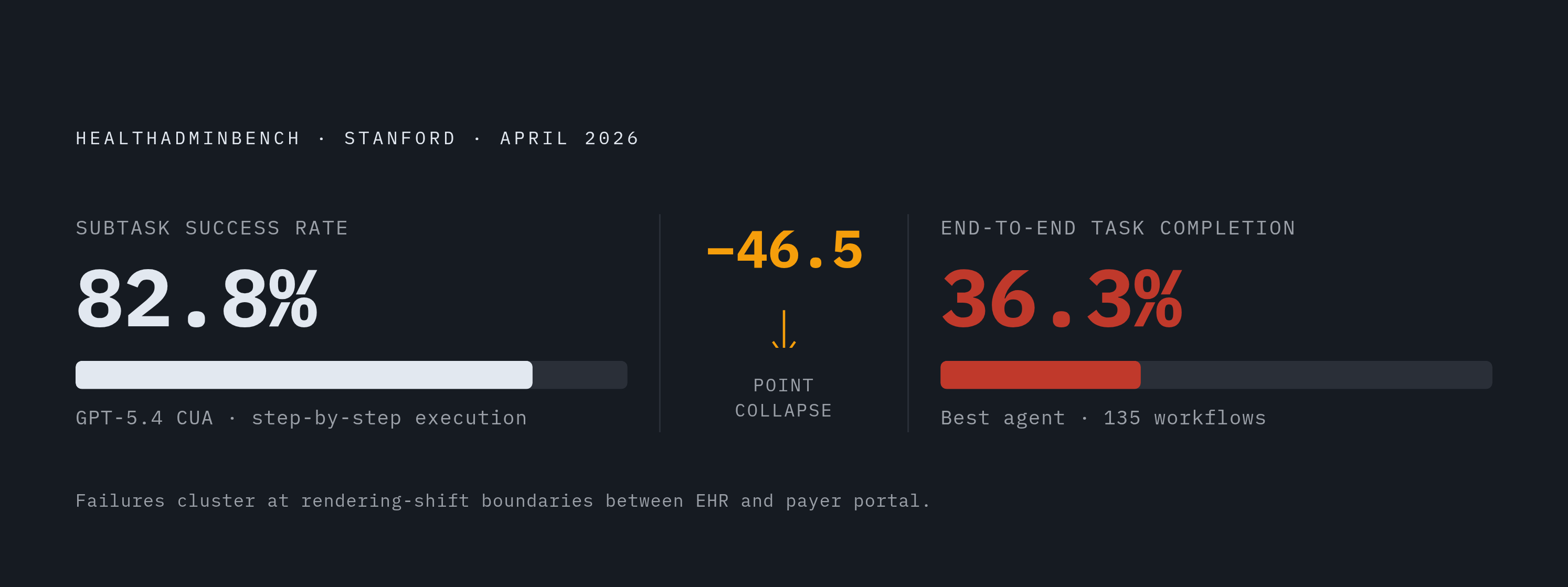
Stanford's HealthAdminBench, released in April 2026, is the clearest evidence of how much that inheritance costs in practice HealthAdminBench (Stanford, April 2026). The benchmark evaluates computer-use agents across 135 expert-defined healthcare administration tasks, spanning prior authorization, appeals and denials, and DME order processing, broken down into 1,698 fine-grained, verifiable subtasks run across four deterministic environments simulating an EHR, two separate payer portals, and a fax system HealthAdminBench (Stanford, April 2026). The best model, GPT-5.4 CUA, hits an 82.8% subtask success rate, yet the best-performing agent completes only 36.3% of full end-to-end tasks HealthAdminBench (Stanford, April 2026).
That gap between strong step-by-step performance and weak full-workflow completion is the whole story in miniature. An agent can execute nearly every individual action correctly and still fail the overall task, with failures clustering disproportionately at the exact points where rendering shifts, a field that looked one way in the EHR appearing differently once the agent reaches the payer portal, or a legacy value that simply doesn't match the format expected downstream. This isn't unique to any one vendor's model. Tools trained on one hospital's EHR routinely underperform once moved to a different institution running slightly different workflows, because rendering inconsistency transfers directly into agent reliability. Earlier benchmarks for healthcare agents were mostly text-based and never tested this full, payer-facing chain. That gap is why HealthAdminBench's numbers land as significant rather than incremental. Worse, the same inconsistency that trips up a live agent also poisons the data used to train the next one: EHRs full of missing fields, inconsistent documentation habits, and legacy entry errors produce noisy training sets that degrade model performance before an agent ever reaches a live portal.
What a system-agnostic approach to reading EHR data requires
The requirement, once you sit with the evidence above, is fairly plain to state. A practice needs a layer that can read any EHR, any payer portal, and any third-party system the way a trained staff member reads them, without demanding that those systems first agree on a shared API, schema, or data format. That's a meaningfully different bar than waiting for the industry to finish converging on FHIR, and it's the only bar that matches how practices actually operate today.
It matters operationally because no practice should have to rip out its EHR, wait years for a vendor to reach full FHIR compliance, or fund a $50,000-plus consulting engagement just to get consistent handling of its own data. In practice, this looks like computer-use agents that read screens, click, type, and navigate exactly the way a staff member would, rather than depending on an API handshake that snaps the moment a portal redesigns its layout or a vendor pushes a schema change. That's the real architectural difference from older RPA tools or API-dependent automation: an agent that perceives the interface the same way a human does adapts to rendering differences in real time, instead of relying on a brittle field-position or API endpoint that breaks on any format change.
None of this should be evaluated against vague promises of automation. The right test is workflow-specific: prior auth turnaround time, denial rate, claims rework volume, whatever bottleneck actually costs a given practice money, because that bottleneck differs from one practice to the next. The value compounds when the automation spans the whole chain, extraction from the EHR, submission through the payer portal, follow-through on a denial appeal, rather than stopping at one isolated task and leaving the rest to manual reconciliation. And the metric that actually matters is end-to-end completion, not subtask accuracy: GPT-5.4 CUA attains the highest subtask success rate at 82.8%, yet the best-performing end-to-end agent achieves only 36.3% task success HealthAdminBench (Stanford, April 2026).
The prior auth AI market reached $100+ million in 2025, growing 10x year over year, demonstrating the direction the industry is heading, though most of that growth has been on the payer side 2026 Healthcare AI Trends survey sully.ai. Most of that growth, though, has landed on the payer side of the table, while 59% of providers still haven't automated any part of their revenue cycle 2026 Healthcare AI Trends survey sully.ai. That gap is the opportunity as much as it's the problem. Inconsistent data rendering was never going to wait for a standards body to finish its work before costing practices money, and it isn't going to wait now. A system-agnostic, screen-operating layer that works across whatever systems a practice already runs, without requiring those systems to agree on a format first, is the approach built for the problem as it actually exists today.
Sources
- EHR Interoperability Solutions in 2026: What Actually Works?
- Incompleteness of Electronic Health Records: An Impending Process Problem Within Healthcare
- EHR System Integration Challenges: 10 Pitfalls & Solutions
- EHR Interoperability Overview 2025: How We Move Interoperability Forward - KLAS Research
- arxiv.org
- sully.ai