Screenshot Handling and Ephemeral Image Storage in HIPAA-Compliant Agents
Ephemeral screenshot storage and audit trails protect patient data in healthcare AI agents.
Screenshot handling is a central compliance engineering problem for computer-use agents in healthcare. Images captured inside EHRs and payer portals contain PHI. A defensible deployment therefore needs deliberate screenshot lifecycle controls, with task-scoped capture, protected processing, no image-retention pathway, and an audit record that survives after the image is gone.
Why every screenshot a computer-use agent takes inside an EHR or payer portal is a PHI event
A screen-operating agent perceives its environment by capturing the current viewport, reasoning over that image, and then acting. The viewport may show an EHR patient record, a payer authorization page, or a referral intake form. Its pixels reproduce member demographics, diagnosis codes, clinical notes, procedure codes, and payer identifiers. The image is a record of patient information whether the agent uses it to choose its next click or to populate a database.
That mechanism puts PHI access inside every perception step. A workflow need not write anything back to expose regulated information, because reading the screen has already brought that information into the agent pipeline. HIPAA’s access control and minimum-necessary requirements apply to those images just as they apply to the underlying records. Query-level governance alone therefore leaves a gap when the same information reaches an agent through a rendered page. The compliance boundary must include both what the agent sees and what it submits.
How HIPAA's Privacy Rule, Security Rule, and the 2025 amendments map onto screenshot data
For the administrative tasks discussed here, access must be limited to the PHI the task requires. A confirmation-number lookup does not justify exposing an entire authorization history simply because the portal renders both together. Screen layout is not a permission boundary. The architecture must constrain the agent’s view.
The Security Rule sets the tests for identity, access, audit, and protection. Unique user identification is a required implementation specification, while least-privilege permissions are a strongly recommended practice rather than a separately named required specification. Shared credentials with no agent-level attribution leave no way to tell which agent accessed a record. The audit record must connect PHI access to an identity, time, and purpose, including access through screenshots, prompts, and retrievals. Encryption also belongs in the design review, although the existing rule treats it as addressable and permits a documented equivalent alternative.
As of late 2026, the proposed 2025 Security Rule amendments had not been finalized or become law. The proposal would make encryption of ePHI in transit and at rest mandatory and require a written inventory of technology assets, which would encompass AI systems handling ePHI. It also proposes more detailed risk analysis and business associate verification and oversight. Direct Security Rule liability for business associates, however, predates that proposal and was established through the 2013 Omnibus Rule.
Why agent frameworks accumulate screenshot PHI by default and what makes that structurally dangerous
A prior authorization workflow exposes the mismatch between broad agent context and narrow task scope. The agent may pull up an EHR record, work through the steps of a payer submission, and later check authorization status. At each page transition, another screenshot can enter the reasoning context. A status check may capture full demographic and diagnosis history even when the needed output is only a confirmation number. The agent captures more than it needs before any decision about retention.
Across a multi-step session, dozens of images may collect in temporary buffers or inference-step caches without automatic purging. General-purpose frameworks favor enough context to complete the task. When conversation context is kept, that exposure can carry over to later steps. Temporary is not the same as self-deleting. If those images reach logs or debugging stores, the deployment has created a PHI repository outside its intended record system.
Orchestration adds another boundary to the problem. Sending a screenshot to another agent also sends the PHI it holds, which could reach a subprocessor outside the documented BAA chain. This is an architectural default to override. A practice cannot reliably inventory or audit image copies whose locations and lifetimes it does not control. A successful workflow demonstration does not establish that these secondary stores are governed.
What ephemeral storage architecture means and how it addresses the screenshot lifecycle problem
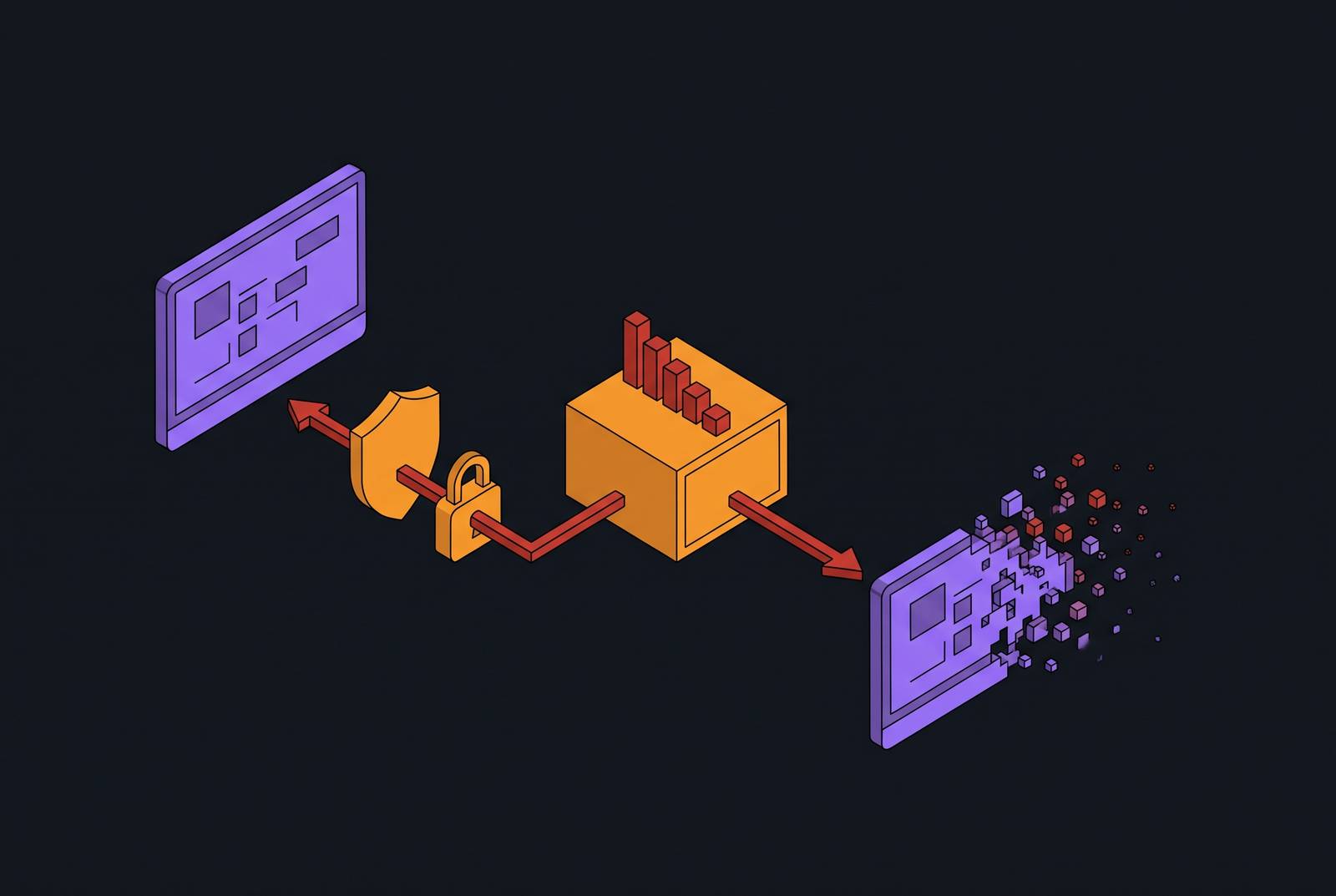
Ephemeral storage means that screenshot data exists only for the reasoning step that needs it and is then cryptographically purged. There must be no image-retention pathway into logs, persistent caches, model state, or downstream systems. That distinction changes the engineering objective from managing a screenshot archive to preventing one. Every part of the system that handles the image must follow that lifecycle.
The intended sequence is capture, encryption in transit, use for the single reasoning step, buffer purge, access-event logging, and deletion confirmation. Every transition requires an explicit design decision. A temporary buffer remains part of the ePHI handling environment, so protection cannot stop at stored files or network connections. The design must account for inference buffers and image caches as well. Calling a component temporary does not establish either its protection or its deletion behavior.
Minimum-necessary controls act before the image enters reasoning. Task-scoped cropping or masking limits the view to the fields needed for the current operation, reducing exposure before transmission or downstream storage. This complements access controls at the source where the rendered interface presents more information than the agent needs.
Even with ephemeral handling, proof of access must last. The replacement for the image is a record containing agent identity, session ID, task type, system accessed, timestamp, fields accessed in descriptive terms, and action taken. Purge evidence completes that record without preserving the pixels.
Why system prompts and BAAs alone do not satisfy the Security Rule's access control requirements
A system prompt that tells an agent to discard screenshots says what the agent should do but puts no enforced limit on storage. Prompt injection, model updates, or multi-step execution can cause that instruction to fail without the prompt showing that it failed. The model’s assertion is not deletion evidence. A design that depends on the agent choosing not to retain PHI leaves the retention pathway intact.
A BAA serves a different purpose from a technical safeguard. Signing one with the primary vendor does not, by itself, demonstrate that every screenshot processor is covered by the necessary agreements. The business associate chain must account for all model providers, hosting services, and intermediate inference services. Nor can an agreement repair missing attribution when several agents use credentials that reveal no individual agent identity.
The corrective action is to enforce restrictions below the model. Retrieval and rendering controls must limit access before capture, while PHI sensitivity tags propagate restrictions through downstream processing. Unique agent identities must be bound to specific workflow sessions so that permitted access can be distinguished from unattributed activity. Deletion must be confirmed by the storage layer. Compliance is consequently a property of the complete arrangement, including the agent, model provider, hosting, connected tools, agreements, and enforced safeguards.
The audit trail an ephemeral-storage agent must produce and what an HHS examiner will actually test
For a design review, the required evidence begins with a reconstructable screenshot event. Each record should identify the unique agent, session, task, system, and fields or screen region accessed, described categorically. Capture and purge timestamps show how long the image existed. Storage-layer confirmation supplies evidence that the lifecycle ended.
An examiner’s access-control review needs more than a named account in a log. The supporting evidence must show the agent’s permissions and connect its access to the authorized workflow. Log completeness must extend beyond screenshots to prompts, retrievals, and actions so that an omitted step does not break reconstruction. The evidence must show that protection in transit, storage, and buffers meets the rules that apply. BAA documentation must identify coverage throughout the processing chain, while deletion evidence must come from the storage layer.
These records also help with risk analysis by showing which systems touch ePHI and whether access stays within what the task needs. The proposed 2025 changes would require a more detailed analysis covering technology assets and systems, with AI recognized as an emerging technology warranting attention. The pending proposal’s inventory requirement is broader than an AI-only register, but an agent architecture should make each agent’s PHI contact surface discoverable within it. An inventory that excludes inference caches or screenshot processors would miss the very components the lifecycle controls are intended to govern.
Why the screenshot modality persists even as FHIR APIs expand, and what that means for the compliance timeline
As FHIR expands, agents still need to use screens to work in some systems. CMS-0057-F separates operational provisions effective January 2026 from FHIR API requirements effective January 2027. Its prior authorization decision requirements include a 72-hour urgent timeframe, and the mandate’s coverage is limited to CMS-regulated payers. API availability therefore cannot be assumed across the administrative workflow. A practice may still need portal access where standardized interfaces do not cover the task.
That produces a dual-stack environment in which production workflows need FHIR and legacy channels, including X12, payer portals, and fax. Third-party PM software, legacy clearinghouses, specialty payer portals, and referral platforms without API surfaces extend the need for screen operation beyond the FHIR mandate. Even an API-native portion of a workflow can receive screenshot PHI through an agent hand-off. The pipeline that receives the image must keep its restrictions in place, because an API-based design alone offers no protection against visual PHI.
Dhar et al. propose a unified orchestration runtime coordinating multi-agent workflows across EHR and HIMS environments. When agents work together this way, boundary controls are especially important because screen-operating and API-native agents can share context within one task. More API coverage can reduce some screen interactions without eliminating this mixed environment. Ephemeral handling should be designed in now. Its usefulness depends on the remaining screenshot surface.
What a compliant computer-use agent deployment looks like in practice across the full administrative workflow
A prior authorization deployment brings these controls together across EHR retrieval, payer portal submission, and status tracking. Across three systems, each screenshot requires task-scoped access, protected use, and a logged lifecycle. At each boundary, the agent identity is authenticated and the task scope is established before access. The image is limited to required fields, used for its reasoning step, and purged. These controls must travel with the workflow rather than depend on each interface offering the same safeguards.
A continuous audit trail then links those events to the originating task and agent identity, without leaving a residual image store. The deployment described here retains that trail for six years. Its agreement chain covers the agent vendor, model provider, cloud infrastructure, and any intermediate inference API before the first patient record is accessed. That chain must remain explicit across system transitions. Otherwise, a workflow can be well controlled at its starting point and lose coverage at the next hand-off.
For a deployment intended to go live in weeks, these properties must already exist in the framework before the first workflow runs. Retrofitting them after launch leaves earlier sessions outside the intended safeguards. Agents built this way can work across existing EHRs, payer portals, and PM software without practices having to replace those systems or staff having to change their workflows. The acceptance test is a complete, agent-level access record for a patient record in any workflow session, supported by purge evidence and an unbroken BAA chain.