How Healthcare Organizations Are Replacing Manual Admin Work With AI Agents
AI agents automate healthcare paperwork across disconnected systems without needing new APIs.
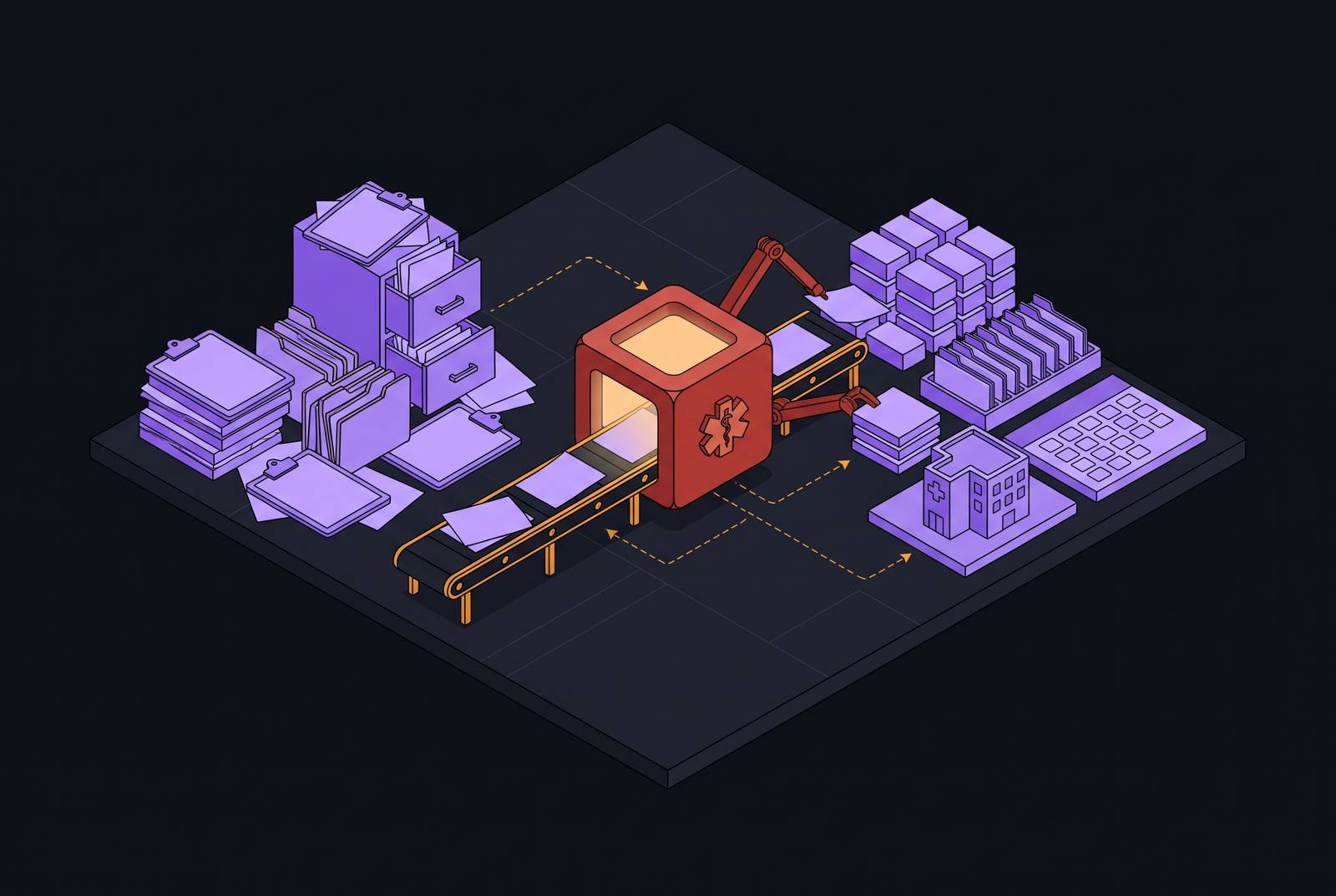
Computer-using AI agents replace manual healthcare administration by reading screens, clicking, typing, and completing workflows across existing EHR systems and payer portals without API integrations.
Why manual admin is still the dominant operational burden in healthcare
Healthcare administrative work involves doing the same steps many times, but rarely in just one system. A staff member reads information in one application, enters it into another, checks the result, and moves the case forward. Scheduling, eligibility checks, prior authorization, and claims all follow this pattern. The individual steps are often straightforward and repeatable. Their volume and the movement between systems consume staff capacity that more hiring alone cannot sustainably provide.
Burnout and turnover compound that pressure in roles dominated by repetitive screen-based work. Each departure makes consistent front- and back-office operations harder to maintain while the incoming workload continues. The constraint is the repeated need for a person to connect systems that do not complete the work together.
Why rules-based automation and point solutions have not solved this problem
Rules-based automation works well when a process follows a stable, predefined path. It can execute a known action when specified conditions match, removing predictable work from a staff member’s queue. But healthcare workflows often stray from that path. A payer portal changes its layout, an authentication challenge appears, or a claim enters an exception state. At those boundaries, fixed rules can stop and return responsibility to a person.
A scheduling bot, coding assistant, or reminders tool can improve its own task without resolving the handoff to the next system. The EHR, payer portal, clearinghouse, and patient communication platform still need coordination. API-dependent tools also encounter inconsistent data formats and uneven standards adoption. Earlier automation’s task-level design leaves staff responsible for a workflow whose complexity extends beyond any one tool.
How can AI agents navigate EHR systems and payer portals without API setup?
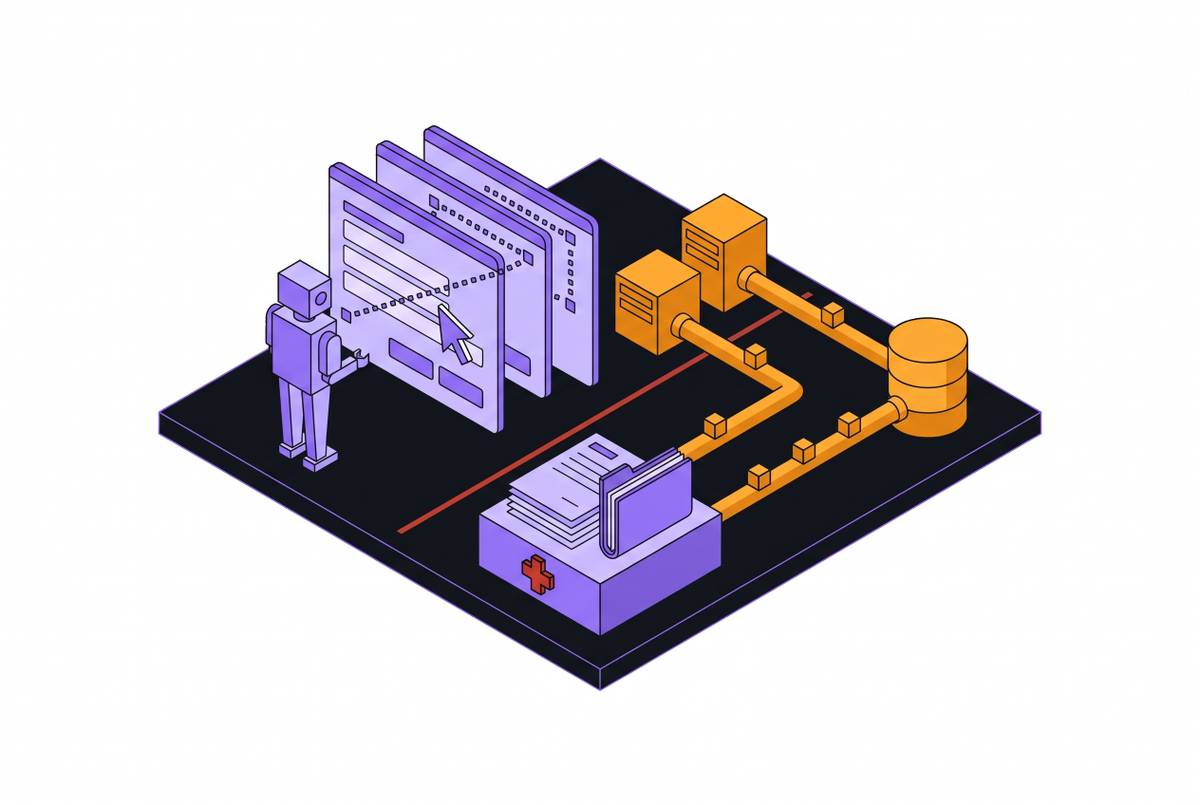
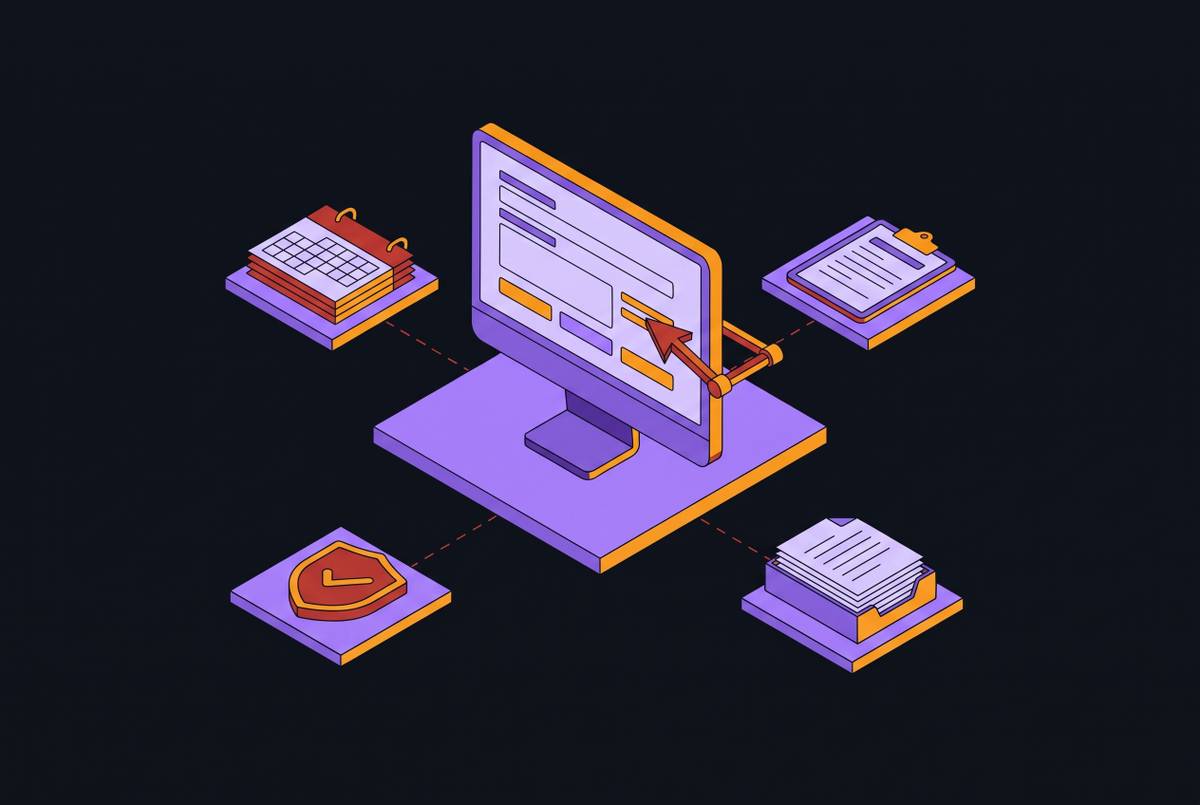
A computer-using agent operates at a virtual desk. It reads the interface, clicks controls, types information, and moves between applications using the screens available to staff. Because it interacts through the user interface rather than the database layer, it does not need an API connection to each system. The existing EHR, portal, and other applications remain in place. Staff do not need to replace those systems for the agent to execute the work.
The distinction from fixed scripts is how the agent selects its next action. Rather than relying only on predetermined screen coordinates, it interprets what appears on screen and reasons about the next step. This lets it adapt to layout changes. Browser-based agents can also handle authentication challenges as part of navigating a portal. Their work proceeds across multiple steps rather than requiring a person to approve every action.
When a case falls outside the agent’s confidence threshold, it escalates through email, Slack, or a task queue with context attached. A person resolves the exception, and the agent continues. Agents learn by observing and replicating existing staff workflows, which supports onboarding measured in weeks.
What end-to-end automation of prior authorization actually looks like
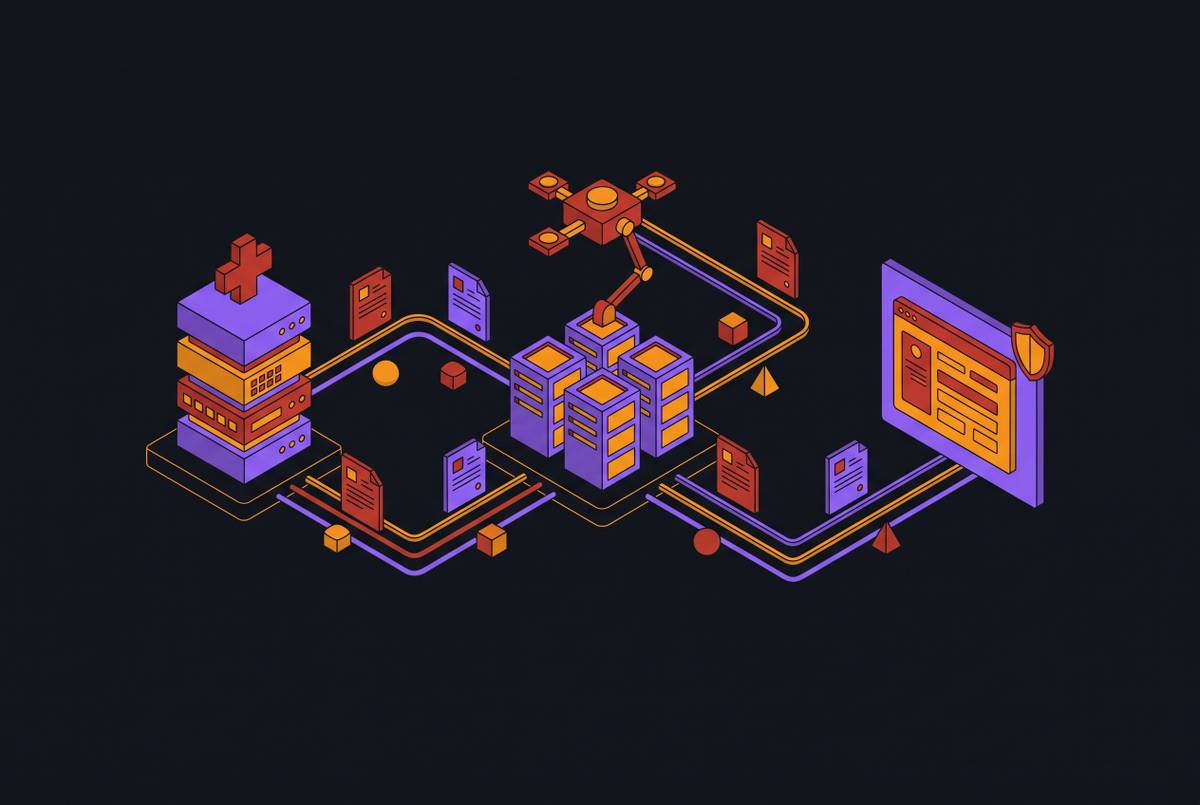
Prior authorization provides the clearest test of that operating model because completion depends on several systems and repeated follow-through. The workflow begins with CPT/ICD codes and clinical notes in the EHR. The agent retrieves the information, navigates the payer portal or electronic prior authorization channel, and submits the request. Submission is not the end of the work. The agent follows up, including by phone when portals are unavailable, and writes the outcome back to the chart.
A tool confined to preparing or submitting a request leaves those later steps with staff. An end-to-end agent connects documentation, submission, status tracking, and the final chart update. Early AI prior authorization deployments show reduced handling time, approval cycles compressed from weeks to hours, and improved first-pass approval rates. These gains address a capacity constraint. When staff do all the work, how much gets done depends on how many people can handle requests and follow up on decisions that have yet to come.
The CMS Interoperability and Prior Authorization Final Rule (CMS-0057-F) adds practical urgency. Its operational provisions generally began January 1, 2026, including a requirement for impacted payers to issue standard decisions within 7 calendar days. By January 2027, payers must implement FHIR-based Prior Authorization APIs. Those APIs offer another way to automate the work. Screen-operating agents address the present workflow without making that future connection a prerequisite for completing requests across existing software.
How agents handle claims and denial management across the revenue cycle
Claims and denials extend the same operating model into time-sensitive revenue recovery. An agent that identifies a denial but stops there leaves staff to assemble documentation, enter the payer portal, submit an appeal, and track the response. Detection alone does not resolve the claim. End-to-end execution connects denial identification to appeal submission and resolution, so a coordinator does not have to manage every transition.
Hospital for Special Surgery illustrates the difference in results. Its appeal success rate rose from 65% to near-total, while the time it took to process each appeal fell sharply. The full-cycle approach connects the appeal to the documentation and timing needed to move it forward.
HFMA’s “Applying AI to Revenue Cycle Management” describes a similar pattern at a Fresno community health network. The network meaningfully reduced prior-authorization denials for commercial plans and non-covered claims while saving substantial staff hours each week without adding revenue cycle headcount. Authorization and claims work are connected, so improvement upstream can reduce work downstream. In these cases, teams stay the same size or staff move to exceptions and appeals that need their judgment.
Scheduling, referral management, and the front-office workflows agents close out
The same gaps appear before the patient encounter. Voice AI may answer an inbound scheduling call, but answering is only one channel into a longer process. An agent can read intake information, identify an open slot, book the appointment, send reminders, and manage the waitlist. When a patient cancels, the agent can rebook the slot from that waitlist without staff managing every step.
Hospital for Special Surgery also deployed an AI scheduling service that matches patients to clinicians using symptoms, location, insurance coverage, and availability. Sensitive or uncertain cases go to human specialists, and staff can intervene at any point. That preserves judgment within an otherwise repeatable workflow. Continuous waitlist management also addresses a time-sensitive constraint, because a canceled slot loses its value if it remains empty when the appointment time passes.
Referral management also needs follow-through across different systems. Instead of leaving staff to coordinate through calls, emails, and manual tracking, agents exchange relevant records, arrange the follow-up appointment, and monitor completion. A referral is not complete when a message is sent. Managing the sequence through the appointment closes the gap between an administrative action and the next patient encounter.
What end-to-end automation requires from the systems and compliance stack
A careful buyer should verify the operating and compliance requirements before deployment. Screen-based operation sidesteps the need for clean API connections because the agent works with what each interface presents. It does not depend on every vendor adopting the same data format. HIPAA compliance and SOC 2 Type II certification are baseline procurement requirements for agents handling PHI.
Verification should cover Business Associate Agreements, encryption in transit and at rest, and audit-grade logging of agent actions and human review decisions. PHI must not reach a third-party model without a BAA in place. Buyers should also guard against vendor training on prompts or outputs and excessive retention of authorization data in logs. A physician must review any clinical justification that AI generates. Automated denial processes need explainability and appeal paths rather than an opaque decision returned without recourse.
Oversight also needs to be built into execution. Validation layers can filter outputs, apply confidence thresholds, and trigger mandatory escalation when a case requires human review. The rule’s API requirements also cover how to keep data secure and be ready for an audit. A deployment therefore needs evidence of controlled operation.
What happens to staff when agents absorb the repeatable work
Agents absorb repeated screen work and volume growth, while staff move toward exception review, appeals, relationship management, and tasks requiring judgment. A fixed-size team can process more work. For practices unable to justify additional headcount, the financial case can therefore rest on absorbing growth.
People review agent outputs, manage escalations, and refine workflows as operational needs change. The work becomes less about moving information between screens and more about governing the process. One organization’s lesson is relevant here, namely that the process needs fixing before an agent is added. Automation changes who performs repeatable work, but it does not remove the need to define that work coherently.
How to decide which workflow to automate first and what good deployment looks like
Administrators should start with work that comes in large amounts, needs little judgment, and has a clear outcome. Appointment reminders and waitlist management or insurance eligibility verification often fit those conditions. Both involve repeatable work across systems without extensive exception handling. The most painful workflow is not automatically the best first deployment. A process with clear limits and an end result that can be measured makes it easier to judge how well it works.
Agree on the workflow’s KPIs before deployment begins. Measures can include appeals success rate, first-pass approval rate, slots filled from the waitlist, and staff hours recovered per month. The measure must match the work being delegated. Even with a promise of ROI for every use, there must be evidence that the chosen process works better. Automating one workflow, measuring its result, and then expanding avoids the stalled implementation that can follow an attempt to automate everything at once.
Process repair should precede replication, while the software environment can remain intact. Agents can learn existing staff actions without requiring a wholesale change in how the practice works, but an inconsistent sequence still needs resolution before it is scaled. Multi-location groups should standardize the underlying workflow before extending an agent across the portfolio. A well-designed first deployment then becomes a repeatable operating model rather than a separate implementation effort at every location.
Why the end-to-end approach produces results that task-level tools cannot replicate
Task-level tools optimize a bounded action, while end-to-end agents take responsibility for the sequence needed to reach a completed outcome. That changes where human attention is required. Staff step in when a case is uncertain or needs their judgment, freeing them from the routine work of linking applications.
The organization does not have to wait for every application to share data cleanly before connecting the workflow. Its remaining deployment challenge is choosing and defining the process that deserves that responsibility first. The question for a practice administrator is therefore not which task to automate, but which workflow to close end to end first.