Computer-Using AI Agents vs API Integrations for Healthcare Admin Automation
Screen-reading AI agents handle healthcare admin tasks APIs cannot reach.
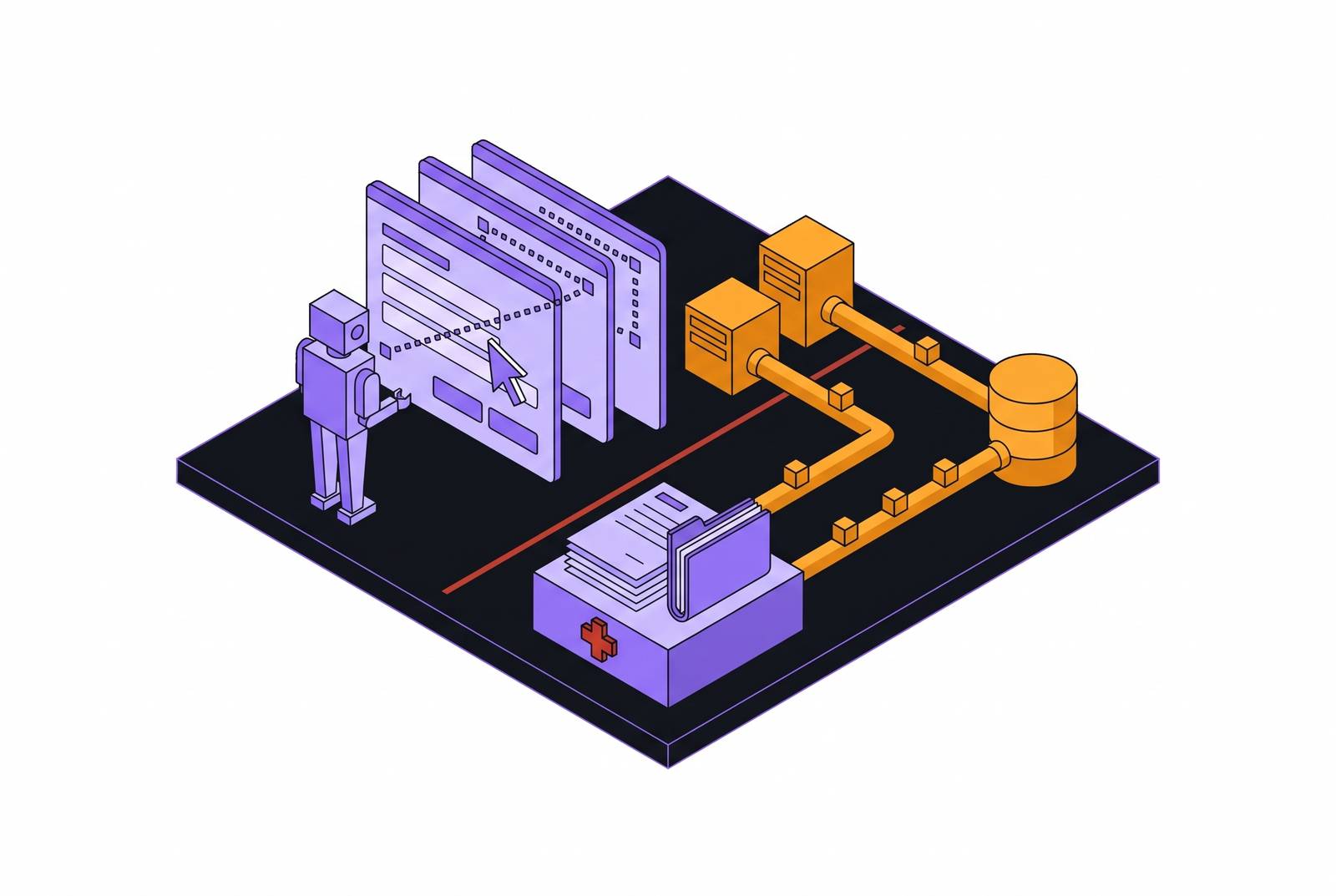
Computer-using AI agents can automate healthcare administrative workflows without API integrations by reading screens and operating EHRs, payer portals, and other software through their existing interfaces. API integrations remain the better fit for structured transactions where reliable endpoints exist. The strongest architecture uses both, with agents handling interface-only steps and people reviewing exceptions, because screen access alone does not prove that end-to-end automation will work reliably.
Why most healthcare admin workflows cannot be automated with APIs alone
A staff member completing a single prior authorization may have to log into four different portals. Each login reaches another part of the same job, but those systems were not designed to work together. Payer portals, fax platforms, legacy clearinghouses, and third-party scheduling tools often lack the developer access needed for a programmatic connection. An API-first workflow stops when the next system exposes no endpoint.
Standards address only part of this landscape. The 21st Century Cures Act’s FHIR mandates apply to EHR vendors, with clearinghouses and third-party tools outside their scope, while payers face parallel requirements under the CMS Interoperability and Patient Access Rule. Even available endpoints can differ in practice. Two systems that claim FHIR support may map the same clinical concept to different resources, so machine-to-machine transactions can fail without anyone knowing.
What are computer-using agents, and how do they differ from APIs, RPA, and voice AI?
Computer-using agents, or CUAs, are LLM-based agents that perceive and operate graphical interfaces. They read screens, reason about what they see, plan an action, click or type, and check the result before continuing. Their access path is the user interface. API integrations instead exchange structured data directly between systems and require an exposed, conformant endpoint. That makes APIs fast and auditable where a suitable connection exists, but unavailable where it does not.
Rules-based robotic process automation also operates screens, but it follows a fixed script. A changed portal layout can break that script because it lacks an understanding of the screen. CUAs can reason about interface variation, enabling them to address interfaces that scripted automation struggles to navigate. Voice AI handles inbound calls and conversations with patients rather than using back-office portals, handling documents, or moving data between systems.
HealthAdminBench distinguishes computer-use agents, which interact with software interfaces, from API-dependent agents, which use structured endpoints. That makes them applicable where a human can log in, without requiring an API. A single agent can handle a specific task, while orchestrated networks of agents pursue multi-step goals across systems. Most administrative workflows require this broader coordination.
How reliable current computer-using agents actually are on end-to-end healthcare admin tasks
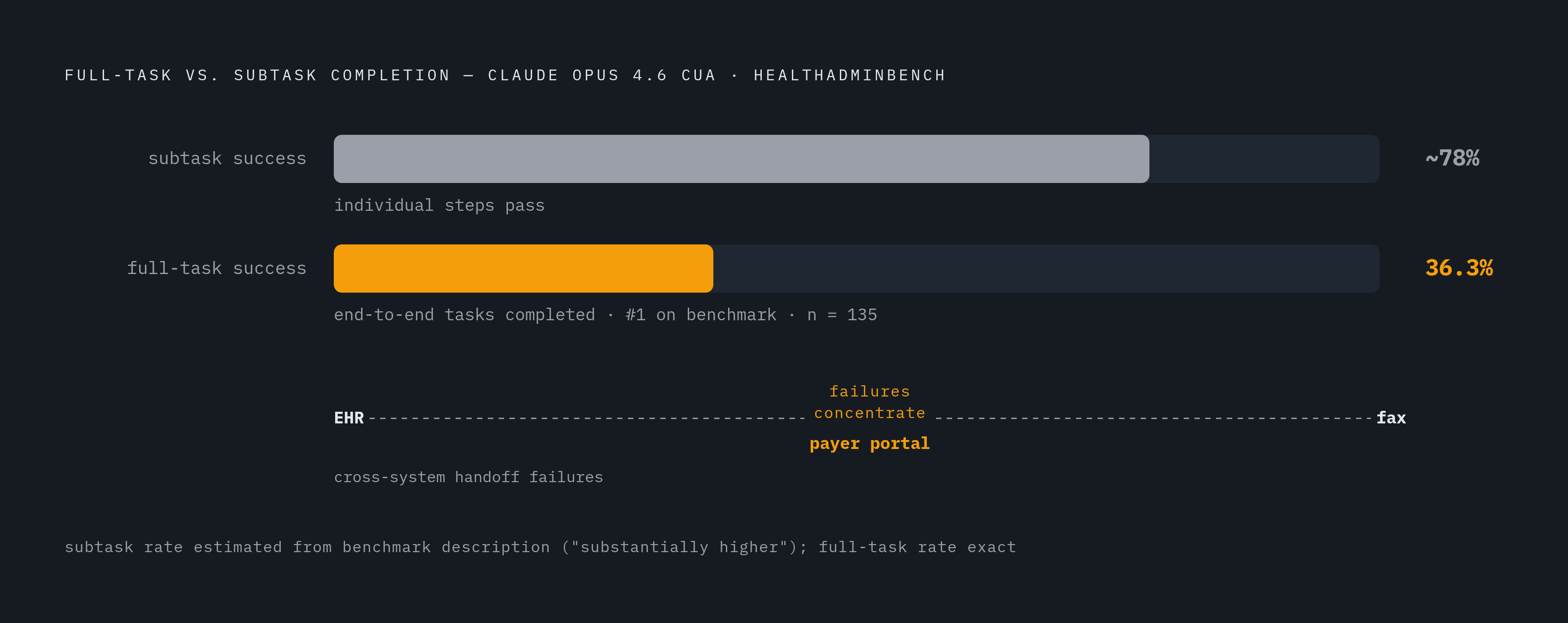
HealthAdminBench is the first benchmark built specifically to evaluate LLM-based computer-use agents on healthcare administrative workflows. It includes 135 expert-designed tasks across four realistic GUI environments, namely an EHR, two payer portals, and a fax system. The task types are Prior Authorization, Appeals and Denials Management, and Durable Medical Equipment order processing. Each task is decomposed into verifiable subtasks. This design separates success on individual actions from completion of the full administrative job.
Claude Opus 4.6 CUA had the best full-task success rate in the benchmark at 36.3%. Subtask success rates are substantially higher. Errors in handling documents and moving data between systems cause key end-to-end failures, especially when information must move between the EHR, payer portal, and fax system in that order. Those results describe benchmark performance, with a production completion rate for a governed workflow still to be demonstrated.
Dependable workflow completion from useful subtask performance depends on human-in-the-loop review, error detection, and workflow checkpointing. Partial automation can still save staff many hours when it handles routine subtasks and flags exceptions for review. A vendor must show both what its agent completes and where staff must intervene.
Where each architecture wins: mapping API integrations and CUAs to the actual revenue cycle
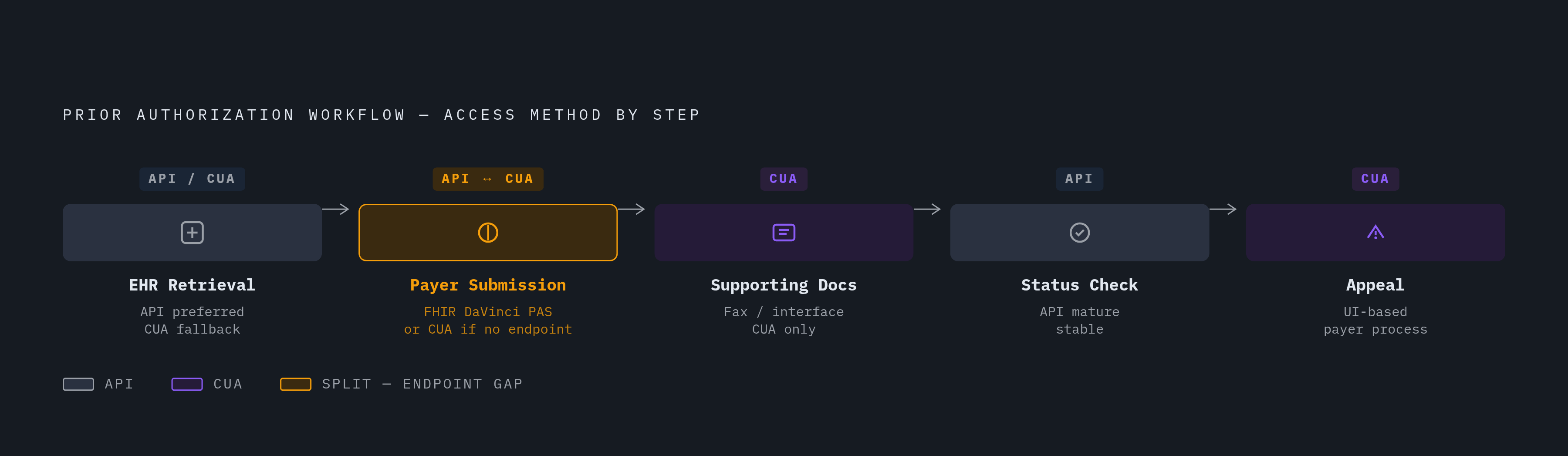
A prior authorization illustrates why the architecture must follow the workflow. Information retrieval from the EHR can use an available, conformant API, while a CUA can operate the EHR interface when that route is unavailable. Submission then depends on the payer. A FHIR DaVinci PAS API or an electronic submission system that supports the request can accept it without anyone having to navigate a portal. Where no endpoint exists, the CUA operates the payer portal instead.
The choice also depends on the connections available when the workflow reaches supporting documentation and fax confirmation. If the fax system exposes only an interface, a screen-operating agent handles that step rather than leaving it outside the automated workflow. Status checking follows the available connection path.
Elsewhere in the revenue cycle, eligibility and benefits verification are well suited to APIs because the transactions are structured and standardized, where payer connectivity exists. Claims status polling is another mature, stable API use case. Changes in the interface pose less risk to these transactions. Appeals, denials management, DME order processing, and fax-based documentation more often involve systems without APIs. The hybrid architecture uses structured connections for these established transactions and CUAs for the interface-only work between them.
Prior authorization as the clearest case where CUAs fill a gap APIs cannot close
Prior authorization exposes the practical cost of missing payer connectivity. A practice may have the clinical information needed to submit a request but still need someone to enter it into a portal. HealthAdminBench includes simulated payer authorization portals for this reason. An API-dependent agent needs a submission endpoint from the payer to finish that step. A CUA can use the same submission interface available to staff.
The CMS Interoperability and Prior Authorization Final Rule requires electronic prior authorization APIs for covered payers starting in plan year 2027. That deadline does not create universal connectivity. The mandate covers certain payers and plan types, and it does not reach every tool involved in supporting documentation or follow-up. Waiting for mandated APIs therefore leaves current portal-based work manual without resolving every future interface gap.
A well-designed agent layer can submit through an API where one exists and through the portal where it does not. Staff need not choose the access method. The same principle applies when a denial moves the work into an appeal, because payer appeal processes often remain UI-based. Prior authorization is therefore not simply a submission problem. Its automation must extend to the connected steps needed to bring the request to a resolution.
The compliance surface that screen-operating agents introduce — and what it requires
Screen-operating agents create a PHI data path that needs clear rules and oversight. They send screenshots to a model, and EHR or payer portal screenshots can contain protected health information. The model endpoint therefore enters the compliance scope. A business associate agreement must cover that endpoint, and governance must extend to intermediate storage and the rest of the inference pipeline. API integrations also fall under HIPAA, but their structured data paths are typically more bounded and easier to audit.
For procurement, the requirements are concrete. Practices should require BAAs covering vendors throughout the PHI data path, encryption of PHI in transit and at inference, role-based access controls, and audit logging of PHI access events at the subtask level. Minimum necessary access applies to agents as it does to other systems using PHI. SOC 2 Type II certification should be a baseline procurement requirement alongside verification of the actual safeguards.
The 2025 HIPAA Security Rule proposed amendments are not finalized, with final action delayed to July 2027. If finalized as proposed, they would require validated cryptographic encryption across PHI data paths, including temporary storage and inference pipelines. They also propose holding business associates more accountable, including a requirement to verify technical safeguards in writing each year. Covered entities are ultimately liable for compliance and must check more than a vendor’s self-attestation.
Why end-to-end workflow automation across every system produces more value than automating isolated tasks
Automating prior authorization submission leaves substantial work untouched if staff still retrieve documents, track status, and file an appeal after a denial. The submission may be faster, but a person still coordinates the process. System boundaries become recurring manual handoffs. The same limitation applies in reverse when status polling is automated but the actions prompted by a status change remain manual.
End-to-end coverage means handling EHR retrieval, portal submission, fax-based documentation, status checking, and an appeal if needed. API calls can handle the steps with connections, while CUAs work through systems that have only an interface. Human review remains available for exceptions. The objective is not to remove oversight, but to avoid requiring staff involvement at every boundary in otherwise routine cases.
The benchmark’s cross-system transfer failures show why this value is difficult to realize. The handoffs with the greatest potential to reduce staff work are also steps where agents can lose end-to-end reliability. An API-only design leaves gaps wherever connectivity ends, while an ungoverned screen-operating agent may reach those systems without reliably completing the work. The economic case rests on verified completion across the sequence.
What fast, low-disruption deployment of computer-using agents actually looks like in practice
CUAs operate existing interfaces rather than requiring a practice to replace its systems. They can use the access available to staff without a payer API partnership, an EHR integration agreement, or a new middleware layer. This removes an external deployment dependency. It also allows CUA-based automation to go live in weeks rather than the months that API integration projects typically require, because interface navigation happens at runtime rather than through connections engineered in advance.
That advantage does not eliminate deployment work. Credentials establish access, while the PHI safeguards, review paths, and completion criteria establish whether that access is ready for operational use. Staff can keep using the systems they know without having to learn a replacement tool. This reduces adoption friction, which can stall automation regardless of the underlying architecture. A low-disruption deployment changes who does the routine steps without making the practice change its whole workflow.
For an initial deployment, practices should select high-volume workflows with clear, verifiable completion criteria. Repetition creates the opportunity to return staff hours, and explicit criteria make success measurable from the start. Workflow-specific KPIs should be agreed before deployment. Prior authorization submission rate, denial appeal turnaround, and slot fill rate each measure a different limit on the practice’s work. A universal ROI promise cannot replace measures tied to the practice’s actual bottleneck.
How to evaluate a computer-using agent vendor against the criteria this architecture actually demands
Can the agent handle EHR retrieval, payer portal submission, fax documentation, status checks, and appeals, or does each system boundary trigger a manual handoff? Where does it use APIs, and where does it operate screens? The vendor’s answer should identify the limits of coverage rather than treating access to an application as evidence that the work is complete.
The next questions concern PHI and demonstrated reliability. Do BAAs cover the model endpoint and all intermediate storage? Is encryption validated throughout the inference pipeline, with role-based access and subtask-level audit logs? What is the end-to-end success rate on the specific workflow being purchased, and how are exceptions detected and routed for human review? Subtask accuracy alone is insufficient evidence. The benchmark’s best full-task result of 36.3% shows how much vendors need to improve through the way they design a deployment.
Deployment questions should expose hidden dependencies. Does go-live require API partnerships, EHR reconfiguration, or new staff systems, and will the vendor agree to workflow-specific success metrics before work begins? Finally, can the same architecture expand from a single-location practice to a multi-location group or PE/MSO portfolio without a separate integration project at each site? That is the scalability test for automation intended to follow the workflow wherever it runs.