Human-in-the-Loop Escalation Triggers for Clinical Agents
Escalation must stop irreversible actions before execution, not after they fail.

Operational agents now execute multi-step healthcare workflows, scheduling appointments, submitting prior authorizations, and filing claims appeals across EHR interfaces and payer portals without a human reviewing every step. The escalation question they raise is not whether to add oversight, but where the handoff points must sit so that consequential errors stop before they become irreversible. That placement is a design problem, not a safety slogan.
Traditional automation fails in ways a team can anticipate. RPA breaks predictably when a field moves. Rule-based systems halt cleanly on an unrecognized input. A computer-use agent does neither. The failure is not a crash, it is a wrong answer delivered with the same polish as a right one. That difference changes what escalation has to do. It is no longer a recovery mechanism for broken processes. It is the enforcement layer that stops an irreversible action before it executes.
The compounding problem is worse than a single bad step. LLMs trained with reinforcement learning from human feedback are systematically miscalibrated, so a claimed 90% confidence per step can correspond to real-world accuracy in the 70 to 85 percent range. In healthcare operations, a prior authorization submission or a claim denial appeal is not a three-step chain where one wrong step is easy to catch. It is an external action with regulatory timing attached, often irreversible once sent. Escalation must sit before the fact, at the points where error becomes expensive.
What makes an agent action a genuine escalation candidate in healthcare workflows
Confidence score alone is an unreliable escalation signal. The agents most likely to be confidently wrong are the ones handling high-stakes, atypical inputs, which are precisely the cases where autonomous action is most dangerous. A threshold on reported confidence therefore misses the failures that matter.
Four dimensions actually determine whether an action warrants human review. Irreversibility asks whether the action can be undone if it is wrong. Submitting a prior authorization request to a payer portal is external and often irreversible. Reading an eligibility status is not. Blast radius asks how many records or patients the action affects. A bulk scheduling change across a provider's panel is categorically different from rescheduling a single appointment. Compliance exposure asks whether the action creates a legal or regulatory obligation. Actions touching PHI transmission, prior authorization decisions, or claim submissions carry exposure that many organizations must have a human own explicitly. Confidence calibration asks whether the agent's score has been validated against its own error-cost data, not assumed from vendor claims. One that has not been validated is noise.
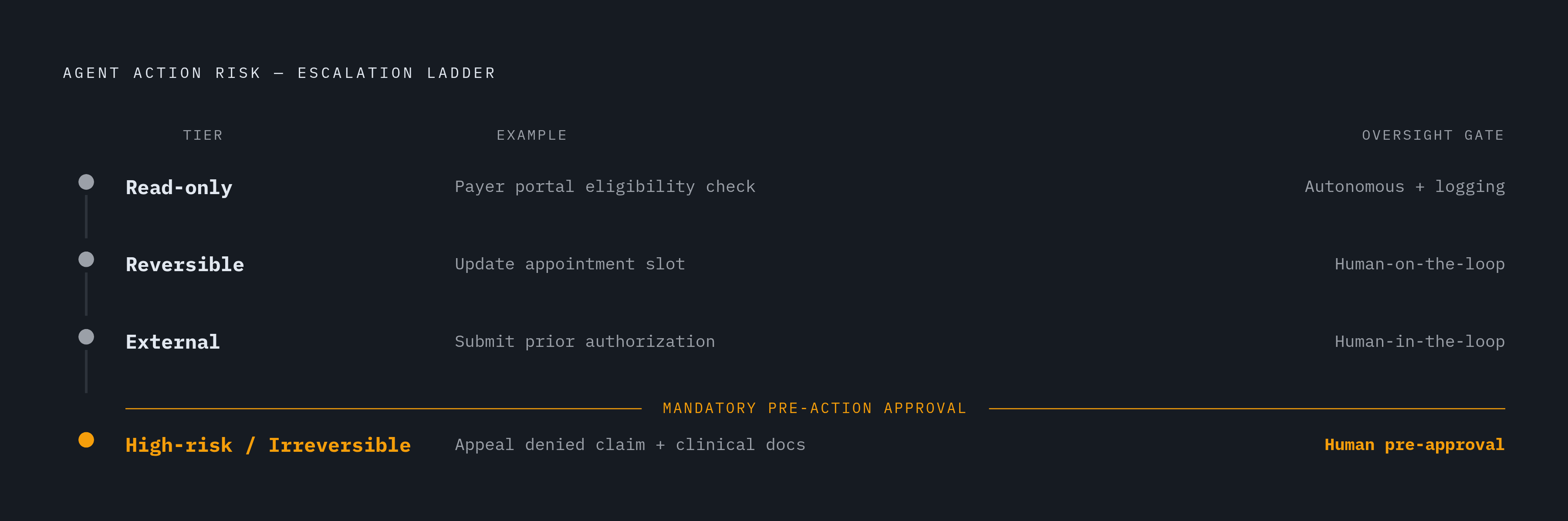
These dimensions map cleanly onto the four-tier action-risk model used in production: read-only, reversible, external, and high-risk or irreversible. Reading a payer portal for eligibility is read-only. Updating an appointment slot is reversible. Submitting a prior authorization is external. Appealing a denied claim with clinical documentation attached is high-risk and irreversible. The tier determines the gate, not the agent's self-reported confidence.
The specific escalation triggers that apply to prior authorization and claims workflows
Prior authorization and claims appeals carry the highest cost of autonomous error in healthcare operations. A poorly constructed appeal can close the denial permanently. The escalation design in these workflows must therefore discriminate between steps the agent handles reliably and steps where an error forecloses the outcome entirely.
Several steps in the prior authorization flow are now appropriate for full autonomy based on current production deployments. Need detection from the EHR, identifying that a procedure requires authorization, is high-accuracy and needs no gate. Programmatic submission to payers where API or portal support exists is appropriate for autonomy with logging. Decision capture, recording the payer's response, is high-accuracy and autonomous.
The escalation triggers sit elsewhere, on the actions agents should not take without human approval. Any submission where the agent's constructed documentation materially conflicts with the clinical record requires the agent to flag the discrepancy rather than resolve it autonomously. Cases where the payer response triggers a next action that was not anticipated in the workflow design call for the agent to surface the exception rather than improvise.
Regulatory timing turns escalation design into a speed problem. Under CMS-0057-F, effective January 1, 2026, impacted payers must decide standard prior authorization requests within seven calendar days and expedited requests within 72 hours. The escalation loop must clear faster than the regulatory clock, which means the queue cannot be an afterthought appended to the agent.
Escalation triggers in scheduling and referral workflows, where clinical complexity is the signal
Scheduling and referral agents handle high-volume, low-complexity actions autonomously and should continue to. The escalation signal in these workflows is not confidence score or regulatory timing. It is clinical complexity.
The distinction matters because the action looks the same from the agent's perspective. The agent has read the referral status and can see the open slot. But the decision about whether the referral is clinically appropriate is not a navigation task. An agent that encounters a referral question requiring clinical disposition must hand off with a summary, not resolve it.
A second trigger applies when outreach fails. The cost of missing a clinically urgent rebook exceeds the cost of a human callback. Here the signal is not what the agent knows but what it cannot responsibly conclude.
Why emotional escalations are harder to govern than technical ones, and what the Alibaba field data shows
Most escalation design focuses on when to hand off. The harder and less-addressed problem is whether the human who receives the escalation actually performs as expected once the handoff occurs. A randomized field experiment on Alibaba's Taobao platform, involving 647 customer service workers and more than 680,000 service chats in August 2024, provides the strongest evidence on this question. The study found that human intervention preserves service quality in algorithm-triggered technical escalations, cases where the agent hit a task it could not resolve, but is meaningfully less effective in algorithm-triggered emotional escalations, where the customer expressed frustration or dissatisfaction.
The mechanism the study identifies is engagement. The study also found that early intervention timing matters substantially. Reviewers who engaged quickly after the handoff performed better than those who engaged late, regardless of escalation type.
The application to healthcare operations is an inference, not a claim the study makes directly. It requires a prepared, attentive human, not merely an available one. Escalation queues that mix technical and emotional handoffs without distinguishing them will see inconsistent human performance, because the cognitive and emotional demands on the reviewer are different.
How to build the escalation architecture so the handoff doesn't break the workflow
The design failure most teams make is treating escalation as a synchronous confirmation prompt. The correct default is async-first: durable, state-managed interruption with idempotency keys preserves the agent's position in the workflow across an arbitrary review delay. The human reviewer can take minutes or hours to respond without breaking the workflow, which is how real clinical staffing works, and the agent resumes execution cleanly rather than restarting.
Four governance design patterns cover different oversight needs, drawn from Dataiku's agent governance framework. Interrupt and resume has the agent pause at a predefined point, surface its proposed action and the reasoning behind it, and wait for approval, modification, or rejection. Human as a tool treats the human as one of the agent's available tools, called when the agent encounters ambiguity or a task outside its confidence threshold, with the response incorporated before the agent continues. Approval flows route structured decisions to a qualified reviewer with documented decision records, creating the audit trail regulatory frameworks require. Fallback escalation has the agent complete what it can and hand off the remainder with a context package, used when the agent reaches the boundary of its authorized scope rather than a predefined checkpoint.
The context package at handoff must contain more than the proposed action. A rubber-stamp review is worse than no review. It creates false audit confidence while adding latency. Five governance elements define a functioning escalation architecture: policies specifying which decisions require human approval; approval workflows routing to qualified reviewers; immutable logging of every approval and override; role segregation ensuring the agent builder is not the production approver; and defined escalation paths for edge cases outside both the agent's scope and the standard approval flow.
The compliance layer that escalation architecture must satisfy in 2026
Any agent that processes, stores, or transmits PHI in the course of executing an escalation, whether passing a patient record to a human reviewer, logging the approval decision, or resuming after a checkpoint, must meet HIPAA's Privacy, Security, and Breach Notification Rules. There is no AI exemption. Standard BAA language is insufficient for agentic deployments. Organizations must address data training opt-out, model retention policies, and subcontractor AI usage in AI-specific BAA clauses, because the escalation handoff introduces a new data-sharing event that a generic BAA may not cover.
State AI laws now layer on top of HIPAA. Texas TRAIGA, Colorado's AI Act, and California's AB 489 impose healthcare-specific disclosure requirements, and in the case of Colorado's AI Act and California's AB 489, broader governance requirements. Colorado's AI Act takes effect January 1, 2027, not 2026, but the disclosure requirements under these statutes begin applying in 2026, meaning the compliance surface for a multi-state practice or health system is wider than HIPAA alone. The EU AI Act Article 14 requires that high-risk AI systems be designed so people can effectively oversee them while in use. Standalone high-risk systems under Annex III move to December 2, 2027, and AI embedded in regulated products under Annex I move to August 2, 2028. For organizations operating in scope, interrupt-and-resume and approval-flow patterns are not optional design choices. They are demonstrable compliance requirements.
The gap between requirement and practice is wide. Dataiku's governance analysis notes that only a small fraction of organizations report AI output as traceable at all times. Most organizations cannot produce the audit trail a regulator would require if an escalation decision were challenged. Clinicians remain legally liable for over-relying on AI outputs. Human judgment must remain in the loop at every clinical decision point, so the escalation architecture must give the reviewer enough context and authority to exercise genuine judgment, not just to click approve.
How to calibrate the escalation boundary so the automation benefit survives
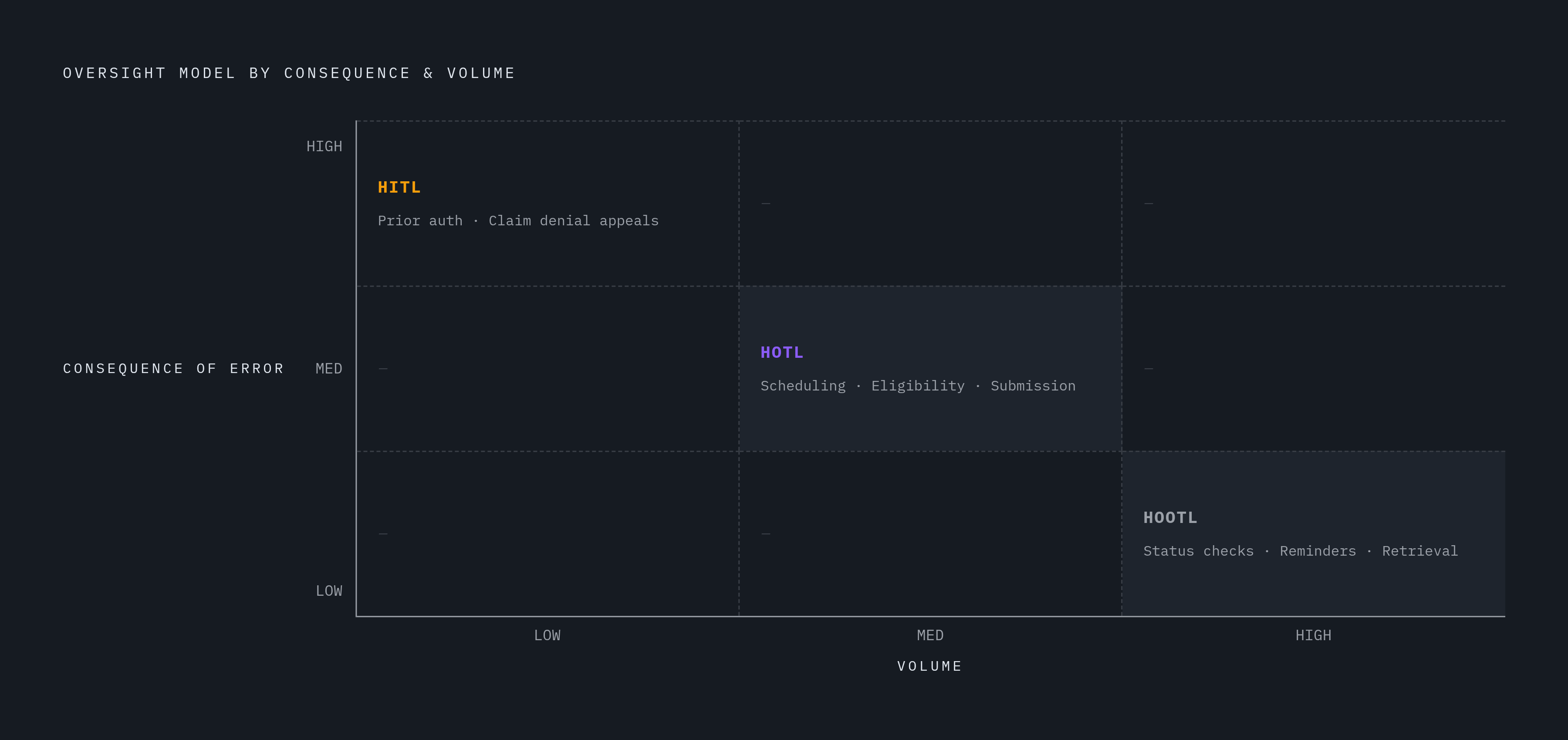
The failure mode on the other side of under-escalation is over-escalation. Requiring human approval for every action produces a queue that is slower than the manual process it replaced. Reviewer fatigue in high-volume queues can degrade decision quality to the point where the oversight provides no protection. Parloa's HITL implementation framework identifies three distinct oversight models, human-in-the-loop, human-on-the-loop, and human-out-of-the-loop, that a single deployment should apply simultaneously across different action types rather than choosing one model for the whole workflow.
Calibration means matching oversight intensity to the consequence of error in a specific action type. Full human-in-the-loop with pre-action approval belongs on high-stakes, low-frequency actions: prior authorization submissions on complex cases, claim denial appeals with clinical documentation, any action that creates an external obligation. Human-on-the-loop with monitoring and exception alerts fits medium-complexity, high-volume actions like appointment scheduling, eligibility verification, and standard submission building, where the agent operates autonomously within guardrails and an alert fires on threshold breach. Human-out-of-the-loop with post-operative audit covers low-risk, well-bounded actions like status checks, reminder outreach, and read-only data retrieval, with periodic pattern review to flag retraining needs.
The ROI metric for escalation design is not the escalation rate itself. It is whether the escalation architecture preserves the automation benefit on the actions that remain autonomous while containing cost on the actions that do not. Computer-use agents that operate across EHRs, payer portals, and scheduling systems without requiring API integrations make this calibration more tractable than traditional automation. The same agent that submits autonomously can pause at a defined point and surface a context package to a human reviewer within the same workflow, without a separate system or integration layer.
The practical starting point for any deployment is mapping every action in the target workflow to the four-tier risk model before the agent goes live, defining the escalation trigger and the reviewer's authority for each tier, and instrumenting the queue so reviewer latency is visible. A slow escalation loop on a time-sensitive workflow, such as a 72-hour expedited authorization, is itself a compliance and revenue risk. The goal is not maximum oversight. It is precise placement of handoff points, so that the automation benefit survives on the actions where error is cheap, and the human owns the actions where error is not.