Task Integrity Under Payer Portal Timeouts and Errors
Preserving task integrity requires per-step state checkpoints, not just error recovery.
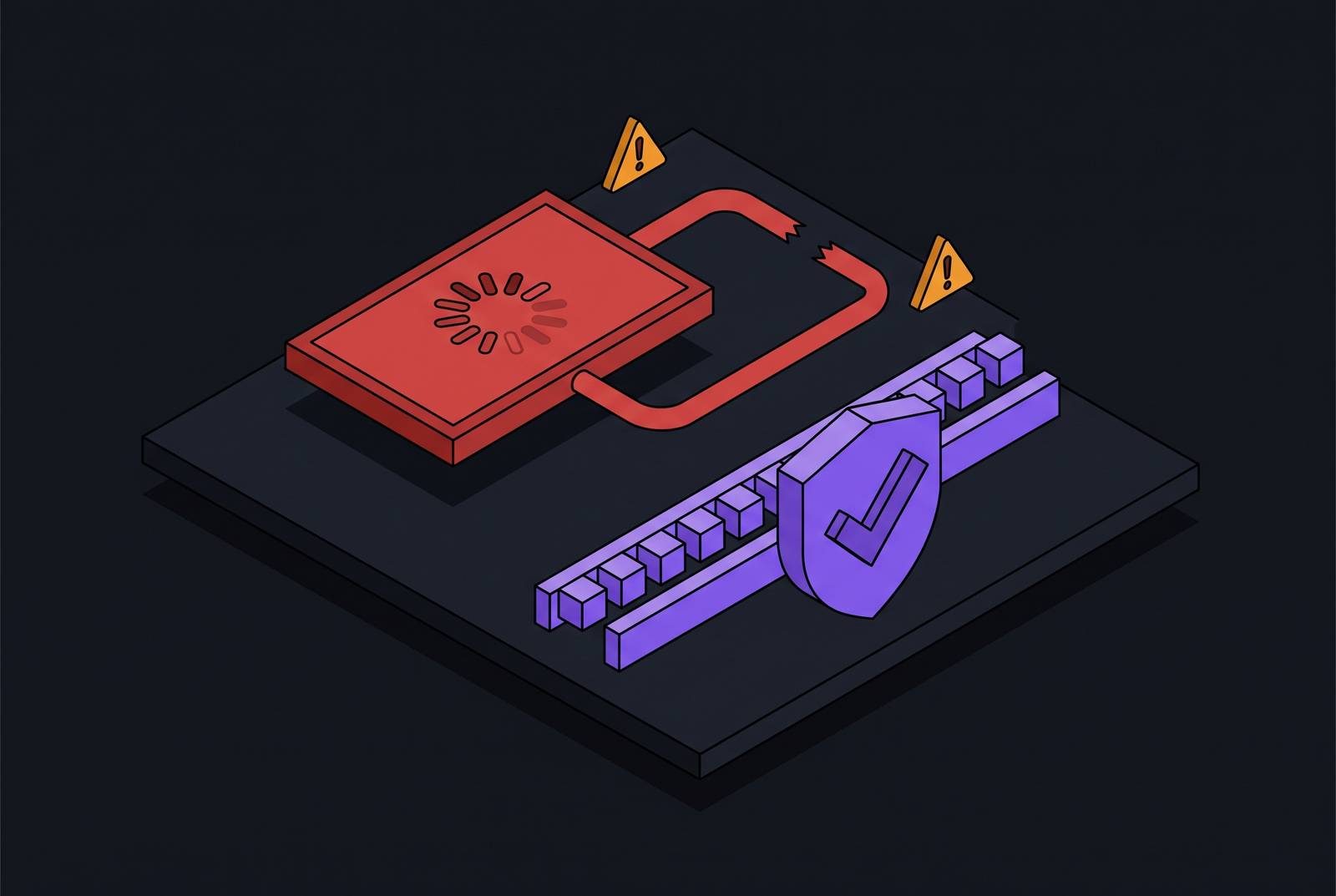
Payer portal instability is a structural property of the environment, not an intermittent disruption. Any automation layer designed around the assumption that portals will behave predictably will fail most of the time, because the environment itself is fragmented in ways that guarantee routine failure. The question is not whether a session will end unexpectedly, but how the system responds when it does.
Each payer maintains a separate portal with its own login credentials, navigation patterns, session timeout rules, and form structures. There is no unified interface and no standard workflow across payers, which means every task that spans multiple payers must accommodate multiple incompatible interaction models. Within a single payer, behavior is also inconsistent: status terminology varies between screens, session timeouts are aggressive and non-negotiable, credential resets interrupt work mid-task, and interstitial modals appear without notice. Revenue cycle teams in enterprise health systems navigate dozens of different portals for tasks that individual payers still handle inconsistently, including secondary claim status checks, appeals submissions, and prior authorization status tracking. A single claim denial may require multiple portal interactions before resolution, and each one is a fresh exposure to the environment's failure modes.
The volume-times-fragility calculation makes the consequence unavoidable. When staff or agents must touch many portals at high volume, even a low per-session failure rate produces a large absolute number of dropped or stalled tasks every day. A two percent failure rate across five hundred daily portal sessions is ten broken tasks, and each one requires someone to notice, investigate, and recover. That is the normal operating condition for any system that depends on payer portals.
What actually breaks when a portal session times out mid-task
A timeout or portal error mid-task does not simply pause work. It severs the execution state, leaving the task in an indeterminate condition that is neither completed nor cleanly recoverable without deliberate architectural handling. The phrase "task integrity" names something specific: the property that a task can resume from a known state without duplication, loss, or silent abandonment. When a session ends mid-workflow, that property is exactly what disappears.
The failure modes specific to computer-use in portal environments are concrete and enumerable. A session can end in a signed-out state. Buttons can be hidden due to permission state. An agent can target the wrong tab because of a similar name, enter text in the wrong field, or click a control before it is ready. Unsaved edits can remain on a stale page. A double submission can occur when a retry is issued after an unconfirmed first attempt. An agent can resume from an unknown screen after a failed recovery attempt. Each of these produces a different kind of incomplete state, and none of them announces itself.
Some tasks are silently abandoned, which means the work was never completed and no one knows. Some are partially submitted with unknown payer-side status, which means the system of record and the payer's system now disagree. Some are duplicated, which means the payer may process the same request twice and potentially generate a denial where a clean single submission would have succeeded. These outcomes are worse than a clean failure because they are invisible to the staff who must reconcile them. The downstream consequences are not technical inconveniences: delayed or ambiguous authorization status creates scheduling gaps, services rendered before authorization is confirmed generate denials, and a rescheduled patient requires a new eligibility check because coverage may have changed in the interval. The failure mechanism is specific, and its operational cost compounds with every hour the indeterminate state persists.
Why traditional RPA has no architectural answer to this failure surface
Script-based robotic process automation was built for stable, predictable interfaces. Payer portals are neither. The result is that RPA's failure rate under real portal conditions is a structural property of the technology, not a fixable configuration issue. The limitation is architectural: a script can only replay what its author has seen and recorded, and payer portals change faster than scripts can be updated.
Authentication is where traditional RPA reaches its hardest limit. Static credential storage works until portals rotate session tokens, introduce multi-factor prompts, or add interstitial modals that did not exist during script recording. Scripts built to replay a clean login path have no mechanism for handling what they have not seen. Payer portals require vaulted portal login, meaning a user's own username, password, and MFA credentials stored encrypted and injected at call time. That authentication model is incompatible with script-based RPA, which cannot satisfy it without manual intervention each time the session breaks. And each portal break in an RPA environment requires a manual recovery cycle: triage the failed job, re-inspect the page, update the script repository, re-validate the workflow, redeploy. The cycle repeats with every payer UI change.
The consequence is that RPA in a multi-portal environment does not reduce staff workload so much as relocate it. The work moves from executing portal tasks to monitoring failed scripts and rebuilding broken automations. The staff member who previously spent their day entering data into portals now spends it diagnosing why a script stopped at step three of a twelve-step workflow. The automation layer has not eliminated the fragility of the portal environment. It has added a maintenance burden on top of it.
What task integrity requires from an agent architecture in a timeout-prone environment
Preserving task integrity under portal failure requires the agent architecture to treat session interruption as an expected operating condition, not an exceptional one. That means the system must maintain recoverable execution state at every step, not only at task boundaries. A workflow that lacks per-step state persistence will lose all progress when a session is interrupted at step four of twelve. A workflow that checkpoints state at each discrete action can resume from the last confirmed position rather than from the beginning. The difference is not a matter of degree. It is the difference between a system that can recover and one that cannot.
A prior authorization agent's operational workflow illustrates the complexity of the state problem. The agent must detect the order, check authorization requirements, gather documentation across multiple chart sources, draft the submission, track status through API responses or portal checks, and write the authorization number back to the order. Each step is a discrete action that, if interrupted, must be recoverable without duplicating payer-side submissions. Recovering from an unknown screen state, where the agent cannot confirm whether a prior submission was received by the payer, is the hardest case. The system must distinguish between "task not submitted" and "task submitted but unconfirmed," because the remediation actions differ, and a duplicate submission can itself generate a denial. That distinction is not a feature request. It is a requirement for any system that operates in an environment where the answer to "did it go through?" is frequently unknowable at the moment of failure. is frequently unknowable at the moment of failure.
Authentication recovery must be built into the agent loop, not handled outside it. When a portal session expires mid-task, the agent must re-authenticate using vaulted credentials and return to the correct task position without human intervention. If a human must intervene to refresh credentials, the automation has not solved the timeout problem. It has outsourced it back to the staff whose workload the system was meant to reduce. The agent must be able to walk the same recovery path a trained staff member would: recognize the session is dead, log back in, find where the work left off, and continue.
How benchmarking reveals the gap between subtask success and end-to-end task completion
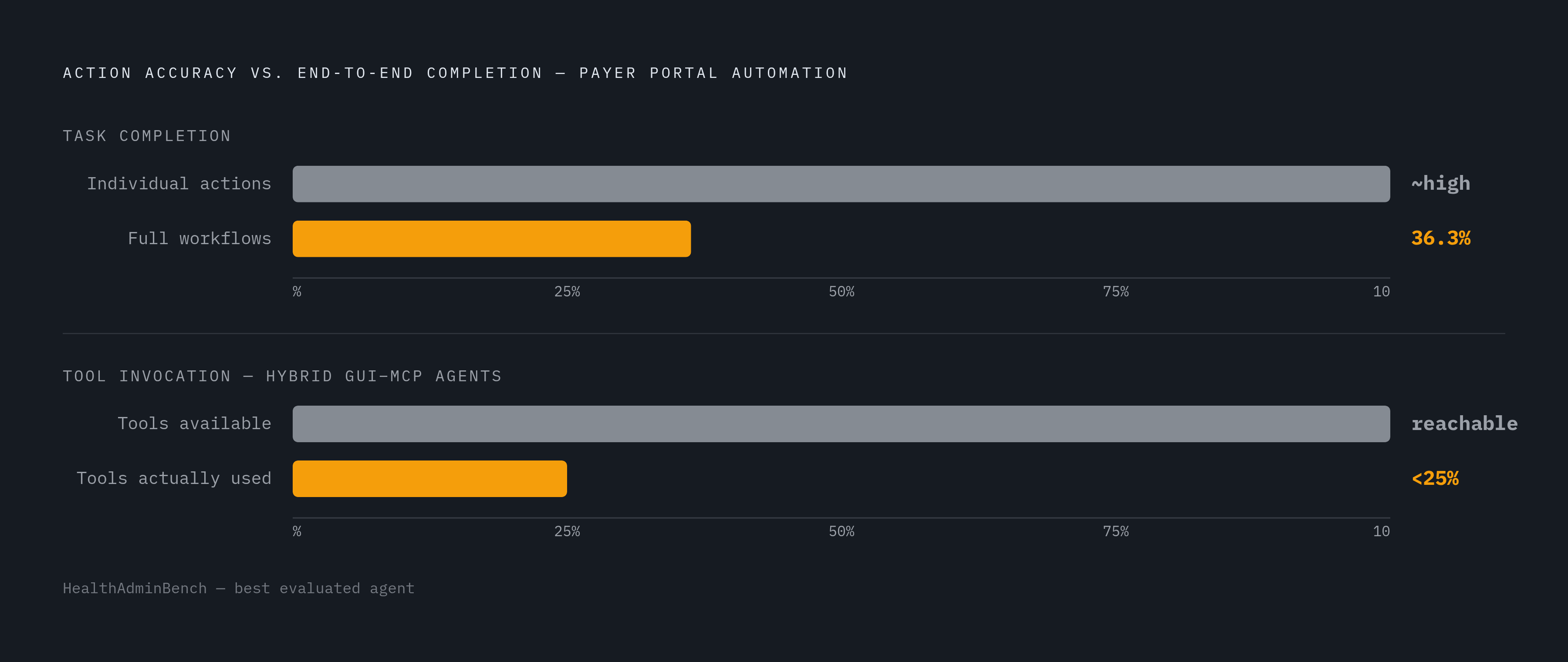
The engineering challenge of task integrity is not hypothetical. Current benchmark results show that agents can execute individual actions correctly at high rates while still failing to complete full end-to-end administrative workflows reliably. HealthAdminBench found the strongest evaluated agent reached only 36.3 percent end-to-end task success despite much higher subtask success rates. The gap is especially pronounced in tasks requiring document handling, cross-portal coordination, and sustained state tracking. An agent can read a screen correctly, click the right button, and fill a form accurately, and still fail to complete the full workflow, because the workflow's difficulty lives in maintaining coherent state across many steps and many sessions rather than in any individual action.
The benchmark evidence points to a specific category of difficulty. Leading state-of-the-art agents struggle substantially on vast-horizon repetitive workflows, which is precisely the category that describes payer portal operations, where the same multi-step process must be executed reliably across many patients and many portals. The repetition itself is part of the challenge: each iteration is a fresh exposure to the environment's failure surface, and a system that succeeds nine times out of ten on a single task will fail far more often when the task must be repeated hundreds of times.
A second benchmark finding sharpens the point. Research on hybrid GUI–MCP agents finds that even a reasoning model that benefits from having structured tools available calls those tools on fewer than one in four tool-reachable tasks. The adoption gap is a quiet failure mode: the infrastructure cost of building tool support is paid, but most of its benefit goes unrealized because the model does not reliably invoke the tools it has. The implication for task integrity is direct. A system that is architecturally capable of checkpointing state, distinguishing unconfirmed from unsubmitted, and re-authenticating mid-task still requires the agent to actually use those capabilities when the moment requires them. Capability without reliable invocation is not capability in practice.
HIPAA obligations that portal timeouts trigger and what they require of agent state management
When an agent session is interrupted mid-task, protected health information that was loaded into execution context does not automatically resolve. The HIPAA requirements that govern how that PHI may be held, logged, and surfaced create specific obligations that an agent architecture must satisfy before resuming or abandoning the task. Timeout conditions are therefore not only an operational problem. They are a regulatory one, and the compliance requirements under failure are distinct from the requirements under successful execution.
HIPAA's minimum-necessary rule requires that an agent access only the PHI required for its specific task. A prior authorization agent's context window, even mid-recovery, must not hold clinical data outside the scope of that authorization request. When a session times out and the agent writes to an error log or monitoring output, any PHI present in that execution context at the moment of failure must not appear in plaintext in those outputs. That constraint is easy to satisfy in successful runs and structurally difficult when the failure itself exposes partial state, because the error record that would help diagnose the break is exactly the place where PHI is most likely to leak.
HIPAA's automatic logoff specification, an addressable rather than strictly required safeguard, creates a direct tension with portal session management. A portal that enforces its own timeout may leave a partially completed submission in an unresolvable state, and the agent's recovery path must handle that condition without creating a secondary PHI exposure through retry logic. Audit trail requirements impose a further obligation: the system must be able to show exactly which PHI fields were accessed, by which agent instance, at what timestamp, and with what outcome. That requirement applies to sessions that ended in failure, not only to completed tasks. A system that audits only successful completions has no auditable record of the cases where integrity actually broke down, which are precisely the cases a compliance officer would need to examine.
What well-designed agent behavior looks like when a portal fails, and how to evaluate it
The right test of any agent operating in a payer portal environment is not whether it completes tasks when portals behave. It is whether the agent maintains recoverable execution state, re-authenticates without human intervention, and produces an auditable record when portals do not. Those three properties, state recovery, autonomous re-authentication, and failure auditability, define what task integrity means in a timeout-prone environment, and they provide the criteria against which any automation system can be evaluated.
The evaluation criteria are specific enough to be applied directly. Does the system checkpoint state at each discrete action, or only at task boundaries? A system that checkpoints at boundaries loses all progress on a twelve-step prior authorization when the session expires at step nine. When the agent cannot confirm whether a submission was received by the payer, does it distinguish between "not submitted" and "submitted but unconfirmed," and does it handle those two states differently in its recovery path? A system that treats both cases the same way will either duplicate a submission or skip a necessary one. Does re-authentication happen inside the agent loop or outside it? Any system that requires human intervention to refresh credentials has not solved the timeout problem; it has outsourced it. Does the audit trail cover failed sessions, partial completions, and recovery actions, or only successful task completions? An audit trail that omits failures is not an audit trail for a timeout-prone environment. Does the agent operate across both structured API channels and direct portal interaction, so that when one path fails the workflow can route through another without losing task state? A system dependent on a single channel has a single point of failure, and in a portal environment the failure will arrive.
Computer-use agents that interact with payer portals the way a trained staff member would, reading screens, navigating, typing, re-logging in when a session expires, carry an architectural advantage over API-dependent systems in timeout scenarios. The recovery path is the same path the agent already knows how to walk. That advantage is not rhetorical. It is the difference between a recovery capability that must be constructed separately for each failure mode and one that is already part of the agent's normal operation. The measure of value, ultimately, is not task initiation volume but task completion rate under real portal conditions, including the sessions that time out, the portals that return errors, and the submissions whose status cannot be immediately confirmed. Those are the cases that determine whether the automation layer actually holds the work or silently drops it.