Retry Logic Design for Multi-Step Administrative Tasks
Designing retry logic upfront prevents cascading duplicates in healthcare workflows.

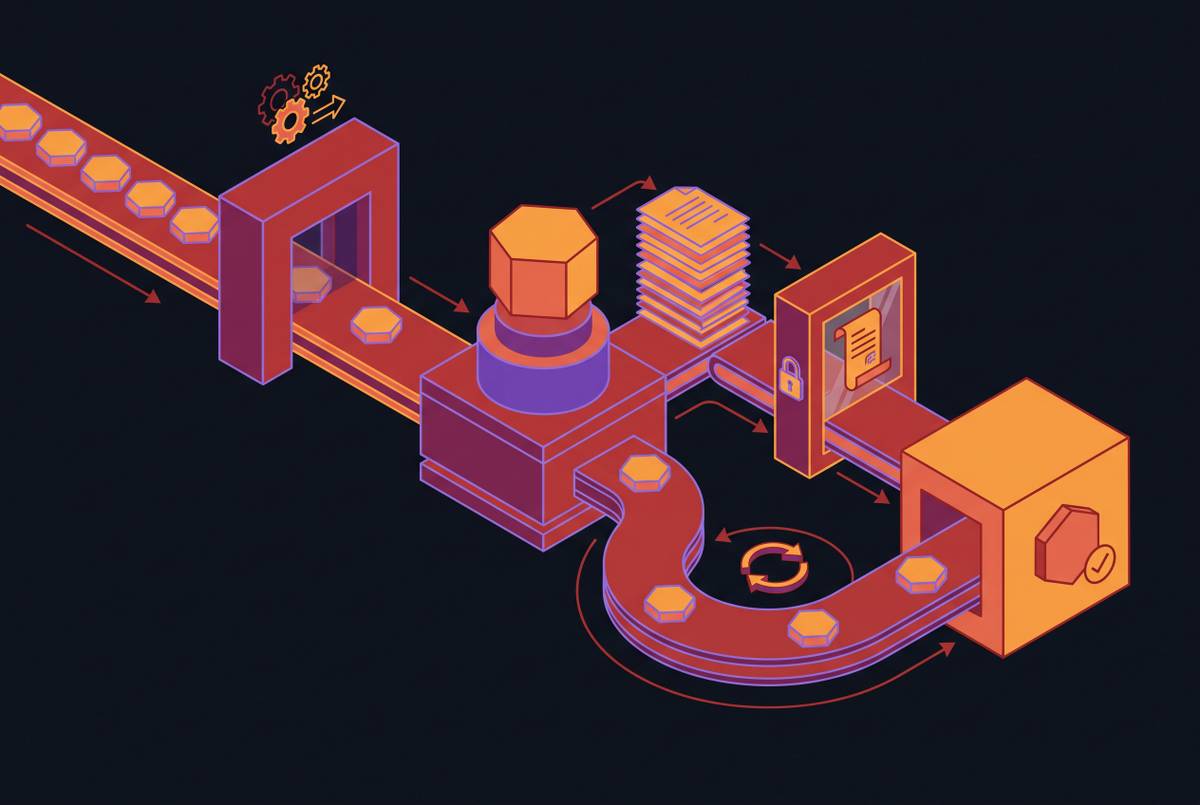
Retry logic for multi-step administrative agents belongs in the design phase, before a single workflow runs in production, not in the patch cycle after one fails. Each step depends on the step before it. A workflow that submits a prior authorization or files a claim appeal cannot simply restart from the top when something goes wrong partway through, because restarting from the top is not a neutral act. It has consequences.
The property that turns this into an architectural problem rather than a runtime inconvenience is non-idempotency. Multi-step workflows accumulate side effects as they run, and those side effects do not undo themselves. In a billing or clinical context, a duplicated submission is a second prior authorization request attached to the same patient encounter, a second claim line, a second entry a payer or a staff member now has to reconcile by hand, not a harmless inefficiency.
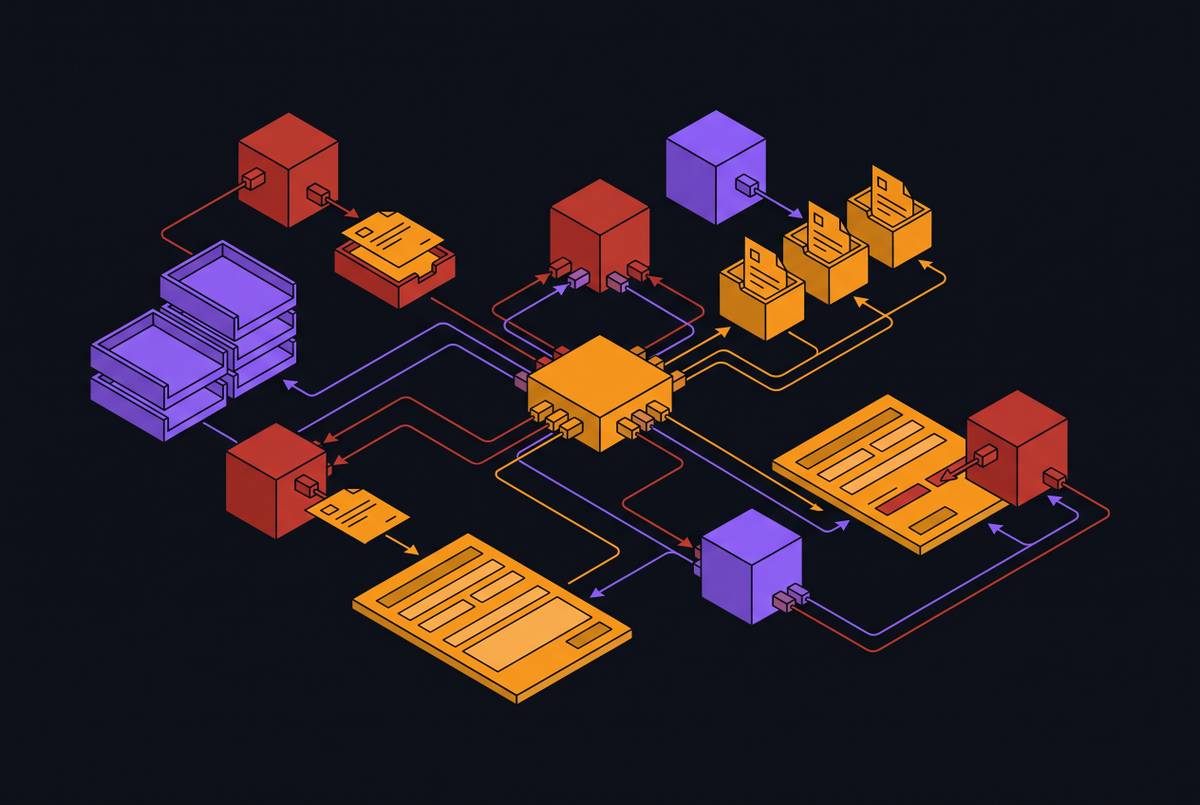
Avoiding that outcome requires more than a smarter retry loop bolted onto the end of the workflow. It requires a saga pattern: compensation logic that can undo or skip steps that already completed, built into the workflow before the agent goes live, not added after the first duplicate submission turns up in a payer's queue. Compensation logic cannot be retrofitted cheaply, because retrofitting it means tracing back through every step an agent might have already taken and deciding, after the fact, what should have been reversible.
The working claim behind this entire framework is that an agent without purpose-built retry logic fails ungracefully. Retry logic, in other words, is part of what the workflow is, not a safety net under it.
The four failure modes a retry system must distinguish
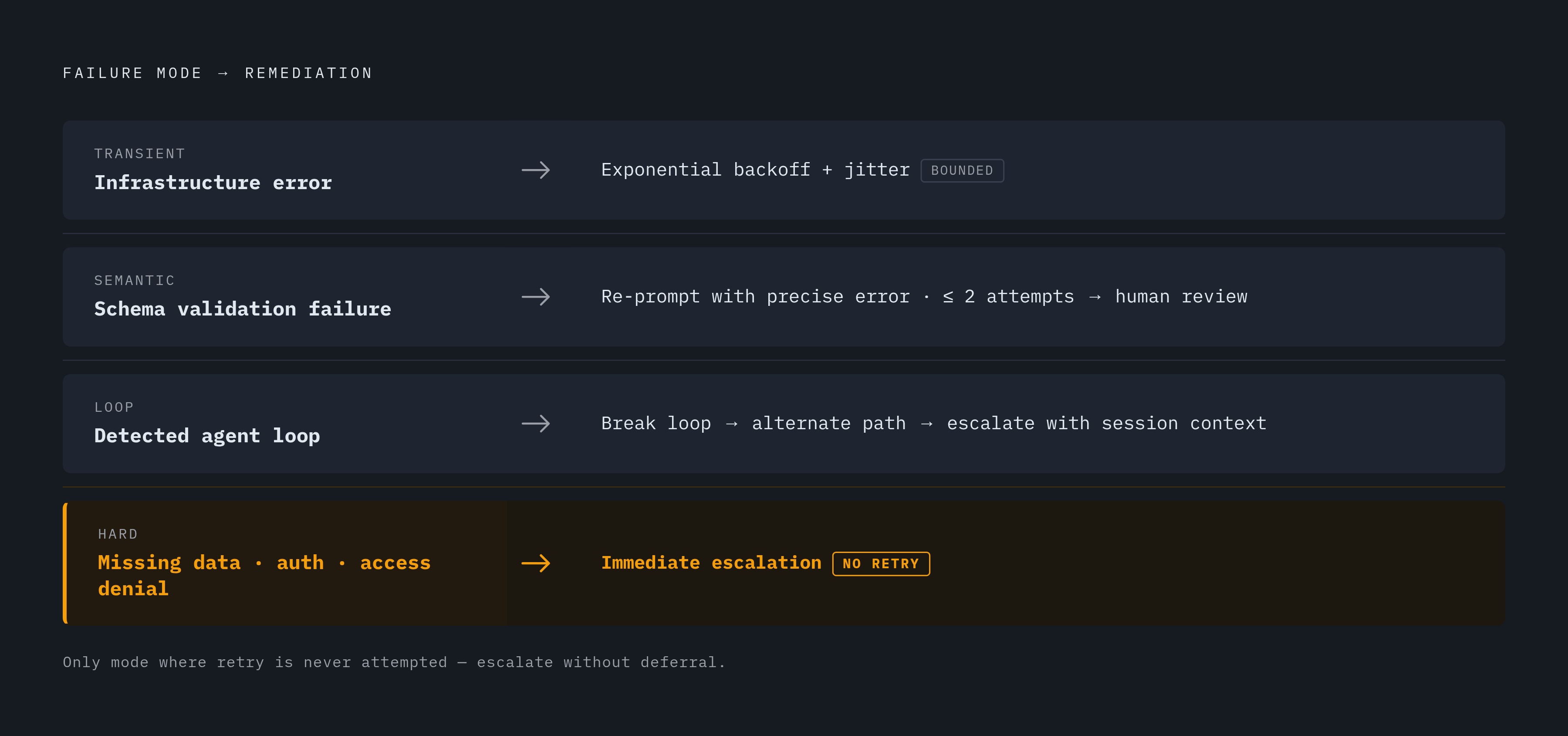
A retry system can only make the right decision if it first classifies what actually went wrong, because the correct response to a transient timeout is close to the opposite of the correct response to a semantic error or a missing piece of data. Four failure modes cover the space, and each demands its own remediation path.
The first is transient infrastructure error: a timeout, a rate limit, a service that is briefly unavailable. The correct response is exponential backoff with jitter, bounded by a maximum number of attempts. Synchronized retries from multiple agent instances hit the same endpoint at the same moment and make the congestion that caused the original timeout worse, not better.
The second is semantic and schema validation failure: malformed output, a field in the wrong format, a hallucinated value that looks plausible but is not grounded in the source data. The correct response is to re-prompt with the precise error included in the correction instruction, so the model knows what was wrong about what it produced last time. In practice, two attempts is close to the practical limit for this kind of correction before the task needs to move to a human reviewer.
The third is a detected agent loop: the agent navigates the same sequence of screens without making progress. This is a live risk for any agent operating payer portals, where a page can reload identically after a submission without confirming or denying that the submission was received. The correct response is to break the loop deliberately, attempt an alternate navigation path, and if no alternate path resolves the problem, escalate with the full session context captured at the point the loop was detected.
The fourth is a hard failure: missing required data, an authentication error, an access denial. The correct response is immediate escalation, never deferred, with enough context attached that the human who receives it can act without having to reconstruct the session from scratch.
These four modes, transient, semantic, loop, and hard failure, form the taxonomy the rest of this framework builds on.
The failure class standard retry patterns miss in payer portals
Payer portals introduce a failure mode the four-part taxonomy above does not fully capture: a submission that is acknowledged by the system but never resolved into an approval or a denial. Generic retry patterns treat acknowledgment as success and stop watching the task, which leaves the workflow stranded indefinitely with no error signal to act on. That absence of a signal is what makes this failure mode especially dangerous in a clinical context, since the delay it produces looks, from the outside, identical to a task that completed normally.
Most payer portals still lack APIs. Large national payers and clearinghouses are beginning to offer them as CMS-mandated FHIR Prior Authorization APIs phase in through 2027, but today a screen-operating agent has to navigate the great majority of portals exactly as a human staffer would. That means every submission is a multi-step, stateful session with a real failure point at each screen transition, not a single API call that either succeeds or returns an error.
The specific failure pattern looks like this: a prior authorization submission registers as received, and then produces no approval, no denial, and no status update. From the agent's point of view, the task is done, the submission went through, so a naive retry system never re-engages with it. From the practice's point of view, the authorization is simply lost until someone notices, often only when the scheduled service date has already passed.
The correct design response is to treat status resolution, not submission acknowledgment, as the actual completion condition for the workflow. That requires a proactive polling loop with a defined cadence and a timeout threshold that triggers escalation if no resolution arrives within the expected window. This turns a passive wait into an active follow-up behavior the agent is responsible for, the same way a well-trained staff member would follow up on a submission that never got a reply.
Practices should build retry channels around that coverage gap. A retry framework built only for portal navigation will not reach every payer a practice deals with, and real coverage requires multiple submission channels, including fallback paths the agent can execute directly or hand off to a human.
Checkpoint architecture as the precondition for safe retries
A retry system that does not know where in the workflow a failure occurred has only two options, and both are worse than completing the task correctly the first time: restart from the beginning and risk duplicating every side effect along the way, or abandon the task. Checkpointing is the architectural element that removes that false choice. It is what separates an agent that recovers cleanly from a mid-workflow failure from one that creates a bigger problem than the one it was trying to solve.
A checkpoint persists the verified state of each completed step: what data was collected, what actions were taken, where the workflow currently sits. When a failure occurs, the retry system resumes from the last confirmed checkpoint. This is the practical implementation of the saga pattern described earlier. Each step commits as complete before the next one begins, and compensation logic handles what to do if a later step fails after earlier steps have already executed and cannot simply be rerun.
In a prior authorization workflow, checkpoints belong at specific points, not scattered arbitrarily through the process. A third sits after submission acknowledgment, though that checkpoint is not the final one, since status resolution, as the previous section established, is the real completion condition. A fourth sits after each status poll that returns a substantive response.
The data persisted at each of these checkpoints may carry protected health information, and that fact changes what a checkpoint store is allowed to be. Checkpoint stores are governed artifacts under HIPAA, not engineering logs that can sit in a general-purpose monitoring system. They need encryption, access controls, and the same level of protection any other system holding patient data requires. The next section develops what that governance actually looks like in practice.
PHI governance across retry logs, escalation packets, and error states
Retry infrastructure produces protected health information at every stage it touches: the logs that record what happened, the escalation packets sent to human reviewers, the error context captured at the moment something fails. Treating any of these as outside the compliance perimeter is as real a HIPAA exposure as a breach in the primary clinical workflow itself. Protected health information enters AI pipelines through retrieval windows and model outputs, so the context an agent captures at the instant it fails is likely to contain patient-identifiable data by default, not as an edge case.
A 2025 proposal to update the HIPAA Security Rule would require a written inventory of AI systems that create, receive, maintain, or transmit electronic PHI. That requirement puts the retry subsystem itself inside the compliance inventory, not just the primary agent workflow it supports. A practice cannot inventory the agent that submits a prior authorization and leave out the logging and escalation layer that handles what happens when that submission fails.
Several specific points are where PHI tends to escape the compliance perimeter in a retry context. A fourth is overly broad FHIR scopes that give the retry agent access to more patient data than the specific task requires. The minimum necessary standard applies to the retry path exactly as it applies to the primary path. A retry handler built to simplify debugging by pulling a wider data scope than the task needs is itself a compliance problem.
Any AI vendor that creates, receives, or transmits PHI while handling a retry needs a signed data protection contract with the practice before that data reaches them. This applies to monitoring services, logging platforms, and alerting tools just as much as it applies to the core agent vendor, and a practice evaluating a monitoring tool for its retry pipeline should ask the BAA question before asking about dashboard features.
Compliant retry design also implements real-time alerting on anomalous access patterns, such as a retry agent reaching into PHI fields outside its defined scope, with anomaly detection feeding compliance logs directly rather than waiting for someone to notice the problem during a manual audit. Built correctly, this turns PHI governance into a property of the retry system itself rather than a separate compliance exercise layered on top of it after deployment.
Escalation design as the completion path for exhausted retries
Escalation is what turns a stalled agent workflow back into something a human can resolve, and it only works if the escalation packet gives that human everything needed to act immediately. An escalation that arrives without context forces the staff member to reconstruct the task from scratch, which erases the efficiency the agent was supposed to deliver and adds a handoff failure directly on top of the original one.
A well-formed escalation packet carries four things. And it carries deadline context: if the escalation involves a prior authorization tied to a pending service date, or a claim appeal with a filing deadline, that detail belongs at the top of the packet, not buried somewhere in a log a staff member has to scroll through.
The stakes of getting this right are visible in how often prior authorization denials get reversed. An agent that escalates a denial by simply flagging it leaves that recoverable revenue sitting on the table until someone finds time to build the appeal from scratch. An agent that escalates the same denial with a fully assembled appeal packet attached, the clinical documentation, the denial reason, the relevant policy criteria, turns what looked like a closed case into a recoverable one with far less staff effort.
The real measure of an escalation path is whether the staff member who receives the escalation can finish the task without starting over.
Applying the framework to a complete prior-authorization workflow
Prior authorization is the administrative workflow where failures in retry logic are most costly and most visible, and tracing the framework through it from start to finish shows how each design decision compounds or corrects whatever came before it. A single prior authorization request can touch every failure mode described above, in sequence, within one workflow run.
The process typically begins with clinical data extraction from the EHR. Once the data is extracted and validated, a checkpoint commits that state, so a later failure does not force the extraction step to run again. Documentation assembly follows, and this is where semantic and schema validation failures tend to appear, a malformed field, a hallucinated value in a structured form. Once documentation is verified complete, a second checkpoint commits that state, directly addressing incomplete documentation as a leading cause of first-pass denials.
Submission to the payer portal comes next, and this is where detected agent loops are most likely, a page reloading identically after submission without confirming or denying receipt. The workflow moves into a proactive polling loop with a defined cadence and a timeout threshold, because status resolution, not acknowledgment, is the actual completion condition.
If the polling loop times out without resolution, or if the portal returns a hard failure such as a missing required field the agent cannot supply on its own, the workflow escalates, carrying the last verified checkpoint, the failure classification, the precise condition that stopped progress, and any deadline tied to the pending service date. An agent built with this framework in mind escalates the denial with a fully assembled appeal packet attached, giving the staff member who receives it a running start on recovering the revenue. Every design element described in this piece, the failure taxonomy, checkpoint placement, PHI governance, escalation routing, earns its place at exactly this moment, when a single workflow run has to survive contact with a system that was never built to talk to it directly.