Idempotency Design for Agents in Revenue Cycle Workflows
Duplicate submissions sink agentic revenue workflows without idempotency design.
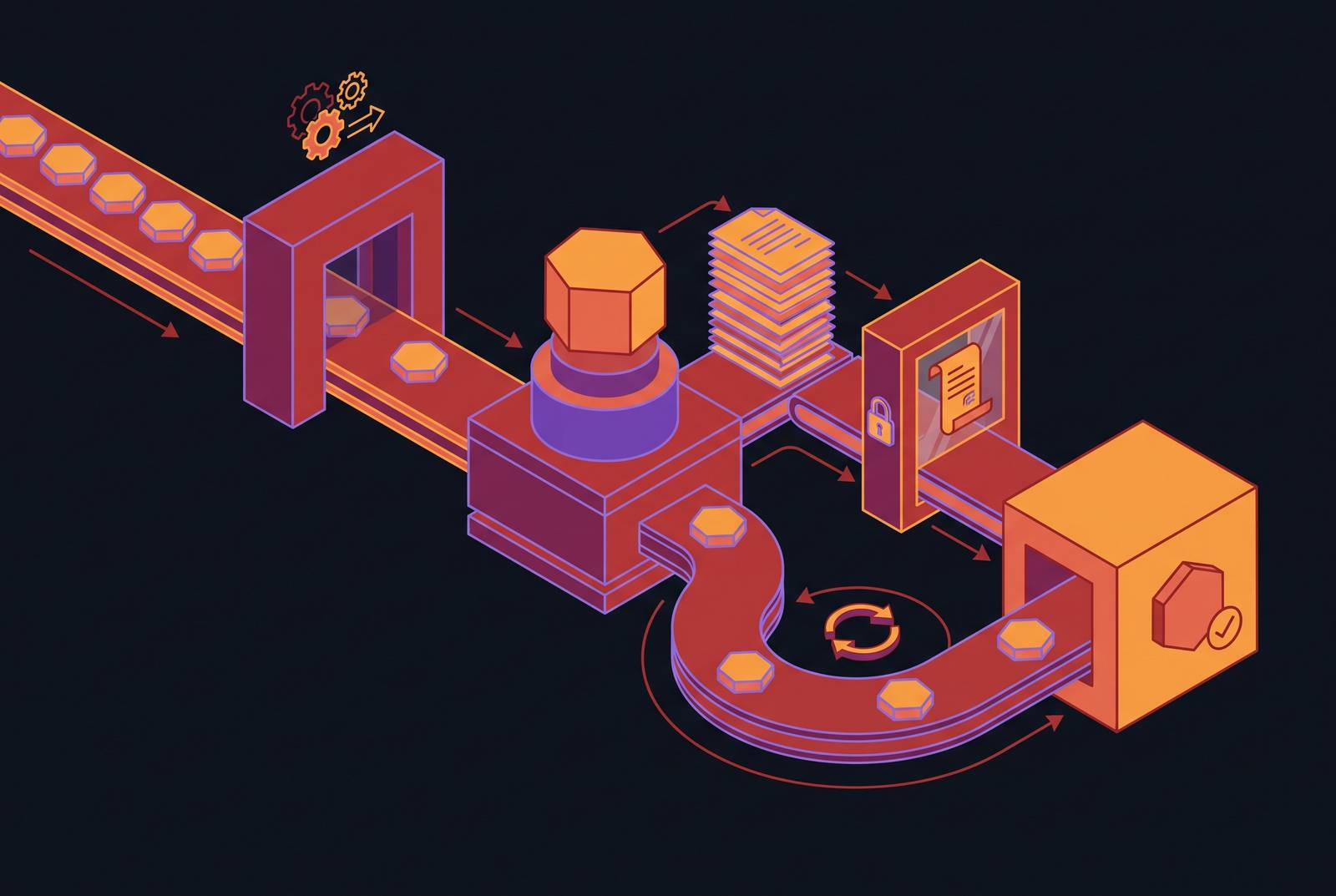
A prior authorization agent reaches the final step of a workflow: submitting a structured request to a payer portal. The portal times out mid-submission. The agent's retry logic, built to be resilient, fires again. The form goes through a second time. Nobody designed this to happen, and nothing in the agent's reasoning was wrong at any point along the way. The agent did what it was built to do: finish the task, recover from an error, and retry until it succeeded. The trouble is that it succeeded twice.
The underlying model's reasoning quality has almost nothing to do with most production failures in agentic revenue cycle management; the real cause is the pattern described above. Testing environments rarely reproduce the conditions that cause it: a dropped connection mid-form, a worker process that crashes after sending a request but before logging the response, a session timeout that leaves the agent unsure whether its last action landed. Those conditions occur constantly in production because payer portals, EHRs, and billing platforms are not built for machine-speed interaction and were never tested against it at scale.
In revenue cycle work, the stakes of a repeated action are higher than in most software domains because nearly every tool call touches money, protected health information, or both. A duplicate claim submission is not a harmless retry: it is a billing event that can trigger a duplicate-claim denial or a fraud flag. A prior authorization submitted twice generates two pending requests that can be approved, denied, or left open independently of each other, leaving staff to determine which one reflects the actual status. A redundant write-back to the EHR creates a duplicate record that corrupts the one source of truth every later step in the workflow depends on. McKinsey's analysis describes agentic AI by its capacity to decide and execute complex, end-to-end processes on its own. That same capacity is what turns a single retry bug into a compounding one: the agent keeps building on a state that was already wrong, one step after another, until a human has to go back and find where it broke.
What idempotency means in the RCM context
Idempotency, in an agentic system, means that repeating the same logical action produces exactly one durable effect no matter how many times it actually runs. Running it once or running it five times after five failed connections should leave the system's final state identical either way. That is the property revenue cycle agents need and frequently lack.
Most engineers learn idempotency through a simple example: an HTTP PUT that sets a value is idempotent, because sending it twice leaves the value the same; an HTTP POST that creates a new record is not, because sending it twice creates two records. That framing is a reasonable starting point, but it badly understates what an RCM agent actually does. An agent does not make one API call and stop. It chains a sequence of tool calls together, where the outcome of one step feeds the next, and a side effect introduced at step three can silently corrupt everything that follows at steps four through eight. A single idempotent endpoint buried somewhere in that chain does not protect the workflow as a whole.
The problem runs deeper still, because an agent operating a payer portal through a browser interface often cannot tell whether its own prior action succeeded. If a screen-based agent submits a form and loses its session before the confirmation page loads, it has no reliable way to check whether the submission registered on the payer's side before it tries again. And because the systems an RCM agent writes to (payer portals, EHRs, billing platforms) belong to someone else, the team deploying the agent cannot go rebuild idempotency protections into those systems. The agent has to carry that protection itself, because the receiving system was never going to provide it.
This is a direct consequence of what makes these agents useful in the first place. Agentic AI systems in healthcare are goal-driven and adaptive: given an objective and a set of tools and permissions, they decide on their own how to get from one to the other. That adaptability is why their retry behavior is hard to predict without deliberate idempotency design built in from the start. An agent that is clever enough to route around a dead end is also clever enough to retry its way into a duplicate.
Where in the RCM workflow failure modes concentrate
Idempotency risk does not spread evenly across a revenue cycle workflow. It piles up at the specific points where an agent writes to a system it does not control and cannot ask for confirmation afterward.
On the front end, prior authorization carries the most risk. An agentic prior auth workflow has the agent read diagnosis codes, treatment history, and payer-specific criteria, decide whether authorization is even required, search for an existing authorization number, and, if none exists, prepare and submit a new request to the payer portal. Each of those steps is a place where a retry could fire, and the final step, the portal submission, is the one with the highest cost of duplication: it is PHI-dense, it is external, and a duplicate submission produces two pending authorization records that can land in different approval states. Untangling which one is the real record falls to a human, every time it happens.
On the back end, the denials and appeals workflow carries similar exposure across more steps. An agent working a denial has to detect that the denial occurred, pull up the record in the EHR, read through unstructured clinical notes, identify the evidence that supports an appeal, draft the appeal, log into the payer portal, and submit it. That sequence contains at least three external write operations, and each one can be retried on its own if the agent loses track of what it already did. The stakes of getting this wrong are not small. KFF's analysis of 2024 CMS HealthCare.gov claims data found that insurers denied 19% of in-network claims, and fewer than 1% of denied claims were ever appealed. Agentic systems exist to close that gap at volume, so a retry bug in the appeal submission step does not cause one bad outcome. It propagates across every claim the agent touches that day.
Account receivable follow-up agents, the ones making outbound portal queries and status checks, carry comparatively lower duplication risk, since a repeated read does not usually cause harm. But a read-and-write sequence interrupted partway through can still leave the system in an inconsistent state, with a status check logged against the wrong claim or a follow-up triggered twice.
A separate layer of risk appears at the handoffs between agents. When a front-end agent passes a completed prior authorization to a scheduling or billing agent downstream, the receiving agent can end up replaying its input queue if the handoff message gets delivered more than once. That replay can re-trigger a submission the first agent already completed successfully, with the second agent having no way of knowing the work was already done.
Screen-operating agents face one more layer of exposure on top of all this. Session timeouts, shifting UI states, and dropped connections happen often enough that they are closer to routine than exceptional, and a retry cannot see whether the previous page submission went through. The only safe assumption an agent operating a portal screen can make is that every form submission may have already happened, and it has to check before it writes again.
The three-layer design response: idempotency keys, deduplication tables, and workflow checkpoints
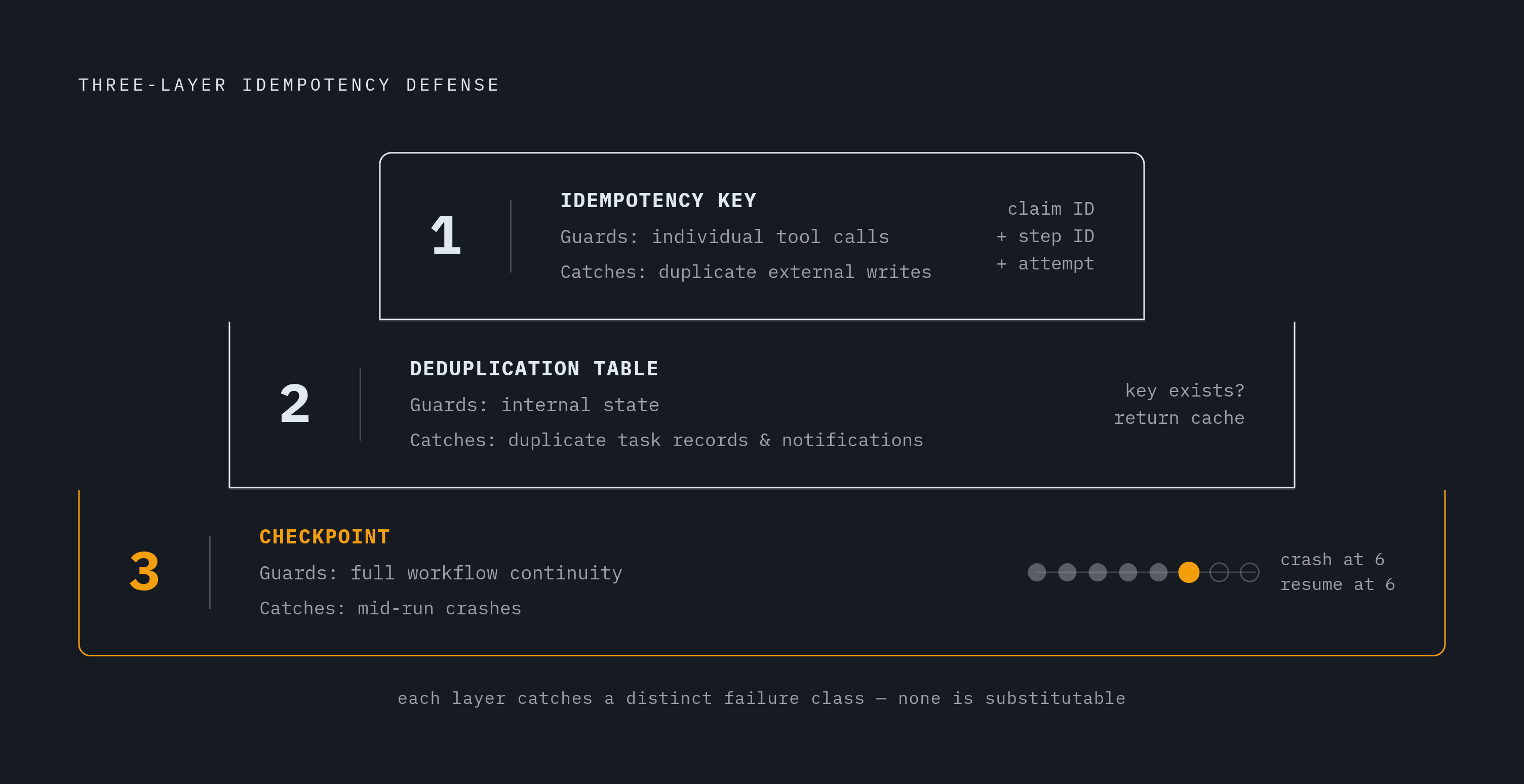
Protecting against this requires three separate mechanisms working together, not one clever fix. A safe production deployment needs an idempotency key on every individual tool call, a deduplication table for internal actions that never leave the agent's own systems, and checkpointing at the level of the overall workflow. Each layer catches a different kind of failure, and none of the three can substitute for the others.
The idempotency key is the most granular layer. Every tool call that produces a side effect, whether it is a form submission, a portal write, or a claim transmission, needs a key built from durable workflow state: the claim ID, the step identifier, and the attempt number. That key cannot be pulled from session state, because session state disappears when the failure happens. Where the receiving system, such as a payer portal or EHR, understands idempotency keys natively, it can use the key to recognize a repeat and hand back the result of the original call instead of running it again. Where it doesn't, which covers most payer portals and EHRs in practice, the agent's own middleware has to do that work instead, writing a confirmed receipt before the external submission goes out, not after. That ordering matters: if the submission completes but the confirmation record is lost on the way back, the next retry checks the receipt log first and sees that the work was already done, instead of submitting a second time.
The deduplication table covers everything that doesn't touch an external system but can still duplicate state inside the agent's own environment: creating a task record, logging a status change, firing off a downstream notification. A dedup table stores the key and outcome of every completed internal action, and a retry checks that table before doing anything, returning the cached result if the key is already there.
Checkpointing operates one level up, at the workflow itself. A checkpoint marks which step in a multi-step process has actually completed, so that if the agent crashes and resumes, it picks up from the right place instead of running the whole workflow over from the start. Take a prior authorization workflow with eight steps that crashes at step six. The checkpoint should bring it back to step six, not step one. But that alone isn't enough, because the checkpoint might have been written a moment before step six's portal submission actually finished. The idempotency key on that submission is what catches the case where step six had, in fact, already gone through before the crash happened.
None of the three layers is optional. Keys guard individual tool calls, the dedup table guards internal state, and checkpoints guard continuity across the whole workflow. Dropping any one of them leaves a specific class of retry failure unprotected, regardless of how well the other two are built.
How HIPAA compliance obligations interact with idempotency ledger design
The idempotency ledger built to solve the retry problem comes with its own obligations, because the ledger itself holds protected health information. A durable record of which tool calls ran, with what keys, and with what outcomes, is not a neutral engineering log in an RCM context. It records which clinical fields were pulled to justify a prior authorization, which claim data went out the door, and which patient records got touched during a denial appeal. The ledger is itself a PHI-bearing artifact, not a technical safeguard sitting off to the side.
That has direct consequences for how the ledger has to be built and stored. Proposed updates to the HIPAA Security Rule would make encryption of all ePHI a required specification rather than an optional one, covering data processed by AI systems specifically, and would require a written inventory of every technology asset, AI systems included, that creates, receives, maintains, or transmits ePHI. An idempotency ledger that logs PHI-touching tool calls sits squarely inside that inventory requirement. It has to be accounted for, and it has to be encrypted under the same controls as the primary claims data store it supports. A ledger stored outside those controls turns the safeguard meant to prevent duplicate PHI exposure into a second, unprotected copy of the same exposure.
A related problem occurs in how agents carry context across retries. To recover cleanly from a failure, an agent often needs to hold onto conversation memory or the outputs of prior steps in a session store, so it knows where it left off. But that same retained context can pull in PHI fields from steps that have already finished, fields the current retry attempt did not actually need to access. The minimum necessary standard under HIPAA limits PHI access to what a given task requires, and a retry that reads back a full prior context can quietly exceed that boundary even though no new data was ever collected. Governing this well means controlling it at the data layer itself, independent of which model or framework is running the agent, because these systems make decisions and execute multi-step workflows far faster than a human reviewer could check them in real time.
The objection that idempotency controls slow the autonomous loop enough to undercut the value proposition
The strongest pushback against building all three layers is a simple one: all of it adds overhead. A system that has to write to a ledger, check a dedup table, and confirm a checkpoint before every single external action starts to look only marginally faster than a human doing the same work directly, undercutting the argument for building an agent.
This objection has real teeth in an RCM setting. A prior authorization agent that has to write a receipt, check a dedup table, and confirm its checkpoint before every portal submission can, in raw per-transaction terms, run slower than an experienced staff member who watches the portal respond in real time and makes a judgment call on the spot without any of that overhead.
But the comparison is set at the wrong scale. KFF's analysis found that fewer than 1% of denied claims ever get appealed, largely because the manual cost of investigating and appealing a denial often exceeds what the appeal would recover, and the realistic alternative to a well-governed agent is a short-staffed team trying to manage thousands of claims at once against that backdrop. McKinsey's analysis points to accounts receivable follow-up, underpayment management, denials management, and cash posting as functions with clear, learnable patterns that AI can replicate, with human staff stepping in only to handle the exceptions. That shift lowers labor hours while raising throughput across the whole operation, not just on a single claim.
Set against that baseline, the overhead of idempotency controls is a reasonable price. An agent that safely processes a thousand prior authorization requests with full idempotency protection delivers more value than one that processes them faster but triggers payer-side duplicate audits on even a small fraction of them, because a duplicate audit on a PHI-bearing transaction carries compliance costs that outweigh whatever time the faster, unprotected version saved. The deployments getting real value out of agentic AI in revenue cycle work are not the ones running it unattended and hoping the retries sort themselves out. They are the ones that built the ledger, the dedup table, and the checkpoint before they let the agent anywhere near a payer portal.