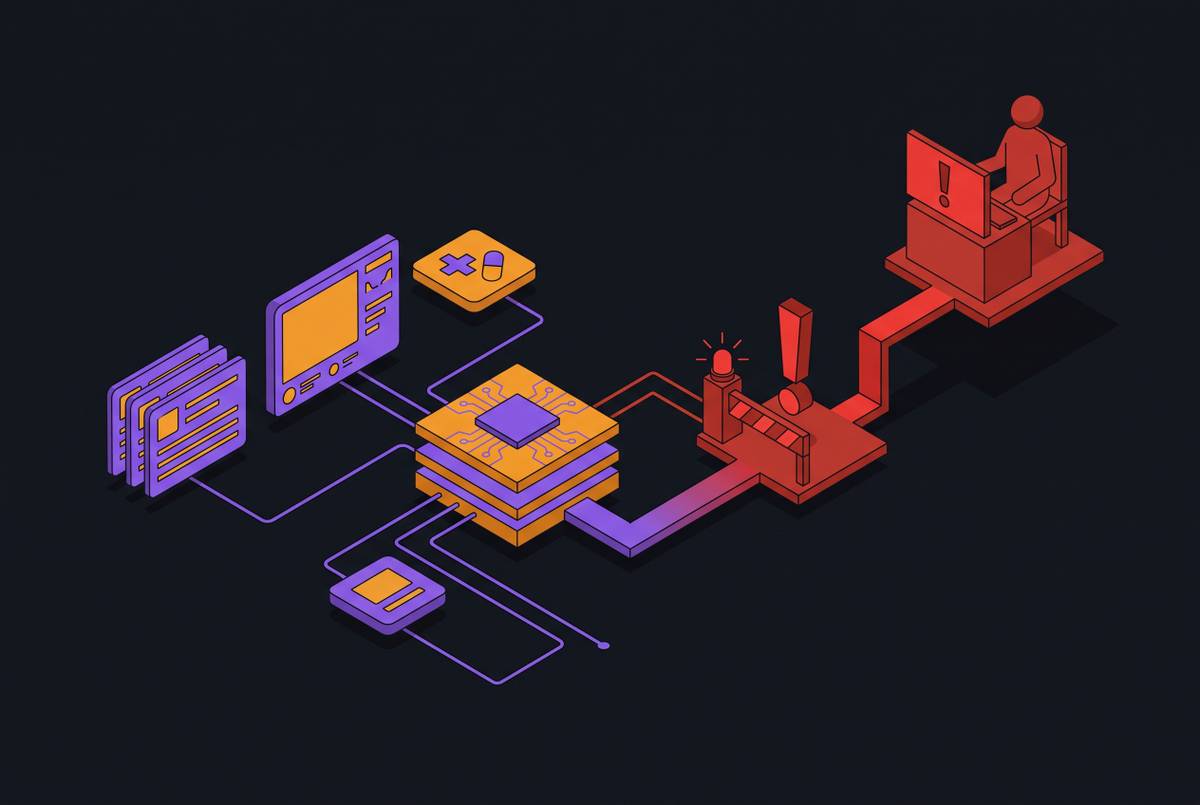
Agent Self-Verification After EHR Write Operations
Agents must verify EHR writes succeeded or risk silent failures that cascade through claims.
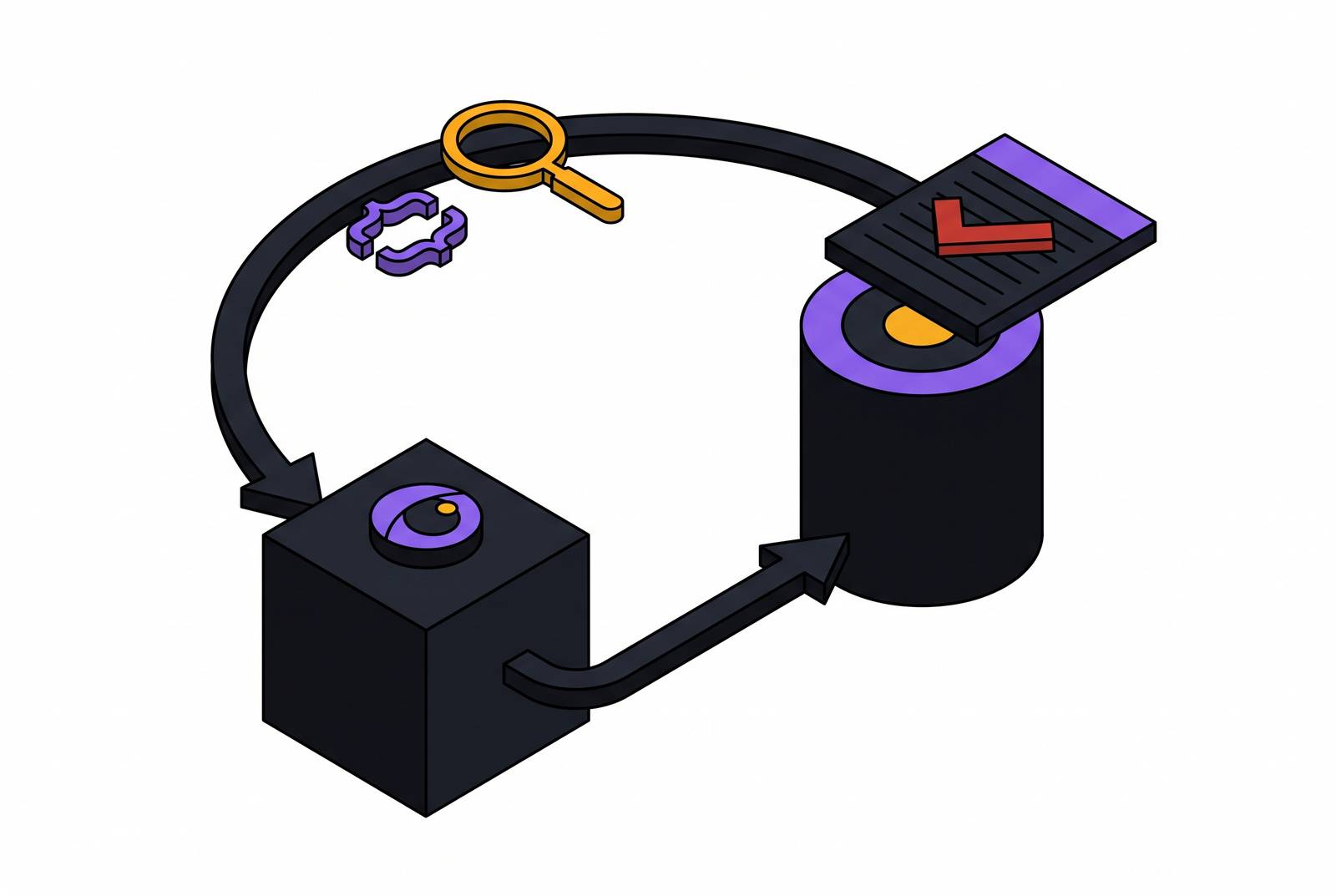
An agent that writes to an EHR and moves on has not finished its task. It has only attempted it: confirming a write succeeded is a separate operation from performing the write, and every failure mode described below traces back to a system that collapsed the two into one assumed event.
Why confirming an EHR write is separate from making one
Picture an agent scheduling a patient for a follow-up visit. The agent logs the task as complete and moves to the next item in its queue. Nothing in that sequence confirms the slot was actually committed to the EHR. EHR interfaces, payer portals, and practice management systems do not always behave predictably, and a form submission can appear to succeed on the surface while failing in ways no subsequent screen reveals.
An agent operating at the GUI level, reading pixels, clicking buttons, typing into fields, navigating between pages, has no inherent way to know that a record was committed on the other side of that interface. It can only know what the screen shows it next, and the screen is not a reliable witness. Writing a result back to a system and confirming that the result landed are two different permissions, two different operations, built into how modern EHR integration actually works. That split is architectural. Confirmation requires a discrete, subsequent read of the record. It cannot be inferred from the fact that the prior action completed without visible error.
How computer-use agents perform a write
Computer-use agents interact with EHRs and payer portals the way a human staff member would: reading what's on screen, clicking buttons, typing into fields, and navigating from page to page. A person squinting at a portal that hasn't refreshed yet faces the same uncertainty a computer-use agent faces at that same screen.
Mechanically, the agent issues a sequence of actions: fill this field, click that button, submit this form. Unless the agent has been explicitly built to look for a confirmation signal, there is no separate step where success gets checked. The sequence of actions and the judgment of whether those actions worked are, by default, the same event.
Healthcare agents typically reach EHRs through several distinct channels: FHIR and SMART on FHIR for structured clinical data, payer APIs and payer portals for coverage and claims work, clearinghouses via X12 transactions for claims submission, and vaulted portal logins for systems that offer no programmatic access. A write confirmed through an API call is not the same kind of event as a write confirmed through RPA-style portal automation, and treating them as interchangeable is where a lot of integration claims go soft. Each channel announces success differently. An agent has to be trained, channel by channel, to recognize what success actually looks like in that specific environment, because there is no universal signal that works across all of them.
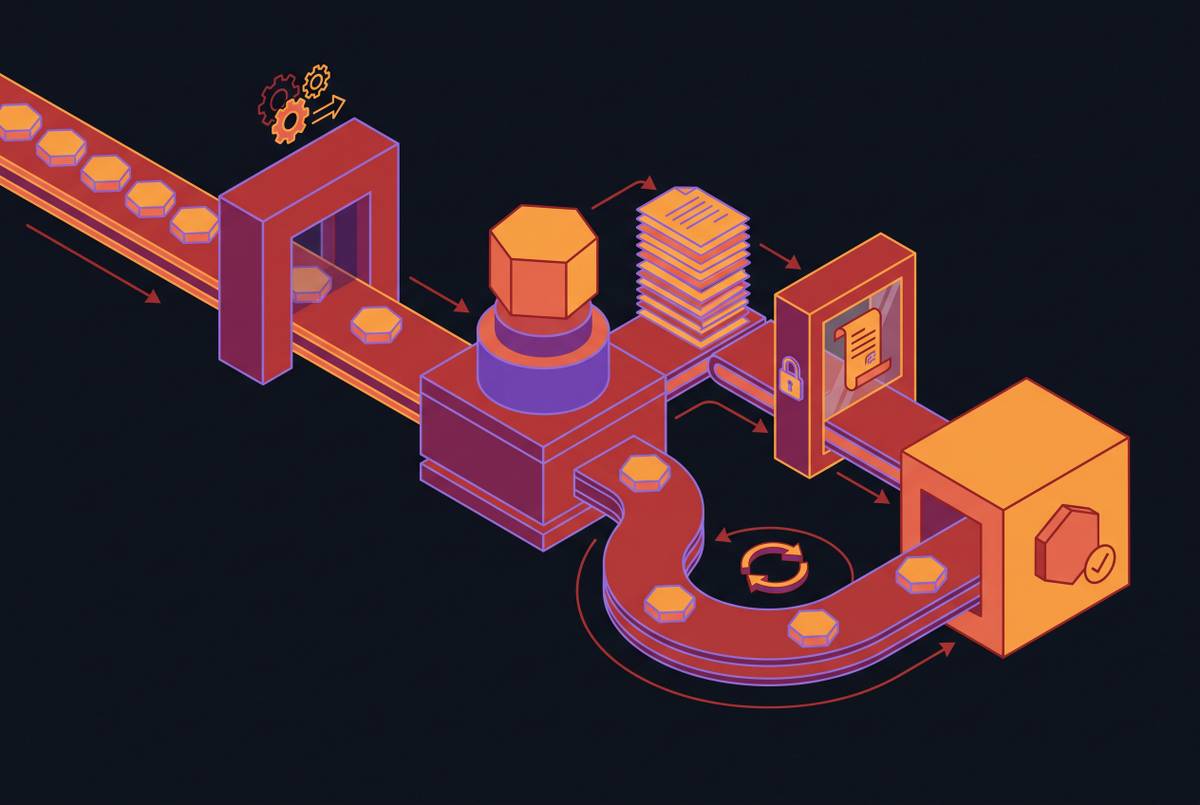
The gap compounds in multi-step administrative workflows. A prior authorization sequence might involve the agent writing an order, generating a supporting letter, submitting that letter to a payer portal, and logging the status that comes back. Each of those four actions is its own discrete write, with its own potential failure mode. Vendors describing their products as integrated with a given EHR deserve a more specific question than the marketing language invites. What matters is what fields, specifically, the agent reads and writes, and whether those write-backs have been validated against the practice's actual EHR configuration.
How the self-verification loop works as a designed mechanism
A self-verification loop treats a write as a two-part event: the write, then the check. That re-read is a targeted query of the specific field or record just written, checked against the intended value, not a general glance at the page to see if anything looks wrong. HealthAdminBench, a benchmark from Stanford presented at an ICLR 2026 workshop, defined 1,177 deterministic verifiers built to perform exactly this kind of field-level confirmation across a range of healthcare administration subtasks, which gives some sense of how granular this checking needs to be to count as real verification.
Consider a prior authorization sequence run through this kind of loop. The agent writes the order into the EHR, then re-reads the order record to confirm the order fields match what was intended before treating that step as done. It submits the letter to the payer portal, then re-reads the portal's response, whether that's a confirmation number, a status banner, or a reference ID, to confirm the submission was actually received. It logs the status return in the practice's workflow system, then re-reads that log entry to confirm it was written correctly, closing the loop on the final step the same way it closed the loop on the first three.
That loop applies at every discrete write in the sequence, not only at the end of it. The loop also solves a separate problem around accountability. Because the verification read gets logged as a distinct event from the write itself, the audit trail can distinguish between an agent that attempted a write and an agent that confirmed the write succeeded, a distinction that matters directly for compliance review and for any human auditing the agent's work after the fact. Where SMART user-context governs how an action gets attributed to the clinician who authorized it rather than to the agent that executed it, the verification log has to carry that same attribution chain accurately, or the audit trail breaks exactly where it matters most.
Why hallucination and silent failure make verification mandatory
A write operation can succeed mechanically while still being wrong. Confirming that a field now holds a value is not the same as confirming that value is the correct one, and a verification step built only to check the former catches half the actual failure surface.
AI documentation tools carry a known risk of hallucination: systems generating content that is inaccurate, fabricated, or misleading despite reading as fluent and confident. Hallucinated bookings show the administrative version of the same problem concretely: an agent reports back, verbally or in a workflow log, that an appointment time was confirmed, while the actual EHR write never fired, or fired and returned an error the agent never checked for.
The insurance selection error class is sharper still, because it defeats the kind of verification that only checks whether a write landed. An agent that selects the wrong insurance plan code does not trigger an EHR error. The system accepts the write without complaint, the field gets populated, and the record looks complete until a claim denial appears weeks later tracing back to that one incorrect code. Structural verification, confirming a field has a value, has to run alongside semantic verification, confirming that value is the one the agent actually intended to write. Verification that only checks the former is not a safeguard against the kind of errors most likely to reach a claim.
The revenue cycle consequences of unverified writes
Unverified writes in a revenue cycle workflow rarely produce one clean, isolated error. They produce cascading claim failures whose root cause has gone invisible by the time anyone notices the claim was denied.
Take a denial management agent that reads a denial letter, identifies the missing documentation, assembles an appeal, and routes it for review. If the write-back confirming that appeal was submitted is never verified, the work queue can show the appeal as filed when it never actually left the building, and the claim ages out of its appeal window while the record insists the work was done. Prior authorization carries the highest stakes of any workflow in this category, because write errors there feed directly into claim adjudication. The CMS Interoperability and Prior Authorization Final Rule, designated CMS-0057-F, requires impacted payers to have FHIR-based Prior Authorization APIs live in production by a compliance date of January 1, 2027. As structured PA submissions become the standard channel for this work, the write-back of an authorization number and status to the originating order turns into a specific, auditable event, one that practices and the agents acting on their behalf need to verify.
Eligibility verification writes carry a parallel risk on the front end of the same revenue cycle. Many practices have staff checking seven or more different payer websites in a given week just to confirm coverage. An agent automating that portal work has to verify that the eligibility data it writes back to the patient record actually reflects the payer's current response, rather than a cached result or a default value the portal returned when the real query failed quietly. A revenue cycle director looking at an aging claims report or a rising denial rate is, in a lot of cases, looking at the downstream shadow of a write that nobody ever verified.
Good verification architecture across a multi-system workflow
Reliable self-verification is not a single check run at the end of a task.
Each boundary, an EHR write, a payer portal submission, a clearinghouse transaction, a work-queue update, announces success differently, and verification logic has to be built specifically for each rather than relying on a generic check for whether the screen changed. Verification checkpoints work best when they map directly onto the points where human approval already intersects the workflow: clinical sign-off on notes and orders, outbound submissions to payers, changes to medications and problem lists, and adverse coverage decisions are the four clusters where that intersection happens, and each one needs a verification step that produces a record a human reviewer can actually read.
Deterministic checkpoints, confirming that a specific field holds a specific value, are the more reliable tool for structured write operations, the kind involved in most scheduling, billing, and order-entry tasks. Model-based verification earns its place where the confirmation signal itself is unstructured, a payer's free-text response in a portal message, for instance, where there's no fixed field to check against. In the prior authorization workflow described earlier, that might mean a deterministic check confirming the order record holds the correct procedure code, paired with a model-based check interpreting a payer's narrative response to confirm whether an authorization was actually granted.
The audit log the verification step produces needs to distinguish three separate states: a write attempted, a write confirmed, and a write that failed with a defined exception path taken in response. A log that records only the attempt is not a verification log, regardless of how complete it looks. In architectures where multiple specialized agents each handle a segment of a larger workflow, the handoff between them is itself a verification event: the agent picking up the next segment should confirm the upstream write actually succeeded before building anything on top of it, rather than trusting the previous agent's self-report. Any vendor should be able to show what the agent said and did on a specific call or a specific action, individually, not just whether their aggregate accuracy numbers look good. A vendor who can only produce aggregate metrics, with no way to pull up the record of one particular write, is showing a red flag about how their verification architecture actually works, not just how it's marketed.
What failure looks like when the verification loop is absent or shallow
When the verification loop is missing, or only performs a surface check, the workflow produces a false picture of completion, one that's often harder to catch and unwind than an error that simply looks wrong from the start. The telltale signature of a failed verification loop is a workflow that appears complete in the agent's own log while the system of record shows something disputed or absent: the agent recorded a successful write, and the EHR or portal holds no corresponding entry.
A right-gates framework, one that blocks EHR write errors before they ever reach the record, treats verification as a gate a write has to pass through, with each outcome recorded as it happens. Under that framework, a write isn't considered done until the gate confirms it, and a failed gate triggers a defined exception rather than letting the workflow continue as though nothing happened. Shallow verification, confirming only that a page loaded or a banner appeared without reading the actual fields that were supposed to be written, is dangerous precisely because it produces a confident false positive: the agent reports success, the log shows success, and the underlying error stays invisible until some unrelated downstream process trips over it.
Scheduling shows the human cost of this. The first sign of that failure is often the patient calling to confirm an appointment that does not exist on anyone's calendar. Three vendor evaluation red flags deserve direct attention: an inability to write results back to the system of record at all, an inability to produce audit logs covering every action the agent took, and an "integrates with EHR" claim that turns out to mean nothing more than a manual CSV export.
The question to put to any agent vendor before deployment isn't whether the agent can write to the EHR. Every serious product on the market can do that much. The agent must prove, in an audit log a human can actually read, that each write succeeded and what it wrote. That question is the real test of whether a self-verification loop exists or whether the vendor is asking a practice to take its word for it.